Showing posts with label Bibliothèque Québécoise. Show all posts

20 March 2026

Tales of Terror, Torment, and... Charm?

The Torrent [Le torrent]
Anne Hébert [trans Gwendolyn Moore]
Montreal: Harvest House, 1973
141 pages

Anne Hébert completed Le torrent in 1945, but it didn't reach bookstores until five years later. No Quebec publisher would touch the work, which explains how it is that the first edition was printed privately. A slim collection of five short stories, it was considered too dark, too disturbing and, according to the author, too violent. That's the story anyway. The truth is much more complicated, as detailed in Marie-Andrée Lamontagne's brilliant, exhaustive biography Anne Hébert, vivre pour écrire. (Montreal: Boréal, 2019).

When Le torrent was reissued in 1963, the Quiet Revolution was well underway, which may explain why Éditions Hurtubise took it on, adding two stories. The Torrent was released ten years after that as the fifth title in the all-too-brief Harvest House French Writers of Canada series.

 
Remarkably, Le torrent, was the first Anne Hébert title to be translated. By the time The Torrent was published, she her bibliography consisted of Les songes en equilibre (1942), Le torrent (1950), Le tombeau des rois (1953), Poèmes (1960), and Kamouraska (1970), her masterpiece.

Growing up in Montreal, the 1973 film adaptation of Kamouraska was everywhere.


As a result, I knew Anne Hébert's name at age ten, though another eight years passed before I read anything she'd written. My introduction was 'The House on the Esplanade' ('La maison de l'Esplanade'), the fifth of the seven stories in The Torrent.

The titular house belongs to elderly spinster Stéphanie de Bichette, "a curious little creature [...] with limbs that were poorly formed, and too thin." It dates from the time of New France: "You  know them, those narrow houses with their steep roofs and their rows of gabled windows, the upper ones about as large as a swallows nest." Stéphanie de Bichette lives there with her chambermaid Géraldine, occupying no more than one or two rooms on each floor. The other rooms – there are many – have been gradually been closed off. The two belonging to her younger brothers, who'd both died of scarlet fever when Mlle de Bichette was ten, were the first. Her mother died shortly thereafter. Irénée, the older brother was killed in a hunting accident, and so his room was shut off. Once sister Desneiges entered the Ursuline convent, her room was also sealed. And then there's Charles... Charles was disowned for marrying a girl from the Lower Town. His former room is treated like all the others. When Géraldine enters to clean, she makes certain to place each item in the very same place as when the room was vacated. The chambermaid looks to the day she will be able to do the same with her mistress's room.

I've reviewed two other French Writers of Canada books over the years: The Temple on the River (Les Écœurants) by Jacques Hébert and Bitter-Bread (La Scouine) by Albert Laberge. Both were dark, but not nearly so dark as The Torrent, which has me wondering about its peculiar back cover copy: 


The titular story does indeed "strike with devastating impact." François, the narrator, grows up on a small remote farm, cut off from the rest of the world. It begins:  
As a child, I was dispossessed of the world. By decree of a will higher than my own, I had to renounce all passion in this life. I related to the world by fragments, only at those points which were immediately and strictly necessary , and which were removed from me as soon as their usefulness had ended.
François knows only his mother, a threatening figure. He dares not look at her face; it is unlikely that he would recognize her on the street.

But there is no street. The boy's early years are spent on the farm, and the farm alone. There is such a sense of foreboding in the early pages that nothing is spoiled in revealing that the story features child abuse, animal abuse,  nd almost certainly murder.

Returning to the cover copy, this sentence stands out: "The background of course [emphasis mine], is a small Quebec community with its morally repressive environment."

In fact, The story features no Quebec community of any size. The morally repressive environment is the sole creation of the boy's mother, who keeps a ledger detailing "the wages of sin."

What strikes even more is this: "Included under the title The Torrent, are a group of stories that are charming, except for 'The Torrent' itself..."

There is not one charming story in The Torrent.

'Springtime for Catherine' is set in wartime. A population is forced to flee, discarding the elderly, infirm, and pregnant to fend for themselves in the face of the approaching enemy. Catherine, a servant girl, is awkward and unattractive, but is able to keep up. Endless years of toil with little sleep have prepared her for such a challenge. She is a "foundling," a "dirty little beast," a "Child of Sin;" Catherine is her name, but she's referred to as "The Flea." 

Having taken refuge in a barn, one night the girl is discovered by a drunken soldier. His clumsy hands undress her and for "one spark of time" she is a princess, she feels loved. In the light of the early dawn, she considers the youth and beauty of the sleeping soldier. How much ridicule might he receive for having slept with her? He would soon awaken and discover his mistake: "He must never know that he had made love to the Flea, the servant girl death's head, the joke and scorn of everyone."

And so, Catherine plunges a knife into his throat.

Have I spoiled 'Springtime for Catherine?' Trust me, there's so much more to the story. My intention was to show the absurdity of the cover copy. Were it not for the fact that the same text continues to be used to sell copies today, I wouldn't have bothered.

Besides, I haven't even touched upon 'A Grand Marriage' ('Un grand mariage') which is Anne Hébert's very best short story.

Wish I'd found it at eighteen.

Object: A mass market paperback printed on paper that is far superior to that typically used in that format, fifty-three years later there's not a hint of yellowing. The cover design is by Robert Reid. The cover illustration is by Gilberte Christin de Cardaillac. I purchased my copy this past autumn at the Merrickville Book Emporium. Price: $2.00.

Access: Though Harvest House is long out-of-business, copies are available through the University of Ottawa Press at $14.95 (plus shipping).


Le torrent is currently available from Bibliothèque Québécoise. Two editions are available. I recommend the most recent, published just last year, for its inclusion of an introduction by Natalie Watteyne. Priced at $10.95, you can purchase it by way of Jeff Bezos, but wouldn't you rather going directly to the publisher? Here's the link.

Related post:

24 November 2014

The Dreams That Things Are Made Of


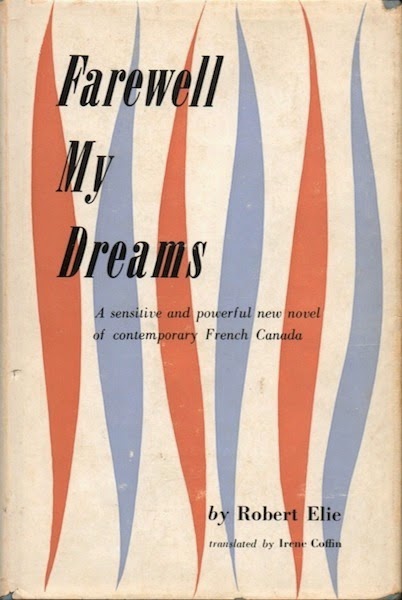
Farewell My Dreams [La fin des songes]
Robert Élie [trans. Irene Coffin]
Toronto: Ryerson, 1954 

Farewell My Dreams isn't a title I would've used; "The End of Dreams", the most literal translation, works just fine. No wispy romance, this debut novel is one of the most depressing and rewarding books I've read this year – and there are just thirty-seven more days to go.

Friends in youth, Marcel Larocque and Bernard Guerin enter middle-age connected only through respective marriages to sisters Jeanne and Nicole. No one is happy. Pudgy Marcel, a Montreal journalist, stares too long at his wife's youngest sister and dreams of past infatuations. Privileged Bernard, a lazy lawyer, wanders aimlessly, half-hoping that something will interest. When offered a seat in Quebec City, he goes through the motions, but stops in his tracks at the sign of the first obstacle. Meanwhile, the wives suffer.

Though the plot suggests otherwise, this is much more than a novel of mid-life crises. Démon de midi takes on new meaning as Marcel's mental illness, so very subtle in the early pages, comes to dominate his actions.

Six decades after first publication, La fin des songes remains in print; not so the English-language translation. I doubt this has anything to do with Irene Coffin, though her work is clumsy and talents ill-suited. The language is stilted, her dialogue peppered with words like "shall" and "forsooth".

Yes, forsooth.

Beaver Hall Hill is "Cote Beaver Hall" and Montreal's great commercial street appears variously as "Ste.-Catherine" and "Sainte-Catherine". The biggest gaff of all comes when the translator has Bernard announce that he is looking to be elected federally.

My advice? Read it in the original if you can. Read the translation if you can't. Either way, you'll be both depressed and rewarded.

A coincidence: Remember Douglas Sanderson's The Deadly Dames? Sure you do. That's the thriller in which a woman is killed by a streetcar rounding Peel and Ste-Catherine. Well, the very same corner features in La fin des songes:
He stopped a taxi which took him to the corner of Peel and Ste.-Catherine. The street-cars were making an infernal din and the crowd, as dense as at noon, flowed slowly. He landed in a tavern where smoke and bad lighting gave the beer drinkers a phantom-like appearance. It suited his mood well, but Bernard began to laugh. "I surely am not going to live in the atmosphere of detective stories."  
The critics rave: La fin des songes received the Prix David and has been described as the great novel of la Grande Noiceur. Reception of the English-language edition was enthusiastic – the exception being a critic I know only as "A.G.P.". Here he is in the 4 March 1955 edition of the Quebec Chronicle-Telegraph:
When the psychologically sound people must face a reality that continues to be fairly rugged and seek escape through the medium of fiction, to depress them with neurotic maunderings is to substitute a stone for nourishing bread.
The critic later provides these words of advice:
There is an abundance of material in French Canada for more cheerful and more constructive themes. Judged by the standards of Mr. Elie's [sic] literary school these may be less dramatic but, so far as I have been able to feel their collective pulse, the contemporary reading public, by a large majority, want to be amused and to laugh. At the very least, it would be interesting for him to provide this sort of escape by way of change of pace, if nothing more.
A.G.P. makes the mistake of identifying Bernard as "Bertrand". Pay him no mind.

Object: An attractive 213-page hardcover bound in pale blue cloth with burgundy print, my copy belonged to my father. The dust jacket sells other Ryerson novels by Ada Pierce Chambers, Will R. Bird, Gaie Taylor and E.M. Granger Bennett. I'm a proud owner of the Bird title – bought for a buck last year in London.

(Cliquez pour agrandir)
Access: John Glassco once stole a copy of the first edition from the Royal Edward Laurentian Hospital; you'll find it with most of his other books at Queen's University. A total of twenty-three Canadian libraries have copies of the Coffin translation.

Though uncommon. decent copies of the Ryerson edition begin at under ten dollars. One copy – and only one copy – of the American edition, published in 1955 by New York's short-lived Bouregy & Curl, is on offer for US$14,


La fin des songs is currently available from Bibliothèque Québécoise, For some reason, I prefer Fides' earlier  Bibliothèque Canadienne-Français edition, even though the building on the cover does not appear in the novel. I purchased mine through the mail from a Montreal bookseller who claimed it was signed by Élie.

It wasn't… and the condition was much worse than described.

18 April 2014

Claire Martin at the Start of a Quiet Revolution


Best Man [Doux-amer]
Claire Martin [pseud. Claire Montreuil; trans. David Lobdell]
Ottawa: Oberon, [1983]

Claire Martin turns one hundred today. I can't think of another Canadian literary figure who has joined the ranks of the centenarians. But why focus on such a thing? Longevity is just one of her many accomplishments, as reflected in honours received: the Prix du Cercle du liver de France, the Prix du Québec, the Prix France-Québec, the Governor General's Award, l'Ordre national du Québec and the Order of Canada.

I've not read Best Man in the original; even if I had my Beaconsfield French is such that I wouldn't have been able to comment on David Lobdell's translation. That said, I imagine the act of translating this work was particularly interesting.

Best Man is a novel written by a woman, translated by a man, featuring a male narrator who in love with a female novelist. And that narrator? His rival is a man who fancies himself a translator. I add that Martin herself has translated Markoosie, Margaret Laurence, Robertson Davies, Clark Blaise and…

I see I'm making the simple confusing.

Martin's straightforward plot begins with the unnamed narrator, an editor at an equally anonymous publishing firm, reflecting back on a twelve-year love affair. Gabrielle Lubin, the object of his affection, enters his life as an aspiring novelist, turning up one day at his office with manuscript in hand. It proves to be a poorly written work, yet our man takes on the arduous task of making it publishable. Why? All these years later he can't quite say:
I fear all these distant memories may have been distorted by subsequent events. The memory, like the heart, is subject to abuse; sometimes, indeed, by the latter.
The collaboration between author and editor leads to passion, most of which emanates from the latter. Gabrielle places her writing above all else. Critical and commercial success, both quick to come, change little in her life and lifestyle; she maintains routine, to which our narrator happily conforms. Separate flats are maintained, marriage is never discussed.

Jarringly, the regular and familiar is disturbed by a young dilettante who whisks Gabrielle from cocktail party to bed to the altar. The novelist knows that she has made a mistake, but does her best to prolong the doomed marriage by appealing to her editor. Our man, her former man, publishes the husband's passable novel and a weak translation of one of Gabrielle's works in order to maintain contact and chart the disintegration.

As one would expect with stories of obsessive love – Nabokov comes to mind – the narrator defers. 'Tis Lolita, not Humbert. This Montreal Anglo, incompetent in French, takes issue with David Lobdell's title: Best Man for the Claire Martin's Doux-amer (Bitter-sweet).

It is Gabrielle Lubin, not the narrator, who is the central character. She is a new woman, set in print the very year that the Quiet Revolution began. Unlike any that came before – I'm looking at you Angéline de Montbrun and Maria Chapdelaine – she is self-assured. She commands.

Who can resist?

Object: Published simultaneously in paper and cloth. My copy, an example of the former, was purchased in 1985 from a bookseller located on the Westmount stretch of Sherbrooke Street. Can't recall the name of his store, though I do remember his price: $2.00.

Access: David Lobdell's translation enjoyed just one small printing. Four copies are currently listed for sale online, though only two are worth consideration: a Very Good paper copy at US$23.00 and a Fine cloth copy (sans dust jacket) at US$40.25.

Beware the Ontario bookseller who dares list an ex-library copy as "Good". This is simply not possible, as further description proves: "Covered in Mylar; one stamp on back page, and with tape holding mylar to book. Stain on end pages of book where dirty fingers opened it, and on pages where DJ tape touches paper. One library tape on page 5." Ugh.

While Best Man is held by most of our university libraries, only Library and Archives Canada, the Bibliothèque et Archives nationales du Québec and the Vancouver Public Library serve those outside the world of academe.

Doux-Amer is better represented, in part due to the fact that it is still in print thanks to the fine folk of the Bibliothèque Québécoise.

I add that at C$9.99 it is a bargain.

And isn't that cover image great?

03 May 2013

Michel Tremblay's Macabre Juvenilia


Stories for Late Night Drinkers
     [Contes pour buveurs attardés]
Michel Tremblay [trans. Michael Bullock]
Vancouver: Intermedia, 1977

Having raised more than a few glasses after hours on St-Laurent, St-Denis and Mont-Royal, I thought I might have some small idea of what to expect here. I was so very wrong. The stories in this translation of Michel Tremblay's first book are set far, far away, in both time and place, from the streets of his Montreal; castles and dark mansions take the places of modest apartments and rooming houses.

Poe and Lovecraft are in evidence. In the first of these twenty-five stories, a caretaker keeps watch over a hanged man left dangling until dawn. In the wee hours, the body sighs and begins to move. Minutes later it's laughing, swinging so violently that the rope breaks and it falls to the ground. The caretaker flees. He returns the next day with the prison governor to find a headless corpse. The upper extremity, of course, is never found.

Stories for Late Night Drinkers was written between the ages of sixteen and nineteen. Tremblay has been fairly dismissive of the whole thing. "I wrote fantastic stuff until I was twenty-three. Pretty bad, all that," he told Jean Royer. And yet, he has allowed reprint after reprint.
It's not his best work, but I found it entertaining. You see, though we're not of the same generation, I saw something of my own youth in this juvenilia. Though, sadly, there was no Poe in mine, at ten I was subsumed by Ghosts, House of Secrets, House of Mystery and The Witching Hour. I've not read anything quite so similar since.

As Tremblay told Royer, "we were all brought up in a country where culture was something exotic and it came from somewhere else." Like the author, I was in my mid-twenties before I realized otherwise.

Object: A trade-size paperback. My copy once belonged to John Glassco, and includes this careless note in his hand:


Of the thirty-five hundred or so Canadian books in my library, this is the only one published by Intermedia.


Doesn't the company's logo look like it belongs to a 'seventies underground comic book publisher?

Maybe it's just me.

Access: Our academic libraries do well, as do those serving the fine folks of Toronto and Vancouver. Montreal fails.

Contes pour buveurs attardés, the French original, was first published in 1966 by Éditions le Jour (right). It's published today by Bibliothèque Québécoise. Though Stories for Late Night Drinkers hasn't been quite so fortunate, its publication history isn't shameful. The first printing, amounting to one thousand copies, sold out... as did the second. Intermedia went back to the printers a third time, but that's the end. It has been out of print for well over thirty years.

There is good news in that decent used copies can be bought as little as ten dollars. Ignore the Vancouver bookseller offering a crummy stamped and stickered ex-library copy at US$48.00 (w/ an additional US$16.50 for shipping within Canada).