Showing posts with label Letters. Show all posts

15 October 2026

Oh, Little Man!


Chipmunk
Len Peterson
Toronto: McClelland & Stewart, 1949
299 pages

Claude Widgewood specializies in buns at Toronto's Modern Baker. He's an expert at adding just the right amount of cinnamon. The other bun-makers aren't so exacting. They don't care. There's no better employee than Claude, and yet he's afraid of being dismissed. Proulx is the problem. Claude considers this co-worker a Communist intent on spreading the Red Octopus's tentacles into his workplace. Leaving for home at the end of his shift, a notice of a union meeting is thrust into Claude's hand. He hides it in his coat pocket, fearful that Mr Cadenza, the bakery owner, is watching. Is he? What about Mr Spidafora, the Assistant Manager?  

Claude tries to rid himself of the notice on the crowded streetcar home. Sliding it from his coat, he lets it loose to drop on the floor. It does not. The sheet is wedged between himself and an elderly woman with purple hair. She gives him a look when he tries to shimmy it loose.

Chipmunk may be a comedy, but its humour is dark. The eyes of Messrs Cadenza and Spidafora are a definite concern, but Claude's greater worry is the tall man in trench coat standing idly outside the bakery cleaning his fingernails with a comb. Claude is almost certain that he's with the Special Branch of the Mounties investigating subversive activities. 

The chill of the Cold War permeates. Whether at the bakery, traveling to and from the bakery, or drinking in a tavern with his friend Mott Kilsoonski, Claude is on edge. It is a mistake to drink so much:


When sober, Claude idolizes Kilsoonski. The man fought in Italy, the man was wounded in Italy, while Claude never even made it overseas:
The first Medical Officer who examined him said he had shoulders like a bird, and all those who examined him afterwards agreed; he had the narrowest shoulders they had ever seen.
The war three years in the past, Mott is a rising talent in the boxing world. He defeated Andy Anzopoulis in his most recent fight at the Gardens.

Mott is one of the three most important people in Claude's life. His friendship with the boxer extends back to pre-war years when the big man rescued him from a bunch of mean-talking thugs. Claude's relationship with young tough Nick Yakyuchuk, the most recent, came about when he volunteered with the "Great Big Brothers." The baker is meant to provide moral guidance and an upstanding male role model. Nick has just returned from a juvenile detention centre. Nick's mother, a prostitute, is intimidating because she is such a good looking woman. Claude is ever wary, thinking that she will make some sort of move. Besides, he has a wife.

This is the novel's most unbelievable ingredient.

The marriage between Claude and Faustina Widgewood is unlike any other I've encountered in Canadian literature. He's as small as she is large, but that isn't it. Faustina is cold and distant, sometimes pushing him away. Then there are times she draws him so close that her knitting needles poke. They wrestle in their marital bed – brutally and violently – but slight Claude always wins and Faustina is satisfied.

It's tempting to dismiss Claude as so many do – as a weakling – but there is strength in his imagination. This muscle he has exercised since childhood in picturing his father, a soldier passing through on way to the Great War... or so his mother told him. As a child, he came up with a believable story about his "widowed mother." It has served him well. Though he has altered it slightly over the years, this is the one Faustina knows.

Of course, it is that same imagination that is the greatest source of torment.

Chipmunk
is a first novel. After publication, Len Peterson spoke of his plans for a second novel, but it never appeared.

I can see why.

In a 16 August 1955 letter to Norman Levine, Jack McClelland responds to a the former's Times Literary Supplement piece titled 'Canadian Writers Come into Their Own.'

McClelland has this to say about Levine's praise for Len Peterson: "as a novelist in the Canadian scene, [Peterson] is hardly worth mention. He hasn't produced a book-length script for about seven years, and even at that he probably showed more promise than anything else."

Chipmunk does show promise. It is one of the strongest debuts I've ever read.  

Len Peterson was first and foremost a playwright. At thirty-two, his age when Chipmunk was published, he was also English Canada's leading radio dramatist. The CBC paid so much better than McClelland and Stewart. 

A man has to make a living.

Claude Widgewood would tell you as much.


About the title:


About the novel:


Trivia: A Len Peterson-scripted CBC Radio adaptation aired in March 1950.

Object: An attractive hardcover in navy blue cloth. The jacket design, superior to most published in 'forties Canada, is credited to German immigrant Robert Langstadt (1912-1987). Nearly everything I know about the artist is found on this McMaster Museum of Art page. It is well worth a read.


My copy was purchased online two years ago from an Ontario bookseller. Price: US$15.00. 

Access: McClelland & Stewart did not reprint. There have been no other editions. Seventy-seven-year-old copies are listed online for as little as fifteen Canadian dollars. At $100, the most expensive is inscribed by Len Peterson to author and academic Sylvia De Vrenet. If you have the money, this is the one to purchase.


Read for the 1949 Book Club hosted by Karen and Simon.

Other titles from 1949 covered at the Dusty Bookcase:

More than any other year! 

09 October 2024

Pearl White is The White Moll!


The Moving Picture World
2 October 1920

A follow-up to last week's post on Frank L. Packard's The White Moll.

TheWhite Moll was the fifth Frank L. Packard book to be adapted by Hollywood. It followed Tinseltown's take on his 1914 novel The Miracle Man by a matter of months. The Miracle Man is considered one of the great lost silent films. I first wrote about it thirteen years ago, sharing the two minutes and twenty seconds of known footage. Since then a further thirty-nine seconds has been found.

Huzzah!

Here's what we now have:


Of the eight Packard novels I've read, The Miracle Man is the best by far. It concerns a faith healer in Maine whose activities attract the attention of a criminal gang. Wanting in on what the grift, they leave the Big Apple for the Pine Tree State, only to find that there is no grift. The White Moll is something altogether different. It was published in 1920, when Packard was all in on thrillers; The Adventures of Jimmie Dale (1917) and The Further Adventures of Jimmie Dale (1919) had been his two biggest sellers.

As a novel, The White Moll has nothing whatsoever to do with religion, but the film was steeped in a baptismal font. I write with confidence, though I haven't seen Hollywood's adaptation. Like The Miracle Man, it's a lost silent. If anything, The White Moll is even more lost in that not so much as a frame has been found. Everything I know of the movie comes through reviews and descriptions found in one-hundred-and-four-year-old newspapers and magazines. 

The screenplay is credited to E. Lloyd Sheldon (1886-1957), who is best remembered for Tess of the Storm County (1922). It starred Toronto girl Mary Pickford; The White Moll starred Pearl White. She'd made a name for herself as "Queen of the Serials," the 20-chapter Perils of Pauline (1914) being the most popular. The White Moll was intended as White's first step toward becoming the Queen of the Features. 

Exhibitors Herald
4 August 1920
The best review I've read is also the worst. Published on in the Chicago Daily Tribune on August 16, 1920, it pulls no punches:

And thats just the start!

Critic Mae Tinée – real name: Frances Peck Grover – isn't completely down on the film. She praises the camera work and sets as "good," and describes Richard Travers, who played the Adventurer, as the only punk actor. It's the religious elements that offend:

Some things transpire in a church at the start of the picture that quite seriously offend one's good taste. The production will go better when the scenes utilizing the image of Christ crucified are omitted.

Christ crucified!

Reading through the reviews, I've managed to cobble together a plot that owes little to Packard's novel. William M Drew appears to have walked a wider trail, so I quote from his recent biography of Pearl White, The Woman Who Dared (Lexington: UP of Kentucky, 2023):

The White Moll cast Pearl as Rhoda, a thief from the underworld slums. Her life is transformed when she has a vision of Christ during a church robbery in which her father is killed. Becoming known as the "White Moll," she dedicates her life to reforming criminals. One of them, the "Sparrow," is a burglar who catches her fancy. Her activities as a settlement worker arouse the antagonism of the the "Dangler" (played by John Thornton  Baston), the leader of a criminal band, who clashes with her throughout the film. Her idealism wins out as she succeeds in bringing the "Dangler" to justice and finds love with the "Pug" (Richard C Travers), another reformed crook. In the course of these adventures, Pearl disguises herself as Gypsy Nan, a toothless hag who not "one fan in a million could guess" was the beautiful actress.

The Rhoda of the novel is a young woman who has been raised in comfort by a loving father, a well-positioned, well-respected mining engineer. She dedicates herself to caring for the poor after witnessing their squalid living conditions. The "Sparrow" appears late in the novel in her time of need. He is not someone who has captured her fancy. In the novel the "Dangler" is gang leader Pierre Dangler. He has no idea Rhoda is working against him. The "Pug" is not a reformed crook, rather an upstanding young man who has infiltrated Dangler's gang so as to bring them to justice.

The 7 August 1920 Moving Picture World reports:

The story is considered by Frank L. Packard, its author, to be the most powerful novel he has ever written, truly reflecting underworld existence.
What, one wonders, did the author make of such a radical departure from his story? As I've not had a chance to comb through the Frank L. Packard fonds at Library and Archives Canada, all I have to go on are these two paragraphs from a letter he wrote producer William Fox, as quoted in the 21 August 1920 edition of Moving Picture World: 


Note that praise does not extend E. Lloyd Sheldon.

I wonder whether Packard, a devout Anglican and congregant of Montreal's St James the Apostle, would have objected to the depiction of the crucified Christ (uncredited), or whether he would've embraced the religious elements, particularly after the success of The Miracle Man.

Le Canada
11 September 1920
On the other hand, The Miracle Man is so much better.

Right?

I suppose we'll never know.

Related post:  

16 July 2018

The Dustiest Bookcase: F is for Fulford


Short pieces on books I've always meant to review (but haven't).
They're in storage as we build our new home.
Patience, please.

Right Now Would Be a Good Time to Cut My Throat
Paul Fulford
Richmond Hill, ON: Pocket, [1972]
pages

The debut novel by Paul Fulford – commonly, "Paul A. Fulford" – about whom I know next to nothing. True, the book's author bio consumes the back cover, but can it be trusted?


Fulford is described as a magazine editor without identifying the publication. He's said to have written magazine articles, but I've yet to find one. Brochures? Speeches? Haven't most of us written these at one time or another?

Fulford is a subject of further research, which is not to say it hasn't begun. I've managed to track down a copy of Should a Scotsman Take Off His Kilt When He Meets a Lady?, published in 1969 by Young & McCarthy.


It was the publisher's only book.

I've also found seven letters Fulford wrote to the Globe & Mail, the earliest (26 March 1965) concerning a crosswalk accident that involved Toronto's Chief of Police. Others focus on problems with parking at the Canadian National Exhibition, Soviet Premier Alexei Kosygin's 1971 Ottawa visit, the Oak Island Mystery, and humorist and columnist Richard Needham (whom Fulford criticizes as unfunny and lazy). The last, published in 6 January 1973, deals with dogs:


Never mind.

Given Fulford's association with Pocket Books, an American mass market branch plant, this letter published on 6 August 1971, is by far the most interesting:


As far as I've been able to determine, Fulford wrote just one paid piece for the Globe & Mail, "Can Penguins Show How To Solve the Generation Gap" (16 March 1971), an op-ed in which he's described as "a supply teacher at Forest Hill Junior High."

It's every bit as funny as Needham.

Barman, labourer, teacher, farmhand, I don't doubt that Fulford had been them all. Initially, I was dismissive about the claim that written of movie scripts, "Unproduced," I'd thought, until I came across a "Paul Fulford" as one of four screenwriters credited in the 1971 Canadian prison drama "I'm Going to Get You... Elliott Boy" (aka Caged Men Plus One Woman).


"Featuring today's bright young stars Ross Stephenson and Maureen McGill," according to the trailer, "this story was torn from today's headlines and actually filmed inside the walls of a modern and active penitentiary." "It seems a rip-off of John Herbert's 1967 play Fortune and Men's Eyes, which happened to have been released as a feature film in the very same month.


I wonder what happened to bright young stars Ross Stephenson and Maureen McGill, just as I wonder what became of Paul A. Fulford. As far as I can tell, he published only one more book, Who's Got the Bastard Pope [sic] (Markham, ON: PaperJacks, 1978). Surprisingly uncommon, I've been looking for it for years, but this small image spotted online is the closest I've got:


As for Fulford being married to a writer named Dorothy Parker... Well, you can't make that stuff up.

05 March 2018

The Pyx Censored!


I spent a couple of hours this past weekend researching John Buell's second novel, Four Days, first published fifty-five years ago by Farrar, Straus & Cudahy. And why not? Buell is one of our finest novelists – Edmund Wilson thought so – but he is also one of our most unjustly neglected. I was honoured to help usher his debut, The Pyx, back into print last year as part of the Ricochet Books series.

The Pyx was roundly praised, enjoyed numerous translations, and was adapted to the screen in a not so bad film starring Christopher Plummer and Karen Black. Four Days too was praised. It has always been in the shadow of Buell's debut, and yet it is the better novel. In fact, Four Days is the author's best novel and is one of the greatest novels set, as least partly, in Montreal.

Why was I researching?

I'll leave you to guess.

An unexpected discovery came from an unlikely source, Anne Montagnes' review of Four Days in the 24 February 1962 edition of the Globe & Mail:
This, Mr. Buell's second novel, is of a texture with his first, The Pyx. Both reveal his careful study of Graham Greene – the concern with outlaw characters, the struggle between good and evil, the ever-narrowing pursuit both spiritual and physical, the compassionate Catholicism that appears before even those who spurn it, the violence, the pity. Unlike Mr. Greene, Mr. Buell writes with an economy of viewpoint and action, a simple unfolding of his story. Furthermore, Mr. Buell is never off-colour, as Mr. Greene sometimes is, making it even stranger that at least one branch of the Toronto Public Library has, because of vociferous complaints, removed The Pyx from its open shelves.
This is the first I'd learned of The Pyx being attacked by the censors... and in Protestant Toronto, no less. Further research uncovered this Letter to the Editor (6 March 1962):


The Toronto Public Library website informs that six copies of the Ricochet Books edition are in circulation. Only one copy of the Farrar, Straus & Cudahy edition survives.

It's reference only.

A coincidence, I'm sure.

Related posts:

01 August 2016

Watch it tumbling down, tumbling down...


Gee, but it's hard when one lowers one's guard to the vultures.

They began tearing down the old school next to our home last week. It was an ugly scene. The first part to be destroyed dated from 1875, when it was known as the St Marys Collegiate Institute. Built in the Italian Renaissance style, it was an impressive structure for so small a town. As the town grew, so did the school, with each extension less attractive than the last. An argument can be made that the devastation began long before the excavators showed up.

My wife put it best in a letter published earlier this year in our local newspaper:
Where were its advocates when the destruction started and the first of its many abysmal additions took form? Each a tumorous growth, defacing and deforming the once elegant building into a grotesque lump of bricks, as a mass it attracts no sympathy. The final insults now come through acts of vandalism committed by clueless, aimless, aggressive teens. But then, why should they care about this school when preceding generations did not? Children learn by example.
The building spent its last days as Arthur Meighen Public School, named in honour of the prime minister who had been educated within its walls. The nicest thing I can think to say about Meighen is that he considered Shakespeare the greatest Englishman of history. Meighen was a better speechwriter than politician, which is to say that he demonstrated real talent in putting words on paper but was otherwise a bastard. Fellow Collegiate alumnus Rev Dr Charles Gordon recognized him as such. Of course, we Canadians know Gordon as "Ralph Connor," the novelist who one hundred years ago dominated bestseller lists.

I lie. We don't remember the man – not even in St Marys.

The father of David Donnell, recipient of the 1983 Governor General's Award for Poetry, taught at the Collegiate. Fellow poet Ingrid Ruthig was a student during the years it was known as North Ward Public School. My daughter, Astrid, attended in its final days as Arthur Meighen.

Time passes.

Last week I saw a roof constructed in the nineteenth-century by local carpenters destroyed by a monster machine from the United States. I saw joists cut from trees that had grown in the time of Lord Simcoe being smashed to bits.

I turned away as a woman shed a tear at the loss.

Shame on me?

Shame on this town.


Related posts:

11 July 2016

The Paratrooper, the Professor and the Publisher: The Nasty Public Battle Over The Quebec Plot


The first review of my first book was negative. The reviewer's disappointment had to do with my having written the book I wanted to write rather than the book he had wanted to read.

The second review of my first book was written by a man who was identified in same as the model for a throughly dislikeable character in George Galt's novel Scribes and Scoundrels. The reviewer made no mention of this, though he did question my existence.

"Do not respond," a senior writer friend advised.

I didn't.

The reviews that followed were very positive. I remember nothing of them other than that – very positive – but I do remember the two negative reviews in detail. For example, I can tell you that the first reviewer got the price and page count wrong. I can also tell you that I was taken to task for not including an index. The book has one, but he'd read an advance copy. His was an amateur's mistake, published in the closest thing Canada has to "the organ of the trade".


Bad reviews stay with you in a way good reviews don't. I know not to read them. I don't read good reviews either. Every now and then I feel bad for not acknowledging a reviewer's kind words... and here I'm certain that they are all kind words.

"Do not respond."

Good advice I pass on to others. And yet all these years later I still fantasize about taking on the critics in question, which is why I so enjoyed Leo Heaps' thrust and parry with Patrick O'Flaherty found in 38-year-old editions of the Globe & Mail.

A professor at Memorial University, Patrick O'Flaherty was tasked with reviewing The Quebec Plot for the paper (22 July 1978). I have no idea why; I don't see that O'Flaherty had reviewed thrillers in the past. His opening sentence betrays a certain ignorance of the genre: "Leo Heaps, who has been reading James Bond stories and learning a little Canadian geography and history, has decided to write a thriller, some would say a roman a clef about the Quebec situation."

Ignoring the obvious (The Quebec Plot owes nothing to Ian Fleming), what irks is the insinuation that Heaps, then living in London, needed something of a refresher in things Canadian. This is very same thinking the most stupid of our cultural nationalists once employed against the great Mavis Gallant. Winnipeg-born Leo Heaps was the second son of A.A. Heaps. He was educated at Queen's and McGill, and lived most of his life in Toronto. At the risk of being accused of racism – more on that later – I find this quip about Heaps "learning a little Canadian geography and history" a bit rich coming from a man whose early education pre-dated his province joining Confederation. It's not O'Flaherty at his worst, but it's pretty bad. His lowest and laziest comes when he quotes two lines of dialogue out of context:
  • "I hope to God there's no armed revolution in Quebec."
  • "Let's get down to business."
This is a cheap trick that we've all seen before; indeed, Heaps himself recognizes it as such in his response. But before I get to that, O'Flaherty's conclusion is worth presenting in full:


Now, I'm the first to recognize that it is not always easy to come up with a decent conclusion to a review – look no further than mine of The Quebec Plot for evidence – but this one is a real head-scratcher. On the other hand, I'm no academic, which is why I so appreciated the University of Toronto's June V. Engel, who in a letter the Globe & Mail (1 Aug 1978) refers to Prof O'Flaherty's conclusion as "incomprehensible."

Engel wasn't alone in her criticism of the critic. An earlier letter found in the 28 July edition describes the professor's review as " jumbled, incoherent." The writer was someone named Caruso, who may or may not have been an academic him or herself.

By that time, Heaps had responded to the critic. In the 26 July 1978 edition of the Globe & Mail, he shrugs off everything to do with his knowledge of Canada, associations with Ian Fleming, Marian Engel, Charles Templeton and Little Orphan Annie creator Harold Gray, then presents a parting shot:
I have been away from Canada for some time and have grown accustomed to having my books read by literate people who are concerned both with their prose and the philosophical content of their reviews. If Mr. O'Flaherty is a professor of English in Newfoundland who is there to protect us from the academics who teach in our schools?
Fair question. I've been asking variations since my graduation from Beaconsfield High School.

Leo Heaps' letter drew no response from Patrick O'Flaherty, though Jack McClelland weighed in with a letter (4 Aug 1978), which reads in part:
At first I thought it was a bad Newfie joke. Then my reaction turned from disbelief to anger. Mr. O'Flaherty's judgement, in my opinion, ranks slightly below that of a Rhesus monkey and I have nothing against monkeys. 
Was the publisher being disingenuous? "It happens that although I am not the publisher, I have read The Quebec Plot," McClelland writes of a novel he would publish within a year. Might as well add that he also published the novel about the cardinal who doesn't want the world to know about the discovery of Jesus' bones and the one in which a woman tries to copulate with a bear.

Curiously, it was McClelland's letter that brought a response from professor. Notably tardy, here he is from the 24 August 1978 edition:
The letter from Jack McClelland (Aug. 4) comes out with abusive, racist talk – "Newfie," "monkey," etc. This letter, contemptible though it is, merits a few words of reply.
     In recent years I have reviewed a number of silly books published by McClelland and Stewart Ltd. rather harshly. Looking back over my reviews, my only regret is that they were not harsher.
     What does a reviewer do when he is sent a trashy book to review? Normally, I, for one, return the item to the editor with a note saying that it is not worth reviewing. But there is so much writing in Canada – especially at the "creative" level – and so much of it is published with the assistance of the Canadian taxpayer, that it is hard to resist occasionally damning bad books. And so I stand by my review of Leo Heaps' book.
I imagine the professor does to this day, ignoring the simple facts that The Quebec Plot received no taxpayer support and was never sold as anything other than a thriller.

The last word is owed Leo Heaps himself, as published in this letter in the 4 September 1978 edition:
I cannot resist taking a parting shot at my friend Patrick O'Flaherty who reviewed my book The Quebec Plot in your columns. I will miss the professor from Memorial College, Newfoundland, at his departure.
    Professor O'Flaherty has in his letter to your newspaper on Aug. 24 presented such a perfect and inviting target that I felt it was irresistable. His remarks either hide a character of infinite subtlety and wit or one of enormous pomposity and self-righteousness. Personally, I am inclined to favor the latter view. Mr. O'Flaherty has sounded like the budding parliamemtary candidate he is when he protests against the waste of taxpayers' money on behalf of Canadian authors struggling to make ends meet. (Unfortunately, I have never had any grants. All my books have been published abroad, except one, which won a Governor-General's Award.) Perhaps the professor might tell us where the subsidy came from to publish his somewhat obscure anthology of Newfoundland and Labrador writing, which he co-edited some years back.
     If Patrick O'Flaherty remains as severe as he is, "untroubled," as Browning said, "by the spark," and if he is allowed to indecently expose himself in book review columns, then one can begin to understand his concern about Canadian prose. One only has to read what the professor writes.
Yes, Heaps is owed the last word... but I can't quite bring myself to let him have it.

In January 2009, at a dinner celebrating the sixtieth birthday of the aforementioned senior writer, I was introduced to the second critic of my first book. On learning my name he paused – here it comes, I thought – and then said: "You wouldn't be any relation to Reverend David Busby? I was one of his altar boys."

"Yes," I replied, "he was my uncle."

"Nice man," said the critic.

"Yes, very nice," I said.

And then we parted.

Related post:

31 August 2015

Langevin's Masterpiece; McClelland's Disappointment


Orphan Street [Une Chaîne dans le parc]
André Langevin [trans., Alan Brown]
Toronto: McClelland & Stewart, 1976
287 pages

This review now appears, revised and rewritten, in my new book:
The Dusty Bookcase:
A Journey Through Canada's
Forgotten, Neglected, and Suppressed Writing
Available at the very best bookstores and through


Related posts:

22 July 2015

Hugh Garner: Article Lost, Article Found


Toronto: McClelland & Stewart, 1962

Toronto: Ryerson, 1968
Markhan, ON: PaperJacks, 1983
Toronto: Dundurn, 2011

A Bonus:
Regarding the sales of "The Silence On The Shore" [sic] I think it has done remarkably well, considering that its publisher didn't want to sell any copies of it at all. I think, however, that had I not wanted to sell it I would have kept its sales down below 1,400, even if I would have to burn the books. 
     My personal feelings to you are friendly, but from a business and professional point of view I think it better that we do not involve each other with the other any more. 
– Hugh Garner, letter to Jack McClelland, 28 August 1963

24 February 2014

Freedom to Read Week: Catherine Seppala, the Book Burning Mayor of Fort William, Ontario


Catherine Seppala
1907 - 1975
RIP
Day Two of Freedom to Read Week, but I consider this the real beginning.

Welcome to the working week.

Looking over past Freedom to Read Week posts, I see I've written about personal heroes – Jean-Charles Harvey, Irving Layton, Norman Levine, F.R. Scott, and Dana Porter – while casting much more light on villains like Howard Burrell, Len Wynn, Raoul Mercier, Premier Maurice Duplessis, Fr. Harrigan, Col. Colin Harding, Sgt. John Watson, Det.-Lt. Lucien Quintal, and the forbidden books card catalogue of Lt.-Col. (Ret'd) John Merner.*

It probably doesn't reflect well on me that I focus so much on those who seek to suppress… and here I am doing it again with Catherine Seppala, once Mayor of Fort William, Ontario.

There's a good deal to admire about Mrs Seppala: she was a conservationist, a dedicated volunteer, a city councillor and Chair of Fort William's carnival queen contest.

The News-Courier (Charleston, SC) 10 January 1956
In 1959, she was elected Fort William's first and only female mayor. Sadly, the accomplishment is marred by abuse of power. It all began when the newly elected mayor visited the offices of the Central News Company and "suggested" to manager Henry Batho that he remove all copies of Lady Chatterley's Lover from city news stands. So persuasive was Mrs Seppala that Mr Bathos not only removed the book from sale, but received permission to use the city's incinerator in burning all seven hundred or so copies.

The Globe & Mail, 13 October 1959
Mr Bathos later told The Globe & Mail that he had feared a lawsuit. The same report has Mayor Seppela admitting that she hadn't actually read the Lady Chatterley's Lover, but she fully intended to one day. Ignorance in no way prevented her from deeming the novel as "a dirty rotten piece of filth", "the dirtiest thing ever put into print." "I will not hesitate to enforce a ban", she warned.

Condemnation followed, the most noteworthy coming in not one but two Globe & Mail editorials. Here's the second, published 14 October 1959:

(cliquez pour agrandir)
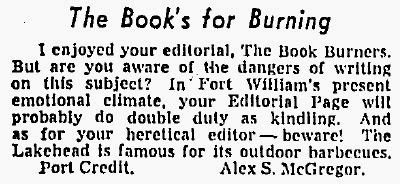
And then there were the letters; so many that I offer but a sampling:

The Globe & Mail, 7 October 1959
The Globe & Mail, 19 October 1959
The Globe & Mail, 27 October 1959
Mrs Seppala seems to have been undaunted, mailing a copy of Lady Chatterley's Lover to Minister of Justice Davie Fulton and asking whether he considered it obscene. Minister Fulton's response was to remind the mayor that her local police had the ability to launch test cases against publications they believed to be prohibited under the Criminal Code.

How far Mayor Seppala was willing to go is anyone's guess. A few months into the crusade she was struck by ill health, which in turn led to her resigning the mayoralty.

The Globe & Mail, 7 October 1959
Anyone wishing an opinion as to whether a book might be obscene is invited to mail same to my St Marys address. And, no, you can't have it back.

* No light will be cast on Barrick Gold Corp. I rush to add that Peter Munk, Anthony Munk, Howard L. Beck, William Birchall, Jamie C. Sokalsky and Brian Mulroney are mighty fine people. Really.

Related post:

18 November 2013

T is for Thievery


Pettes Memorial Library, Knowlton, Quebec
Hugely flattered to hear you stole my book. This is fame. I used to steal a lot of books myself, mostly from libraries: my method was to look at the little card in the back envelope and if it hadn’t been taken out more than twice in the past year I would figure I needed it more than the public. 
— John Glassco, letter to Al Purdy, 18 September 1964
John Glassco, that self-proclaimed "great practitioner of deceit," made a very fine book thief. His personal library, most of which was purchased by Queen's University, included volumes lifted from McGill University, Macdonald College, the Westmount Public Library and the Royal Edward Laurentian Hospital.

Queen's is not alone in having profited from Glassco's ill-gotten gains. Twenty-three years ago, I purchased what I thought to be his copy of Irving Layton's Balls for a One-Armed Juggler (Toronto: McClelland & Stewart, 1963).


A couple of decades passed before I happened to notice this on the top edge:


Glassco dated the copy April 1963, the month of publication. It is presented here as evidence that he was not above breaking the rule described in his letter to Purdy:


Two summer's ago, I purchased another of Glassco's books, Henry de Montherlant's Perish in Their Pride [Les Célibataires] (New York: Knopf, 1936), only to notice this after the sale:

(cliquez pour agrandir)
The Laurentian Sanitarium became the Royal Edward Laurentian Hospital, at which Glassco spent a nearly all of 1961 undergoing treatment for tuberculosis. On 3 November of that year he wrote his wife:
Now that I’m getting ready to leave I’m casting a selective eye on the books in the library. There’s just so much stuff here I’d like to opt (organizieren) that no one has ever read or will ever read. But I’d better not: that’s bad medicine. Only two: Robert Elie’s La fin des songes (there are three copies, all untouched) and Madame Ellis’ book on Garneau. They’ll none of them be missed, as Gilbert says. Anyway, I’d like to give them a good home.
How's that for gratitude?

Trivia: The book Purdy pilfered was The Deficit Made Flesh (Toronto: McClelland & Stewart, 1958). The victim was a Montreal bookseller.

Plug: Both Glassco letters quoted feature in The Heart Accepts It All: Selected Letters of John Glassco, edited by yours truly.

Cross-posted at A Gentleman of Pleasure.