Showing posts with label Barr. Show all posts

11 August 2026

Books I Was Reading On This Day Over the Last Ten Years: A Top Ten Tuesday List


Tuesdays begin like any other day. I rise before the sun, make a carafe of coffee, then return to bed to read The New York Times on my laptop. My wife has made me promise to wake her with news that Donald Trump is dead. The Environment Canada website is next, followed by The Globe & Mail. I then take a tour of my favourite book blogs. On Tuesdays I make a point of visiting That Artsy Reader Girl. For six years now, Jenna has been hosting Top Ten Tuesday in which she suggests topics to we fellow bookish people. A few examples: 

Books I Disliked But Am Glad I Read
The Longest Books I've Ever Read
Books I'd Give Different Titles To 
Much as I've enjoyed the responses, I'd never participated. This changed with today's prompt: Books I Was Reading On This Day Over the Last Ten Years.

It was interesting to revisit summer reads from years past. Published in 1872, James De Mille's The American Baron was the oldest. I Am Not Guilty was by far my favourite of the ten titles. Read in 2019, I liked it so much as to return it to print the following year as part of the Véhicule Press Ricochet series.


I was less impressed by the author's 1949 Harlequin Lost House, which is not to suggest that there aren't others deserving revival... Well, maybe just one. Long time readers will know which:

2025

Onoto Watanna [Winnifred Eaton]
New York: Harper, 1901

2024

James De Mille
New York: Harper & Bros, 1872

2023

The Weak-Eyed Bat
Collected Millar: The First Detectives
Margaret Millar

New York: Syndicate, 2017

2022

Lost House
Frances Shelley Wees
Winnipeg: Harlequin, 1949

2021

One Day's Courtship and The Heralds of Fame
Robert Barr
New York: Stokes, 1896

2020

The Darling Illusion
Margerie Scott
London: Peter Davies, 1954

2019

M'Lord, I Am Not Guilty
Frances Shelley Wees
New York: Doubleday, 1954

2018

Doors of the Night
Frank L. Packard
Toronto: Copp Clark, 1922

2017

Caught in the Snare: The Sequel to Edith Percival
May Agnes Fleming
New York: Street & Smith, [c. 1917]

2016

The Mystery of the Folded Paper
Hulbert Footner
New York: Collier, n.d.

For the record, I'm currently reading Lot's Wife, John Glassco's 1975 translation of La femme de Loth by Monique Bosco.

As I write, Donald Trump is still alive.

Related posts:

26 December 2025

The Ten Best Book Buys of 2025 (and five gifts!)


This year, Simon Thomas of Stuck in a Book and Tea or Books fame made a fourth stab at what he refers to as "Project 24," his goal being to purchase only twenty-four books "for myself" throughout the year. The "for myself" bit is important. Why deprive friends?

As most of my books are stored in one of our outbuildings – there's no way they would all fit in the house  I chose to follow Simon's example. My Project 24 had a different carve-out: I would not be counting books purchased at a certain charity shop in nearby Smiths Falls. My justification for the exception had to do with my support of the charity... and, admittedly, the ridiculously low prices. One 2024 visit yielded three signed Margaret Atwood first editions from the 'seventies for two dollars in total.

When June hit I was feeling quite proud of my myself. I'd purchased just eight books. I'd been picky, even at the charity shop, Between Friends/Entre Amis being my only purchase.


All fell apart two days later when I visited a different charity shop, this one in Brockville, where I came across twelve seemingly unopened Folio Society Anthony Trollope novels at $2.50 each. I bought the lot. This meant that to get back on track I would have to keep my wallet in check until November.

Of course, I paid no mind to that constraint, continuing apace until late August when 
contractors appeared at our door, bringing the year's book buying to an abrupt end

Home renovations will do that.

I ended up purchasing twenty-nine books in 2025, which is far from a disgrace when one takes into account the twelve Trollopes. This year's list of best buys is atypical in that it features two Canadian books I already owned, and another that is Canadian in title only: 

The Victors

Robert Barr
New York: Stokes, 1901

There are real bargains to be had with Robert Barr. Most titles listed online are dirt cheap – so cheap that booksellers can't be bothered to provide a photo. Such was the case with this novel. I have no idea what it is about, but the subtitle, A Romance of Yesterday Morning & This Afternoon, intrigues.
The Girl from Toronto

Hugh Clevely
London:
   Amalgamated, 1954

A last minute addition to an order placed with a UK bookseller, the title caught my eye. Hugh Clevely was a Brit. Nothing in the two-columned 64-pages suggests he ever so much as visited Toronto. But that cover!
Lantern Marsh
Beaumont S. Cornell
Toronto: Ryerson, 1923

A novel set in a "provincial city" modeled on Brockville, Ontario, I'd been looking for a copy since buying a home in the area seven years ago. Cornell was born in nearby Athens Township and became a leading figure in cancer research. The jacket promises a "motif of woman-interest introduced in a rather unusual way." Intriguing!

Murder in a Road Gang

Hugh Cresswell
London: Sampson Low,
   Marston, 1936

Long a subject of interest, I tracked down a copy of this early Canadian murder mystery, likely the very first to be set on the Prairies. Illicit drugs figure!


Hearts and Faces
John Murray Gibbon
New York: John Lane, 1916

The scarce debut novel from the same man who would one day write the brilliant Pagan Love (1922).  This one appears to have been inspired by the Parisian art world. I'll let you know. A fortuitous eBay find, I was surprised and delighted to find that the copy I received was inscribed by the author.

A View of the Town
Jan Hilliard [Hilda
   Kay Grant]
New York: Abelard-
   Schuman, 1954

I already owned a copy of Nelson, Foster & Scott first Canadian edition, but this was signed! The author's first true novel, it is one of only two set in Nova Scotia, the author's home province. 

Trespass Against None
Eric Cecil Morris
Montreal: Whitcombe &
   Gilmour, 1950

Morris should be remembered for having co-written 1965's The Squeaking Wheel, but that bigoted screed is as forgotten as his quirky debut novel A Voice is Calling (1947). I was going on about Morris to a friend when I remembered this second novel. The only copy listed online was signed. An easy sale.

Hugh Pedley
Toronto: William Briggs, 1913

Early 20th-century Christian science fiction inspired in part by early 19th-century Washington Irving, in Looking Forward a pious man of science hibernates for decades, awakening to a Canada made utopian by the union of its Protestant denominations.

Sister Woman
J.G. Sime
London: Grant Richards,
   1919

This book is in horrible condition, but is so very rare that I had to rescue it. The Quebec bookseller had no idea what he had.

Unrecognized in its day, the novel has since been returned to print by Tecumseh Press (sadly, also unrecognized).

Anything Could Happen!
Toronto: Longmans, 1961
Phyllis Brett Young

A thing of beauty, I first purchased a copy in Toronto six years ago. This memoir of sorts inspired by a summer spent as a girl in Muskoka is not only signed by the author but also inscribed by her mother as a gift to an English relative. 


Twenty-twenty-five brought four generous donations to the Dusty Bookcase:


The Great Canadian Novel
Harry J. Boyle
Toronto: PaperJacks, 1973

A novel I've been meaning to read for over forty years, if only because of the title. When my parents were in university, both Bonheur d'occasion and Two Solitudes were promoted as the Great Canadian Novel. Fifth Business was mentioned most often during my own university years. What are the kids being told today, I wonder.

I have my doubts that The Great Canadian Novel "lives up to its title," as the late Peter C. Newman claimed, but aim to find out. 

Robert Stevenson: Engineer and Sea Builder
Kay Grant [Hilda Kay Grant]
New York: Meredith, 1969

A gift from the author's literary executor, Robert Stevenson was the second of the author's two biographies, the first being  Where the copy of A View of the Town above is signed "Jan Hilliard." this book is signed "Kay Grant." An accomplished lighthouse engineer, Stevenson was the grandfather of Robert Louis Stevenson. 


Beside Still Waters
Edna Jaques
Toronto: Thomas Allen, 1939

This summer, my friend Forrest Pass fed my Edna Jaques obsession with a copy of the poet's fifth collection. Seventy-five titles in total, of those I've read 'To a Radio' is my favourite.


The Poetry of Robert Henri Alphonse McGee
Bob McGee
Sherbrooke, QC: GGEL, 2025

My interest in Bob McGee can be traced back to the 2023 fiftieth anniversary of Véhicule Press. The poet's Three Dozen Sonnets & Fast Drawings was the publisher's very first book. Imagine my surprise in being contacted by Libbey Griffith asking whether I'd like a copy of this new collection.

Would I!

An inscribed copy arrived in my mailbox a couple of weeks later. It's a beautifully produced collection, featuring Three Dozen Sonnets & Fast Drawings and McGee's 1977 follow-up Shanty-Horses, James Bay Poems, along with the previously unpublished 'The Labovrs of Alphonsvs' and 'Votive Haiku,' interspersed with colour illustrations. The cover painting and author portrait are by Libbey Griffith.


Dedicated to the Children of Canada
Mr. Peanut
[Toronto]: Planters Nut and Chocolate Co., [c. 1936]

This past spring, I was contacted by a comic book collector who'd come across a copy of the debut issue of Horace Brown's Original Detective Stories. Apparently, he'd come across a 2011 post about the magazine. After a lively exchange, he offered to sell his copy. It arrived with this unexpected and very generous gift.

I'll be making a second Project 24 attempt in 2026... even though my Abebooks shopping basket holds eighty-nine books.

Thanks to my beautiful wife Anyès for the photo of those Trollopes. 

22 May 2023

Petticoat Discipline, Please


The Tempestuous Petticoat [A Chicago Princess]
Robert Barr
London: Collins, [1908]
200 pages

Proper Englishman Rupert Tremorne serves as protagonist and narrator. If he is to be believed – I see no reason why not – Tremorne once held a good position in the diplomatic service, only to resign after receiving an inheritance of £100,000 (roughly £9.9 million today). Ten months later, he lost the entire fortune to an unscrupulous American businessman. 

The Tempestuous Petticoat opens in Nagasaki, where Tremorne had hoped to revive his career. Sadly, his best efforts failed. The reader finds him heavily indebted to Yansan, the sort of patient, polite landlord found only in fiction. The two are discussing their relationship when Tremorne spots a yacht and announces that his "ship has come in." Here I note that yachts aren't ships. In any case, a vessel sails into Nagasaki's harbour, and Tremorne's life is forever changed.

The yacht belongs to Chicago industrialist and investor Silas K. Hemster. Tremorne climbs its rope ladder, makes for its owner, and begins selling himself as a jack of all trades. This does not impress. “You spread yourself out too thin, my son," says Hemster. "A man who can do everything can do nothing. We specialise in our country. I hire men who can do only one thing, and do that thing better than anybody else.”

Recognizing Tremorne's true talents, Hemster makes him his personal secretary. The Englishman's first task is to accompany gorgeous Gertrude Hemster, his new employer's sole heir, on a tour of Nagasaki's finest shops. The two get along famously, particularly after Gertrude learns that Tremorne has met with the Emperor of Japan. Unfortunately, she takes this to mean that her father's new hire and the Mikado are fast friends.

How to explain this misunderstanding? Wishful thinking perhaps?

At twenty-one – "every one says I don't look more than seventeen" – Gertrude has enjoyed a great many privileges: exclusive schools, the best hotels, and the finest restaurants. She has met British lords, French counts, German barons, and Italian princes, but as Hemster explains:

"Gertie got tired of them, and, as she is an ambitious girl and a real lady, she determined to strike higher, and so, when we bought this yacht and came abroad again, she determined to go in for Kings, so I’ve been on a King hunt I ever since, and to tell the truth it has cost me a lot of money, and I don’t like it. Not that I mind the money if it resulted in anything, but it hasn’t resulted in anything; that is, it hasn’t amounted to much."

Upon realizing her mistake, Gertrude sets the crockery flying. The following day, she confronts Tremorne for daring to play the yacht's piano. Miss Hilda Stretton, orphaned daughter of Silas Hemster's closest friend, tries to defuse the situation:

Miss Hemster whirled around like an enraged tigress, and struck her companion a blow that would have landed on her cheek had not the victim suddenly and instinctively raised an arm to protect her face. Then with the viciousness of a harridan of Drury Lane Miss Hemster grasped the shrinking girl by the shoulders, and shook her as a terrier does a rat, finally forcing her down into a seat by the side of the table.
The scene ends in gunfire.
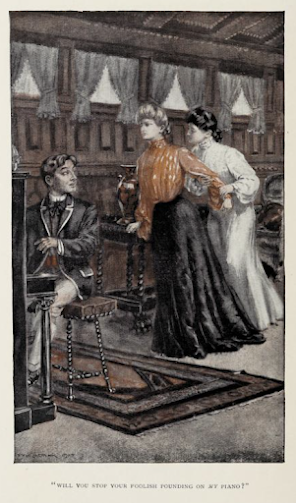
A Francis P. Wightman illustration from the 1905 Methuen edition.

Understandably, any interest Tremorne had for Gertrude shifts to Hilda. But do not be confused, Gertrude is the titular character.

A confession: I purchased The Tempestuous Petticoat for its title, taken from Robert Herrick's 17th-century poem 'Delight in Disorder':
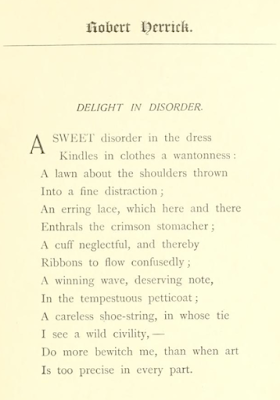
from Elizabethan Songs "in honour of love and beautie"
Edmund Henry Garrett, ed
London: James R. Osgoode, McIloine & Co., 1891

I'd hoped that the novel might prove ribald and naughty; something unique in Victorian Canada. Sadly, The Tempestuous Petticoat is typical Barr, as recognized in the pages of The Bookman (April 1905): 

There are some authors whom it hardly seems necessary to review. They are definitely "placed" by their previous work. The reader knows exactly what to expect; a particular book may be a little above or below the general average, but it is unlikely either to surprise or disappoint. Among the number of these writers whose works may be taken on trust, Mr. Barr may certainly claim a place. It must be years since he wrote a bad novel, if indeed he ever wrote anything approaching a bad novel, but it is equally unlikely that he will ever produce any work much above the average level of its predecessors. The faithful reader can go to the circulating library and ask for Mr. Barr's "latest" with the comfortable assurance that he will not be disappointed. In a now famous phrase, "those who like this sort of thing will find the sort of thing they like," or in other words, those who like Robert Barr will like "The Tempestuous Petticoat." This may sound like faint praise, but in deference to Mr. Barr's numerous admirers we hasten to add that we ourselves are amongst that number.

Not a bad novel, The Tempestuous Petticoat is very much on par with the Barr's other work; Revenge! rises above, In the Midst of Alarms is a touch below, while 'One Day's Courtship' and 'The Heralds of Fame' rest on the very same plane. This means that it is superior to most Canadian novels of the time. Anyone looking for a silly, well-written diversion with plenty of flirtatious banter will be satisfied; anyone looking for sweet disorder in the dress will not.

Still, I do like the title.

Object: An unassuming petite edition in dark blue boards, ideal for a lady's handbag or gentleman's waistcoat pocket, my copy is the eighteenth title in Collins' "'Handy' Modern Fiction" series. According to the publisher, "'Handy' Modern Fiction" was "the greatest revolution the world has ever witnessed."

Robespierre, Washington, Lenin, and Mao Zedong take note.

Surprisingly, for something so cheap, the title page (top of post) and frontispiece (below) are in full-colour on glossy paper.

Object and Access: I've yet to find evidence that this novel was ever serialized. If true, The Tempestuous Petticoat first appeared in June, 1904 as A Chicago Princess (New York: Stokes). Methuen's first British edition followed the next year. My Collins' "Handy" Modern Fiction copy was published in April, 1908. It has been out of print ever since.

If you see them, buy the Stokes or Methuen editions; they have better bindings, clearer type, and each has four colour plates by Francis P. Wightman. 

Sadly, as of this writing, no Stokes or Methuens are listed for sale online. One copy of the Collins edition is on offer at £25.00. Mine was purchased two years ago from an Oxfordshire bookseller. Price £2.00.

Several editions of the novel can be accessed – gratis – at the Internet Archive. I recommend the Methuen.


01 September 2021

The Prince Classics Robert Barr (Monsarrat mentioned)


Prince Classics is new to me, but has quickly become my favourite print on demand vulture. I have it to thank for the introduction to Dutch artist Jac Mars (1919-1992), whose illustration graces the cover of its edition of this Robert Barr novella.

"One Day's Courtship" first saw print in syndication; The Detroit Free Press, for which the author had once worked, was one of the newspapers that paid for the privilege. Set in nineteenth-century Quebec, the novella starts out as social commentary, moves to adventure, and ends as a love story. Jac Mars' illustration, which first appeared in the April 1962 edition of Woman's Realm, has nothing to do with Barr's story. There are no embraces, but one can imagine. My wife, a thirty-year veteran of the fashion industry, informs that the clothing is all wrong, and finds equal fault in Prince Classics' bind-up of "One Days Courtship" and Barr's 1894 novel In the Midst of Alarms:


To those who prefer In the Midst of Alarms on its own, Prince Classics can provide. The image they use, W.T. Brenda's Woman Riding Zebra, first saw print on the cover of Life (30 November 1922).

I remind that In the Midst of Alarms is set in 1866 and concerns the Fenian Raids across the Niagara River into what is today southern Ontario.

No zebras figure.

Longtime readers may remember my disappointment with In the Midst of Alarms. Barr is shaping up to be one of those writers who run hot and cold with me. I didn't think much of One Day's Courtship and The Heralds of Fame (1896), but remain enthusiastic about Revenge!(1896), The Unchanging East (1900), and The Triumphs of Eugène Valmont (1906)Prince Classics offers an edition of the last of these three: 


Don't know about that cover. Valmont looks like a down-on-his-luck gumshoe, whereas Barr describes our hero as "dressed in elegant attire, as if he were still a boulevardier of Paris." Here's Valmont, as depicted in the frontispiece of the first edition:


And then we have Prince Classics' pairing of The O'Ruddy (1903) and The Red Badge of Courage (1895). The latter is familiar to millions as Stephen Crane's great novel of the American Civil War. The O'Ruddy is the novel Crane was writing when he died. Robert Barr picked up his fallen pen and finished the novel. 


I've yet to read The O'Ruddy or The Red Badge of Courage, and so step out on a limb in describing the cover of Tekla (1898) as the most incongruous amongst Prince Classics' Barr offerings. A historical romance it's set in the thirteenth century.


Of all Barr books offered by Prince Classics, the one that most tempts is A Woman Intervenes (1896), but only because it recycles a painting by Tom Dunn. 


It was commissioned for the Pocket Books edition of Nicholas Monsarrat's The Story of Esther Costello.*


I'm getting on, but am not so old as to be familiar with the bibliography of Nicholas Monsarrat. It turns out that The Story of Esther Costello was the author's follow-up to The Cruel Sea. When published, in 1952, the novel caused some pearl clutching. Five years later, The Story of Esther Costello was adapted by Hollywood in a film starring Joan Crawford and Rossano Brazzi. From what I understand, the synopsis Wikipedia editor Sky Captain provides is equally applicable to the novel:
With her marriage to womaniser Carlo Landi (Rossano Brazzi) in ashes, wealthy and childless Margaret Landi (Joan Crawford) finds an emotional outlet in patronizing a 15-year-old deaf, dumb, and blind Irish girl named Esther Costello (Heather Sears). Esther's disabilities are the result of a childhood trauma and are psychosomatic rather than physical. As Costello makes progress with Braille and sign language, she is seen as an example of triumph over adversity. Carlo gets wind of Margaret's new life and re-enters the scene. He views Esther as a source of cheap financial gain and arranges a series of exploitative tours for her under a mercenary manager Frank Wenzel (Ron Randell). One day when Margaret is absent from the Landi apartment, Carlo seduces and rapes the now 16-year-old Esther. The shock restores the girl's sight and hearing. When Margaret learns of her husband's business duplicities and the rape, she consigns Esther to the care of a priest and a young reporter who loves her (Lee Patterson). Margaret then kills Carlo and herself.
Good God.

The Vancouver Sun
4 December 1957

If the November 1896 review is anything to go by, Barr's A Woman Intervenes isn't nearly so unpleasant:


I'm keen on reading one of the two.

You can guess which.
* My thanks to Jim Stephenson for identifying the Avati painting. Thanks also to my old pal Chris Kelly, who suggested the former had been used to illustrate a book titled Backstage: My Life with Clarence Darrow, the Amnesiac, and the Red Ladder. Coffee up my nose.

23 August 2021

Double Fantasy


One Day's Courtship and The Heralds of Fame
Robert Barr
New York: Stokes, 1896
219 pages

Novellas both, "One Day's Courtship" and "The Herald's of Fame" were first gathered for book publication with a third tale, "From Whose Bourne." That the resulting volume was titled From Whose Bourne, etc. says much, I think.

"From Whose Bourne" is one of the earliest attempts at marrying the supernatural with what was then the emerging mystery genre. In the story, the spirit of a murdered man, William Brenton, follows the investigation of his widow, Alice, who is accused of having committed the crime.

From Whose Bourne, etc.
Robert Barr
London: Chatto & Windus, 1893

"One Day's Courtship" and "The Heralds of Fame" are lighter fare and aren't nearly so groundbreaking. Both are woven from tired worn threads we continue to today in today's romantic comedies. Each relies heavily on coincidence and unfortunate misunderstandings. Neither is recommended, though both may appeal to those interested in nineteenth-century depictions of artistic and literary life. Lovers of rom coms will find more satisfaction with Netflix.

"One Day's Courtship" concerns landscape painter John Trenton, who returns to Shawinigan Falls – "Shawenegan Falls" in all editions – with the intent of capturing its beauty on canvas. He was first made aware of the natural wonder through a letter sent by an admirer and lesser talent.

Shawinigan Falls, 1904

As it will turn out – I spoil things a bit here – that letter came from a young woman named Eva Sommerton. A very pretty, very wealthy American, Miss Sommerton has hired a canoe and crew to take her to the falls. Owing to a comical mix-up, John Trenton has hired that very same canoe and crew. Each thinks the other the interloper! What's more, neither knows the identity of the other!

You can imagine to possibilities.

"The Herald's of Fame" is lighter still, though I enjoyed it more. It's hero, Kenan Buel, is a young Englishman with two published novels under his belt. Neither did all that well, so it comes as some surprise when American publisher L.F. Brant expresses interest in his third. Brant reads the proofs when visiting Buel's London publisher and pays £20 for the American rights. Because he'd entered negotiations with the expectation of paying £100, Brant gives the author the difference.

It's all too wonderful. Buel now has more money than he's ever had, and so accepts his American publisher's invitation to visit New York. At the dock, the novelist enters W.H. Smith and Sons, where he spies a young woman looking over the "New Books" shelf. She hesitates over Buel's latest before settling on a title written by our hero's idol, the great novelist J Lawless Hodden. Owing to a comical mix-up, that young woman – a very pretty, very wealthy American named Caroline Jessop – finds herself with a copy of Buel's new novel.

Buel himself ends up sharing his ship's cabin with none other than J Lawless Hodden. The latter proves a mean, cheap, and deceitful bastard, and pretends that he paid for a private cabin. Miss Jessop, who just happens to be in the neighbouring suite, overhears the conflict and clasps her hands together in glee at the drama of it all. Of a sudden, Hodden, whose work she'd admired, is out; Buel is her new favourite. And so begins the flirtation.

I found this exchange between Miss Jessop and Mr Buel clever:

“I only wish I could write. Then I would let you know what I think of you.”
     “Oh, don’t publish a book about us. I wouldn’t like to see war between the two countries.”
     Miss Jessop laughed merrily for so belligerent a person.
     “War?” she cried. “I hope yet to see an American army camped in London.”
     “If that is your desire, you can see it any day in summer. You will find them tenting out at the Metropole and all the expensive hotels. I bivouacked with an invader there some weeks ago, and he was enduring the rigours of camp life with great fortitude, mitigating his trials with unlimited champagne.’’
     “Why, Mr. Buel,” cried the girl admiringly, “you’re beginning to talk just like an American yourself.”
     “Oh, now, you are trying to make me conceited.”
     Miss Jessop sighed, and shook her head.
     “I had nearly forgotten,” she said, “that I despised you. I remember now why I began to walk with you. It was not to talk frivolously, but to show you the depth of my contempt!      Since yesterday you have gone down in my estimation from 190 to 56.”
     “Fahrenheit?”
     “No, that was a Wall Street quotation. Your stock has ‘slumped,’ as we say on the Street.”
     “Now you are talking Latin, or worse, for I can understand a little Latin.”
I was never nearly so good at flirting, but imagine my readers are.

For that reason, I cannot recommend.

You heartbreakers have nothing to learn.

Object: A very attractive book with frontispiece by Edmund Frederick (above). Following the two novellas, the publisher tacks on five pages of adverts. The earliest are the most interesting, but only because of the series title:

The twentieth century, then several years in the future, didn't treat any of the titles well. Robert Barr's In the Midst of Alarms, a semi-comic novel of the Fenian Raids, saw no editions in the twentieth century. The same is true for his short story collection The Face and the Mask, despite high praise from Arthur Conan Doyle. The other books are unfamiliar – even the Ouida – but I'd buy I Married a Wife for the title alone. The author's name is a bonus.

My copy was purchased earlier this year from a bookseller in Florida. Price: US$9.95.

Access: Copies of One Day's Courtship and The Heralds of Fame can be found at Library and Archives Canada, the Canadian Museum of History, Bibliothèque et Archives nationales du Québec, and thirty-three of our academic libraries. 

No copies are listed for sale online.

My edition can be read through this link thanks to the good folks at the Thomas Fisher Library and the Internet Archive.

Related post: