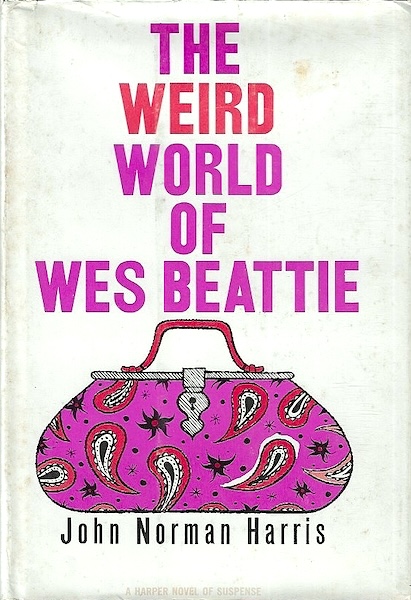
The Calgary Herald, 26 October 1963
The Weird World of Wes Beattie
John Norman Harris
New York: Harper & Row, 1963
216 pages
Wes Beattie was born with a Woolworths spoon in his mouth; father Rupert's came from Birks. The vast difference in fortune is best explained by youthful folly and libido. Rupert had been the favourite son of Toronto's wealthy Beattie family until he had the misfortune of attending a stag party during his sophomore year at Trinity College. There he met a sixteen-year-old tap dancing accordion player named Doreen. She was so unlike the Rosedale girls he'd grown up with that he couldn't help but be captivated. Within nine months, Mr Maggs, Doreen's dad, came calling at the opulent Beattie home demanding money. Ever the romantic, Rupert thwarted the wishes of both sets of parents by marrying Doreen. She gave birth to a baby girl, and Rupert went from golden child to black sheep. Disowned, he became a door-to-door encyclopedia salesman and Doreen turned to drink. When war was declared in 1939, he was only too happy to enlist and be shipped overseas. Son Wes may have been the result of a fond farewell.
Wes Beattie never met his father, though he'd come to know all sorts of very nice servicemen who visited his mother. After Rupert was killed in Italy, his remorseful mother gave Doreen a nice payout and brought the her grandchildren into her home. Jane, the baby girl whose existence had caused the rift, rebelled, while younger brother Wes just wanted his mummy.

Backstory, all of the above is relayed in much more detail – and much more entertainingly – in the seventh of this novel's eighteen chapters. That it comes roughly half-way through the novel, speaks to its complexity.
Wes Beattie himself is a complex character. Though just twenty-three, recent adventures have made his life such a tangled mess that he has drawn the attention of psychiatrist Milton Heber, who lays all out in a seminar attended by doctors, lawyers and social workers. Heber's assertion is that Wes lives in a "weird world" of his own making; he is a fabulist unable to differentiate fantasy from reality. Wes has been charged with two crimes, the first involving a purse he took from a car parked outside the Midtown Motel. He served two months for that offence. The second, much more serious, is the charge that he murdered his beloved Uncle Edgar for fear of being cut out of his will. Lawyer Sidney "Gargoyle" Grant, one of the attendees, is so bothered by a seemingly insignificant detail in Heber's talk that he begins his own investigation.
Grant's efforts bring such small rewards that it would be easy to write at length about
The Weird World of Wes Beattie without revealing much. To detail how it all fits together would take thousands of words. Your time is better spent reading the novel.
The Weird World of Wes Beattie is not "The First truly CANADIAN Mystery" as current publisher claims, but it is one of the very best.
What's more, it will make you laugh.
About the author: The life of John Norman Harris (1915-64) is worthy of a biography; consider the introduction to the John Norman Harris fonds housed at the University of Toronto. Is the "Wooden Horse" escape from Stallaf Ludt III not enough?
The author died alone on 28 July 1964, not one year after The Weird World of Wes Beattie was published, suffering a heart attack during an early morning walk in rural Vermont. This brief bio, attached to the 13 October 1963 Star Weekly bowdlerization of The Weird World of Wes Beattie hints at what we missed.
Trivia I: Though the novel makes much about Wes Beattie facing the gallows, the last execution in Canada took place on December 11, 1962. Capital punishment was abolished for murder in 1976. In 1999, it was abolished for all other crimes.
Trivia II: |
| The Globe & Mail, 14 March 1964 |
Trivia III: Announced by Warner Brothers in 1965 as a forthcoming Merwin Gerard production.
And still we wait.
Trivia IV: John Norman Harris's last address was 45 Nanton Avenue in Toronto's Rosedale, the very same neighborhood in which Wes Beattie is raised.
The house, described in the 17 September 2004 Globe & Mail 'Home of the Week' real estate column as a being of a "rambling English-cottage-style," has had several notable inhabitants. Its first owner, lawyer Edward Brown, was the son of John Brown, who became editor of the Globe after his brother George (Edward's uncle) was shot by a disgruntled former employee.
Future Pearson Minister of Finance Walter L. Gordon lived in the house during the Great Depression, only to leave after a ten percent increase in the rent. It was at 45 Nanton that Harris wrote The Weird World of Wes Beattie, though you wouldn't know that from the Globe piece:
In 1959, it was owned by John Norman Harris, a writer who was also a public relations officer for the Canadian Bank of Commerce, which was poised to merge with the Imperial Bank to form the Canadian Imperial Bank of Commerce.
Mr. Harris offered the home as a venue for the secret negotiations, and the deal was signed in a large second-floor bedroom in 1961.
Bankers in bedrooms! Meeting secretly! Do tell!
The address's connection to things literary doesn't end with Harris. Apparently, playwright Tom Hendry rented a third floor room in the 'seventies. The only reason for the Globe piece is that the house had been put up for sale by children's author Kati Rekai.
This is the house as it was ten years ago.
Note the Heritage Toronto plaque on the fence. It has nothing to do with Harris, Hendry or Reikai, rather J.J.R. MacLeod. Because it's hard to read, I share this template from the Heritage Toronto site.
A man worthy of more than this honour alone.
Object: A solidly constructed hardcover with burgundy cloth and pale orange boards. The endpapers remind that this is a HARPER NOVEL OF SUSPENSE, which explains why the back jacket features no author photo, rather promos for other novels in the series:
Love in Amsterdam - Nicholas Freeling
The Fifth Passenger - Edward Young
A Dragon for Christmas - Gavin Black
It's Different Abroad - Henry Calvin
Access: First published in Canada by Macmillan, in the United States by Harper & Row, and in the United Kingdom by Faber & Faber. I see no evidence of second printings for any of of these editions, though as noted in
the previous post the novel has reappeared a few times through the years, French and Spanish translations included.
The book isn't easily found in Canadian bookstores; online booksellers are your best bet. At £2, the cheapest edition is the 1966 Corgi, listed by a bookseller in Boat of Garten, Scotland who dares charge the equivalent of $35 to ship a mass market paperback to Canada.
The cheapest Faber & Faber edition – "Condition: Good" – is offered at €14.90 by a Dublin bookshop. It will ship to Canada for roughly $24.50.
The Harper & Row, with jacket, can be purchased for US$40 from a New Jersey bookseller.
If I were a rich man, or reasonably comfortable, I'd buy the signed copy of the Macmillan offered at US$150 by a Stoney Creek, Ontario bookseller. There can't be many signed copies out there.
Underpriced, if not sold by this time tomorrow I will be greatly disappointed.
Related post: