Showing posts with label Millar (Margaret). Show all posts

21 December 2025

Dusty CanLit Autumn Reads


What a difference a season makes, twenty-two thousand little hours.

Three months ago, I was bemoaning the slim summer haul.

Well, this past autumn saw reviews of old Canadian books from eleven bloggers other than myself. Twenty-seven titles in total!

It warms the heart on a cold December day. 


I'm torn as to which to recommend most, but you can't go wrong with The InvestigatorThe Magpie or Wild Geese.

Must add that the season also saw the release of Contes de Noël d'antan au Québec, a new anthology edited by Jean-Louis Lessard of Laurentiana fame. It can be purchased here through Archambault. Better yet, buy it directly from the publisher Éditions GID.


Félicitations, Jean-Louis!

22 April 2025

The Man with the Midas Touch


Sword of Desire
Robert W. Tracy [Alvin Schwartz]
New York: Arco, 1952
176 pages

As far as I can tell, "Fort Crime!" is the first Alvin Schwartz story I ever read. It concerns a criminal organization that uses heavy artillery in committing crimes. Superman, Batman, and Robin figure.


"Fort Crime!" first appeared in published in World's Finest Comics #71 (September-October, 1954). I read the story when it was reprinted twenty years later in World's Finest Comics #224 (August 1974).


Alvin Schwartz had long since walked away from comics by the time I caught up with him, but in 1954, when "Fort Crime!" first appeared he was still very active in writing for the comics. He was just as active in 1952, the year Sword of Desire saw print, churning out stories for Batman, SuperboySuperman, and the Superman daily comic strip.

Sword of Desire is not for children. It opens on the meeting of a senate committee looking into a "white slave" syndicate. The most recent witness, a woman who wore a clinging black silk dress and "gracile lizard skin pumps" – much is made of this – has been found naked and dead in a vacant lot. Senator Kingarden, who heads the committee, has had enough:
"Let's stop acting like a collection of sanctimonious old women poking Puritanically around the outer edges of wickedness. Let's be realistic and recognize that you don't investigate a crime by turning up your noses at the smell. If it's our business to legislate, then we can't afford to be so refined that we regard our noses as mere facial ornamentation. We've got, if I may say so, a genuine stink on our hands and the sooner we use the natural organs that God gave us for dealing with it, the sooner we'll get results."
Tough talk, though it is clear that Kingarden has no intention of bringing fellow senators' noses or other organs an inch closer than need be. Instead, he proposes that psychoanalyst Dr Genorius Veresi be brought in to help with the investigation by going undercover as a john. There is some pushback from committee members, though not nearly so much as one might expect.

"One of those rare geniuses of healing that has come out of the new schools of psychology which regard sex as the basis of all man's inner desires," Veresi is a controversial figure who employs unorthodox methods. Schwartz hints that the doctor restricts his practice to married women who have little or no sexual desire. The doctor's treatment, which comes from years of intense study, involves a fleeting touch that unleashes sexual desire.

It's not what you think, nor is it wear you think. In the first case, Veresi grazes the underside of a patient's wrist.  

Consider it a superpower. The doctor uses it to induce women in the syndicate to reveal all.

There were many points at which I nearly gave up on this novel. The whole thing seemed so silly and, to be completely honest, the sex scenes were mild in the extreme. Still, I'm glad I made the effort.

It was, I think, in "Contact Two," the sixth chapter of sixteen, that something twigged. I recalled something about Wilhelm Reich, "orgone energy," and "orgone theory," which were all the rage in the post-war years. I'm fairly certain I skimmed over something about it all in university. I next came upon a 2005 online response to a query in which Schwartz describes Sword of Desire as a "take-off on Reichian Orgone psychology." That he seemingly felt the need to explain suggests limited appeal for today's reader, Reichians excluded. 

I will say that after "Contact Two" things really begin to pick up, even for those who know little of Reichian theory. It's here that Sword of Desire becomes a true detective story.

As might be expected, a woman proves to be both Veresi's Kryptonite and his Lois Lane.


Sword of Desire was read for the 1952 Club, co-hosted by Kaggsy and SimonOther books from 1952 I've read and reviewed here over the years include:

Of these, the one I most recommend is Vanish in an Instant, which is one of my very favourite Margaret Millar novels. She wrote so many!


I would be remiss in not also praising Murder Over Dorval by the mysterious David Montrose (Charles Ross Graham), which I helped return to print as part of the Véhicule Press Ricochet Books series. Coincidentally, I'm now involved in reissuing another of the titles listed above.


More to come! 
Object:
A red hardcover wrapped in a jacket with uncredited illustration. The novel itself is followed by  several pages of Arco promo material, six of which flog "ARCO SOPHISTICATES." The first title listed is Touchable, Schwartz's 1951 Arco collaboration with Lee Scott. It's the first Alvin Schwartz novel I ever read.

Access: Published once, then never again, McMaster and the University of Toronto have it in their holdings.

I purchased my copy two years ago as part of a lot of twelve Arco books. There were only two I wanted, the other being Alvin Schwartz's Man Maid (New York: Arco, 1952), but the price was right at an even US$100. At the time, two copies of Sword of Desire were listed online, the cheaper being US$100!

Never mind! As I write this, just one copy of Sword of Desire is listed for sale online. The price is a mere seven quid! Get it while you can!

Related posts:

26 December 2023

The Best Reads of 2023: Publishers Take Note


The season brings a flurry of activity, which explains why I haven't posted one review this month. Still, I did manage to tackle twenty-four neglected Canadian books in 2023, which isn't so small a number. James De Mille's A Strange Manuscript Found in a Copper Cylinder (1888) was the oldest. Were I judging books by covers it would've been considered the finest. James Moffatt's The Marathon Murder (1972) was the youngest and ugliest. But then, what can one expect of a book that went from proposal to printing press in under seven days.

De Mille's dystopian nightmare is available from McGill-Queen's University Press as the third volume in the Centre for Editing Early Canadian Texts series.  

I first read the novel back when it was a McClelland & Stewart New Canadian Library mainstay. New Canadian Library is no more; it was killed by Penguin Random House Canada. McClelland & Stewart – "The Canadian Publisher" – has been reduced to an imprint owned by Bertelsmann SE & Co. KGaA, but that hasn't prevented the German conglomerate from trying to make a buck – two bucks to be precise – selling it as an ebook.

Dystopia.

Three other books covered here this year are also in print, but from American publishers:

The Weak-Eyed Bat - Margaret Millar
New York: Doubleday, 1942
New York: Syndicate, 2017
The Cannibal Heart - Margaret Millar
New York: Random House, 1949
New York: Syndicate, 2017

The Heart of Hyacinth - Onoto Watanna [Winnifred Eaton]
New York: Harper, 1903
Seattle: University of Washington Press, 2000
I'm wrong,  The Heart of Hyacinth is by far the best-looking book read this year; it was also the very best novel I read this year.

Note to Canadian publishers: Winnifred Eaton's novels are all in the public domain. 

What follows is the annual list of the three books most deserving of revival: 

Pagan Love
John Murray Gibbon
Toronto: McClelland &
   Stewart, 1922

A novel penned by a man who spent his working life writing copy for the CPR,  Pagan Love provides a cynical look at public relations and the self-help industry. Add to these its century-old take on gender bending and you have a work unlike any other.

Dove Cottage
Jan Hilliard [Hilda Kay
   Grant]
London: Abelard-Schulman,
   1958 

The fourth of the author's six novels, this once centres on a man, his wife, and his mother-in-law, whose lives are elevated by way of an inheritance. Black humour abounds!

The Prairie Wife
Arthur Stringer
London: Hodder & Stoughton, [n.d.]


The first novel in Stringer's Prairie Trilogy. Dick Harrison describes it as the author's "most enduring work," despite the fact that it hasn't seen print in over seven decades. I'd put off reading The Prairie Wife because I have a thing against stories set on "the farm." What a mistake! An unexpected delight!


Last December's list of three featured Grant Allen's Philistea (1884), Stephen Leacock's Moonbeams from the Larger Lunacy (1915), and Horace Brown's Whispering City (1947). 


Ten months later, Whispering City returned to print as the eighteenth Ricochet Books title. Yours truly provided the introduction. It can be ordered through the usual online booksellers, but why not from the publisher itself? Here's the link.

As for the New Year... well, I'm back to making resolutions:
  • More French books (and not only in translation).
  • More non-fiction (and not only the work of crazies). 
That's it.

Keep kicking against the pricks!

Bonne année!

Related posts:


14 August 2023

Margaret Millar's Muskoka Murder Mystery


The Weak-Eyed Bat
Collected Millar: The First Detectives
Margaret Millar
New York: Syndicate, 2017

My aunt and uncle had a cottage on Bell's Lake, not far from Markdale, Ontario. I have memories of visiting as a child. Our journeys there would begin with the loading of the family Volkswagen Squareback in Montreal. The final leg had us on a narrow dirt lane at the end of which were four other cottages. I thought of these summer retreats while reading The Weak-Eyed Bat. Millar's setting is Ontario's Muskokas, roughly 150 kilometres northeast of Bells Lake, but it seemed very familiar.


The Weak-Eyed Bat was Margaret Millar's second novel. It followed The Invisible Worm, which I read five years ago. I didn't like The Invisible Worm, and really disliked Paul Prye, its protagonist psychologist/sleuth. Prye makes his return here, hence this delayed visit to cottage country.

I'm glad I made the journey. 

The Weak-Eyed Bat takes place within a small isolated grouping of summer homes like the ones on Bell's Lake, the exception being a large house belonging to Emily Bonner. A man of modest means such as myself might consider it a mansion. Unlike the neighbouring cottages, this Musoka residence is occupied year-round. Miss Bonner lives there, as do nephew Ralph and two servants. At twenty-three, Ralph has a hankering to "go out into the world," but Aunt Emily holds the purse strings. Remarkably, given his milquetoast demeanor, Ralph has proposed to summer neighbour Joan Frost, daughter of classical Greek scholar Professor Henry Frost. Joan's acceptance has everything to do with the aforementioned Bonner purse; she is very aware that it will one day come into Ralph's hands. In the meantime, eighteen-year-old Joan is happy to carry on with Tom Little. Another neighbour, middle-aged Tom had himself married for money. Since that time, plain Jane wife Mary has endured years of infidelity and, as seems appropriate, developed a severe heart ailment.

These are but five of the cast of characters living within this small community; Other residents include: Susan Frost (Joan's half-sister), Miss Alfonse (Emily Bonner's nurse), Jeanette (Mary Little's nurse/housekeeper), Nora Shane (a landscape painter), a "Mr Smith," and, of course, Paul Prye.

This Paul Prye is a different man than the one introduced in The Invisible Worm. Much of what made his so irritating in his debut is gone.  He no longer quotes Blake. Prye does quote Browning's 'Andrea del Sarto,' the source of the title, but that's nearly it:
          Too live the life grew, golden and not grey, 
          And I’m the weak-eyed bat no sun should tempt
          Out of the grange whose four walls make his world.
          How could it end in any other way?
Current publisher Syndicate does a disservice in describing Prye as a "poetry-quoting psychologist."


That was the old Prye.

The Weak-Eyed Bat is nowhere near the best of Margaret Millar, but it is worthy of attention in that it shows Millar becoming Millar. Things unfold more slowly than in her debut. It isn't until the last sentence of the fourth chapter (of eighteen) that the reader learns a character has died. The end of chapter five gives some suggestion as to who it might be. The identity is revealed in the sixth chapter, accompanied by evidence that the character has been murdered.

These discoveries come a touch early for a Margaret Millar novel, but then The Weak-Eyed Bat was only her second. She was finding her legs. Still, it is long enough for Millar to introduce and flesh out and make memorable characters, no matter how minor. My favourite is Emily Bonner, in part because she pretends to be much older than her 65 years so as to receive compliments on her appearance.

It's a neat trick.

Must remember it if I ever find myself swimming again at Bell's Lake.

Trivia: As with The Invisible Worm, the contract for The Weak-Eyed Bat names husband Kenneth Millar as co-author.


Object and Access: The Weak-Eyed Bat was first published in 1942 by Doubleday. It reappeared two years later in Two Complete Detective Books magazine (May 1944). A Spanish translation, El murciélago miope, which Google translates as "The Myopic Bat," was published by Club del Misterio in 1948.


And that was it until 2017 when it was returned to print beside The Invisible WormThe Devil Loves MeWall of Eyes, and The Iron Gates in the first volume of the Collected Millar.

06 February 2023

A Woman Cheated


The Cannibal Heart
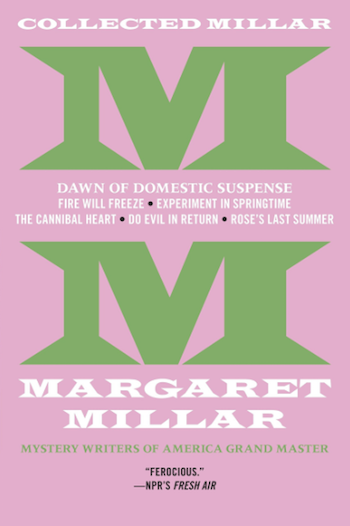
Collected Millar: Dawn of Domestic Suspense
Margaret Millar
New York: Syndicate, 2017

In Margaret Millar's bibliography, The Cannibal Heart falls between It's All in the Family and Do Evil in Return. As a light and lively novel for children, the former is her most unusual; the latter, which deals with the tragic consequences of a refused abortion, is both her most controversial and most timely. The Cannibal Heart isn't so noteworthy. Of the fourteen Millars I've read to date, it ranks below the average, which is to say that it is merely very, very good.

The novel takes place almost entirely on the grounds of a large California oceanfront estate rented by the Banners: Richard, Evelyn, and their active eight-year-old daughter Jessie. The property belongs to a Mrs Wakefield, whose efforts to sell have been thwarted by a draught. Her employees, cook Carmelita and caretaker husband Carl, live with their adolescent daughter Luisa in a three-room apartment above the garage.

Someone spoken of, but not seen, Mrs Wakefield grows as a figure of mystery in the initial chapters. She at last appears as an attractive thirty-something widow worthy of sympathy. In the space of the previous two years, Mrs Wakefield has lost her husband John, as well as Billy, their only child. John was a naval engineer, a wealthy man whom Mrs Wakefield met as a schoolteacher from a small Nebraska town. Their child, Billy, was... well, let's say Billy is revealed gradually. 

But then things in Millar novels are always revealed gradually.

It's suggested that the Banners have come from the East Coast to recover from some sort of domestic disturbance. Might Evelyn's issues with jealousy be related? Even when alone, Evelyn and Richard maintain the pretence that the move has to do with expanding Jessie's horizons.

We come to know Mrs Wakefield intimately. The life she shared with her husband is something of a blur, but her experience giving birth to Billy and the days that followed are too clear for comfortable reading.

As always, Millar delves deeply into the inner lives of its characters, children included. Fifteen-year-old Luisa, a minor character (no pun intended), is a good example. Like most teenagers, she dreams of life far from her parents. In her fantasies, she's a singer with beautiful blonde hair, fawned over by handsome men with lots of money. But this can never happen in the way she imagines. Reality intrudes, reflected in the words of her father, who recognizes that she has been born "half-mulatto, half Mexican."

Syndicate Books, Millar's current publisher, lists The Cannibal Heart as a novel of suspense. It isn't. The Cannibal Heart belongs with Experiment in Springtime and Wives and Lovers, the two (and only two) novels the publisher categorizes as "OTHER NOVELS." As I wrote in a previous review, in these people do bad things; as do we all. While the reader might anticipate murder – after all, Millar was a mystery writer – nothing of the kind occurs. No character commits a criminal act, though one comes close. That that same character is the most sympathetic, most wronged, and most cheated, leads me to wonder whether I'm not right to thinking The Cannibal Heart below average Millar.

Dedication:
"For an old friend, a fine critic, and an ever-imaginative angler, Harry E. Maule."
An editor at Random House, Harry Edward Maule (1886-1971) accepted Millar's 1956 Edgar Allan Poe Award for Beast in View.

Object and Access: A bulky trade-size paperback, Dawn of Domestic Suspense is the second in the attractive (if cramped) seven-volume Collected Millar. The Cannibal Heart was the last to be read; the others have been reviewed in previous blog posts:
The Cannibal Heart is the ninth of Margaret Millar's twenty-six novels. It was first published in 1949 by Random House; Hamish Hamilton issued a British edition the following year. The Random House jacket (above right) better reflects the novel.


The Cannibal Heart was not a commercial success. It had spent over three decades out-of-print when, in 1985, International Polygonics issued the first paperback edition. A Thorndike large print edition followed fifteen years later.

As might be expected, The Cannibal Heart is uncommon in our public libraries. That serving Kitchener, the city in which Margaret Millar was born, the city in which she was raised, the city in which her father served as mayor, does not have a copy.

The Collected Millar remains in print. Used copies of The Cannibal Heart listed online begin at €6 (a first edition lacking jacket). At US$225, the most expensive is the same edition in "fine, bright dust jacket." Do not read the bookseller's description as there is a spoiler. 

The Cannibal Heart has enjoyed two translations: French (Le coeur cannibale) and German (Kannibalen-Herz).

08 March 2020

10 Canadian Books for International Women's Day


One Canadian man recommends ten unjustly neglected novels by ten Canadian women:

The Midnight Queen
May Agnes Fleming
1863

A gothic tour de force by the country's first bestselling author, The Midnight Queen has it all: the Black Plague, the Fire of London, a killer dwarf, prostitutes playing at being aristocrats, and a clairvoyant who has nothing more than a skull for a head.
Marion: An Artist's Model
Winnifred Eaton
1916

I was torn between recommending this and the author's later novel "Cattle" (1924). Marion won out as a roman à clef that reveals much about her family – surely the most remarkable in Victorian Montreal.

Up the Hill and Over
Isabel Ecclestone Mackay
1917

A story of cocaine addiction, opium addiction, love and loss in small town Ontario. Social historians may find Mackay's Blencarrow (1926), in which domestic abuse figures, more interesting, but this novel has the better plot.

John
Irene Baird
1937

A quiet, understated, pastoral novel, this wasn't quite my thing. I include John because it was so well received in its day, and in recognition of those drawn to quiet, understated, pastoral novels. By the author of Waste Heritage.
Do Evil in Return
Margaret Millar
1950

Margaret Millar ranks with husband Kenneth as being amongst the greatest Canadian writers of her generation. The plot is driven by a woman doctor's refusal to perform an illegal abortion. Do Evil in Return is remarkable for its time.
Shadow on the Hearth
Judith Merril
1950

A Cold War nightmare, Merril's debut novel centres on what happens to a nuclear family when the bombs begin to fall. The novel is not so much about war as it is the way governments use crisis to control their citizens.

The Cashier [Alexandre Chenevert]
Gabrielle Roy
1954

Another novel written under the influence of the Cold War, Alexandre Chenevert was to have been the follow-up to Bonheur d'occasion, but ended up as Roy's third novel. A story filled with angst and fear, it almost seems more suited to today.

M'Lord, I Am Not Guilty
Frances Shelley Wees
1954

A novel of domestic suspense centred on a woman's attempt to clear herself of her husband's murder. Set in post-war suburban Toronto, cocktails and adultery figure.

Best Man [Doux-amer]
Claire Martin
1960

A tale of obsessive love set within the publishing world, Martin's protagonist is an editor who falls hard for aspiring novelist Gabrielle Lubin. As a writer, she's not much good, but his work transforms her into a critical darling.
A Stranger and Afraid
Marika Robert
1964

The author's only novel, on the surface it concerns a woman who finds refuge in Canada after the horrors of the Second World War. Below the surface, it's about sexual expression and the protagonist's attraction to sado-masochism.


Related posts: