Showing posts with label Gothic novels. Show all posts

19 October 2024

Darkness on the Edge of Town


Barnabas, Quentin and the Crystal Coffin
Marilyn Ross [W.E.D. Ross]
New York: Paperback Library, 1970
157 pages

The back cover poses a question: 


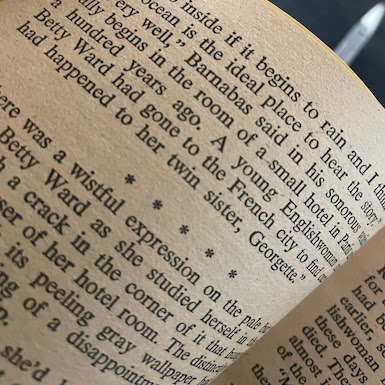
Knowing nothing about Betty Ward, I was stumped. What's more, I wasn't at all sure about Collinwood and its evil forces. Dark Shadows, the gothic soap that spawned this novel, was cancelled when I was eight. All I knew about the series came from a Gold Key comic bought when I was nine:


The featured story is titled "The Thirteenth Star." I remember it as my introduction to the Golem. After that, I thought no more about Dark Shadows for a half-century. My interest as an adult has to do with the discovery that Dan Ross, who penned Barnabas, Quentin and the Crystal Coffin and the thirty-one other Dark Shadows novels, was a son of St John, New Brunswick.

My childhood memories of Collinwood being in Collinsport Bay, Maine proved correct. It's the family home of the Collins family, Barnabas Collins being the oldest member. As a vampire, I suppose he might be considered one of the house's "EVIL FORCES," though he proves every bit the gentleman when accompanying pretty blonde Carolyn Stoddard. One of Barnabas's youngest relatives, Carolyn is keen on visiting the ruins of Frene Castle, located on the vast Collinwood estate bordering the town of Collinsport Bay.

Carolyn Stoddard (Nancy Barrett) and Barnabas Collins (Jonathan Frid) in Dark Shadows episode #351, broadcast 30 October 1967.
"Tell me about Frene Castle and the Frenes," says Carolyn. Barnabas begins, is interrupted by six asterisks, and then an omniscient narrator takes over.
      

Aptly named London orphan Betty Ward is at the centre of the story. She and twin sister Georgette have been under the care of Reverend Prit since their parents died. Bumbling and ineffective, he hasn't been the best of guardians. Prit's opposition to Georgette's desire to study art in Paris was easily overcome and he's heard little from the girl since. Betty, who is more on the ball than the clergyman, gleams through letters home that her sister is falling in love with American sculptor Jeremy Frene; still, their elopement takes her by surprise.

Georgette and Jeremy set sail for his home at Frene Castle. Meanwhile, Betty makes for Paris because she wants to investigate whatever went on before the newlyweds departed. The fact-finding mission doesn't make much sense, though it does bring the very best scenes of the novel. My favourite has to do with an artistic dwarf named Dulez who has been commissioned to create a wax sculpture of Georgette for wealthy French Count Lissay, whom she had rebuffed.

Dulez imprisons Betty because a warm, living, flesh and blood likeness of Georgette is much better than a waxwork, right? Won't the Count Lissay be pleased!

Betty is rescued by Quentin Collins of the Collinsport Bay Collinses. He's the novel's most physically attractive male, though as anyone familiar with the television series will tell you, Quentin is both a bad boy and a werewolf.

For reasons unknown, Quentin does his best to dissuade Betty from setting out for the New World and Collinsport Bay. Failing this, he books a passage on the very same ship, then begins terrorizing his fellow passengers.  

Writing propels the plot with sentence structures that would have not passed muster in my high school English classes:
She didn't refer to it again. But when she was back in her own cabin doing the last of her packing she did think of that bandaged hand. And an odd thought flashed through her mind. The sailor on deck claimed he had shot the werewolf in the front right paw. She stood frowning into space for a moment. And this morning Quentin appeared with a bandaged right hand? Could there be any connection between the two things?
     She at once decided there couldn't.
Barnabas, Quentin and the Crystal Coffin is one of thirteen – thirteen! – "Marilyn Ross" Dark Shadows novels published in 1970. That not one is based on the soap's storylines makes the accomplishment all the more impressive.

Betty Ward wasn't a character in the television series. She exists only in this novel, making the question posed on as the back cover a bit unfair.

Carolyn Stoddard, of course, was a character in the television series. She was born and raised raised at Collinwood, yet in this novel had not so much as seen the ruin of Frene Castle. And so, I have a question of my own:
JUST HOW LARGE IS THE COLLINWOOD ESTATE?
Object: A mass market paperback. The novel itself is followed by three pages of adverts for "Other Great Gothics By Marilyn Ross," along with My Life With Jacqueline Kennedy by Mary Barelli Gallagher. My signed copy was purchased last year as part of a lot of twelve Marilyn Ross Dark Shadows paperbacks.


Access: The Popular Library edition enjoyed a single printing. As of this writing, fifteen copies are listed for sale online ranging in price from US$5.00 to US$24.50.

Condition is not a factor.

This collector, who suffered gouging in the purchase of the aforementioned lot of Dark Shadows paperbacks, notes:
  • A California bookseller is charging US$50.00 to ship his US$13.41 copy to Canada. 
  • A Texas bookseller is charging US$13.01, then asks US$100.00 for shipping.
USPS First-Class International Package Service from their addresses to mine is US$17.00.

Caveat emptor!


10 July 2023

The Witch is Back; or, Cousin Cousine Cousine


A Daughter of Witches: A Romance
Joanna E. Wood
[n.p.]: Luminosity, [n.d.]
241 pages

Of all the books read these past twelve months, not one haunts so much as Joanna E. Wood's 1894 debut novel The Untempered Wind. It tells the story of Myron Holder, an unwed mother who dares raise a child in Jamestown, a provincial village located somewhere in the Niagara Region. To this reader, it is earliest example of Southern Ontario Gothic, holding every characteristic of the sub-genre; Protestant morality and hypocrisy are paramount.

Types of Canadian Women
Henry J. Morgan, ed.
Toronto: William Briggs, 1903

A Daughter of Witches, is Wood's third novel. It's set south of the border in the New England community of Dole, but make no mistake, this is Wood Country. The accents may differ, but the townsfolk of Dole are every bit as narrow-minded-minded and judgemental as those of Jamestown.

Dole is something akin to a closed community. Its families go back generations, stay put, and generally keep to themselves (see below). From time to time, someone will leave the village and strike out for Boston, the most recent being young Len Simpson.

And now he's dead... so there you go.

Old Lansing has this to say:

"Yes the buryin's to-morrow, and it seems Len was terrible well thought of amongst the play-actin' folk, and they've sent up a hull load of flowers along with the body, and there's a depitation comin' to-morrow to the buryin' and they say there's considerable money comin' to Len and of course his father'll get it. I don't know if he'll buy that spring medder of Mr. Ellis, or if he'll pay the mortgage on the old place, but anyhow it'll be a big lift to him."

No one in Dole is the least bit curious as to how Len acquired such wealth. The general consensus is that he was a disgrace to his family. It's whispered that he drank. 

News of Len Simpson's death coincides with the arrival of Sidney Martin, son of Sid Martin. Decades earlier, Sid left Dole to make a life for himself in Boston. He did something there, no one knows just what, but it is known that he married a woman from a moneyed family.

Sidney Martin's mother and father are now dead. Frail and pale, their son isn't looking too good himself. His countenance and weak physique contrast with raven-haired Vashti Lansing, whose Amazonian beauty and strength – she's first seen wrestling a runaway horse – captures the young man's heart.

The Canadian Bookseller, August 1900

Sidney falls hard for Vashti, but Vashti is in love with her cousin Lansing "Lanty" Lansing. Lanty loves another cousin, fair Mabella Lansing. Cousin Mabella returns his love.

The author passes no judgement on this bizarre love triangle, though she does torture Vashti in having her witness the moment in which her two cousins declare their love for one another.

Vashti is the central character in this romance, yet she is one of least realized characters. I believe this is intentional. Wood describes Vashti as acting on instinct; her will is not entirely her own:

Long ago they had burned one of her forbears as a witch-woman. They said she caused her spirit to enter into her victims and commit crimes, crimes which were naively calculated to tend to the worldly advantage of the witch. Vashti thought of her martyred ancestress often; she herself sometimes felt a weird sensation as of illimitable will power, as of an intelligence apart from her normal mind, an intelligence which wormed out the secrets of those about her, and made the fixed regard of her large full eyes terrible.  

Sidney Martin is so smitten, yet so blind, that he proposes marriage to Vashti on the very same spot Lanty and Mabella become engaged. Vashti's acceptance, which came as something of a surprise to this reader, comes with two conditions, the first being that once married they will live in Dole. The second condition, odd in the extreme, is that Sidney, an agnostic, will become an ordained minister so as to take over from old Mr Didymus, the village pastor.

What is Vashti up to? She does not know herself.

Sidney leaves Dole to study theology in Boston, returning years later as Didymus is dying. The elderly preacher's final act is to marry fiancé and fiancée. 

As the bride had long intended, the newlyweds move into the parsonage and Sidney takes over the ministry. If anything, he is more popular than his predecessor. Sidney's sermons, focusing on the majesty of the natural world, go over well in what is essentially a farming community. This is not to suggest that Sidney and Vashti are immune to town gossip.

As the preacher's wife, Vashti draws resentment in lording over the local ladies, attending their weekly sewing circle in gowns made in Boston. Then there's cousin Lanty – secret object of her affection – who has fallen into drink. Harsh words are spoken of Ann Serrup. "Left at thirteen the only sister among four drunken brothers much older than herself," like Myron Holder in The Untempered Wind, Ann is an unwed mother. Might Lanty be the father?

All this poisonous talk exhausts the patience of Temperance Tribbey, Old Lansing's housekeeper. In one of the novel's many memorable scenes, she takes down Mrs Abiron Ranger:

Temperance spoke with a knowledge of her subject which gave play to all the eloquence she was capable of; she discussed and disposed of Mrs. Ranger's forbears even to the third generation, and when she allowed herself finally to speak of Mrs. Ranger in person, she expressed herself with a freedom and decision which could only have been the result of settled opinion.
     "As for your tongue, Mrs. Ranger, to my mind, it's a deal like a snake's tail it will keep on moving after the rest of you is dead."

Vashti's instinct brings what I believe is intended as the climax. My uncertainty has to do with the scene being nowhere near as memorable as others. It should haunt, but it does not haunt. 

And so, the spoiler:

One Sunday morning, Sidney takes to the pulpit and delivers a sermon unlike any other. More brimstone than pastural, he admonishes his parishioners, pointing out their duplicity, dishonesty, deceit, and deception. Sidney repeats town gossip going back decades, but his words are not his own; they belong to Vashti, a daughter of witches. 

Not a spoiler: 

Vashti's fate is not deserved, nor is Wood's fate as a forgotten novelist.

Bloomer:

"Lanty will take it terribly hard," said the old man musingly. "He and Len Simpson ran together always till Len went off, and Lanty never took up with anyone else like he did with Len." 

Object and Access: A Daughter of Witches first appeared serialized in the Canadian Magazine (November 1898 - October 1899). In 1900, Gage (Canada) and Hurst & Blackett (England) published the novel in book form. I've yet to find a copy of either edition for sale, and so bought this print-on-demand edition.

The Gage edition can be read online here at the Internet Archive.

Related posts:

21 November 2022

A Romance of Toronto: CanLit Most Verbose


A Romance of Toronto (Founded on Fact)
Mrs Annie G. Savigny
Toronto: William Briggs, 1888
229 pages

The first chapter, 'Toronto a Fair Matron,' begins:
Two gentlemen friends saunter arm in arm up and down the deck of the palace steamer Chicora as she enters our beautiful Lake Ontario from the picturesque Niagara River, on a perfect day in delightful September, when the blue canopy of the heavens seems so far away, one wonders that the mirrored surface of the lake can reflect its color.
Dale and Buckingham are the two gentlemen friends. In their sauntering, the former teases the latter for being a bachelor. Dale brags that he has not only wed, but has managed to father a child, whilst friend Buckingham prefers the company of his gentleman's club.

I describe this opening scene because it suggests an intriguing read.

Sadly, A Romance of Toronto is not.

Buckingham has joined Dale, Mrs Dale, their child, and pretty governess Miss Crew on a voyage from New York to Toronto. His presence aboard the Chicora is something of a mystery, but then the same might be said of the Dales and young Miss Crew. All may or may not involve a certain Mrs Gower, who has put to pen "a letter descriptive of Toronto." Dale reads it aloud as the palace steamer approaches Ontario's capitol. Four pages are consumed, these being the middle two:

Cliquez pour agrandir.
A Romance of Toronto is not a long novel but it demands a good amount of time and a great deal of concentration and patience. The reader may feel lost in the early chapters, but will eventually come upon a path. That same path will split in two, and then come together in the final pages.


In her introductory note, Mrs Savigny describes A Romance of Toronto as a novel consisting of two plots.

Dale and Buckingham have nothing to do with either.

The first involves young Charles Babbington-Cole. He knows Mrs Gower through his father, Hugh Babbington-Cole. A widower in frail health, Babbington-Cole père was once engaged to a wealthy Englishwoman. Tragically, the union was prevented through conniving and lies told the bride-elect by the sister of his late wife. The Englishwoman instead married her guardian with whom she had a daughter. When the sister-in-law's malfeasance was exposed Hugh Babbington-Cole and the Englishwoman – identified only as "Pearl" – vow that their offspring will one day wed and together inherit her riches.

And so, Charles Babbington-Cole bids Mrs Gower adieu, embarking for England and a storyline that reads like a very bad imitation of May Agnes Fleming; kidnapping, false identity, forced marriage, and a gothic manor house will figure.

The second plot – much more absurd, yet somehow less interesting – concerns Mrs Gower herself. A woman who has has twice worn the black robes of widowhood, she is cornered into accepting a marriage proposal from Mr Cobbe, by far the most repellent of her social set. Mrs Gower tells Mrs Drew how this came to be in 'The Oath in the Tower of Toronto University,' the novel's sixteenth chapter. This is its beginning:

Cliquez pour agrandir.
Several more pages pass in Mrs Gower's telling, but it comes down to this: Cobbe, who has been pestering Mrs Gower to marry him, fools her into believing that they've become locked in the tower overnight. Fearing scandal, Mrs Gower promises to marry Cobbe if he can only find a way out of their situation. The two descend only to find that the tower door isn't locked, and yet she holds herself to the oath.


Is Mrs Gower doomed to marry Cobbe? Is there not a means through which she can be released from her promise? Might the mysterious woman who has been haunting the grounds of Mrs Gower's home hold the key? The situation is made all the more dire when she meets and falls in love with Alexander Blair, a barrister newly arrived from Scotland.

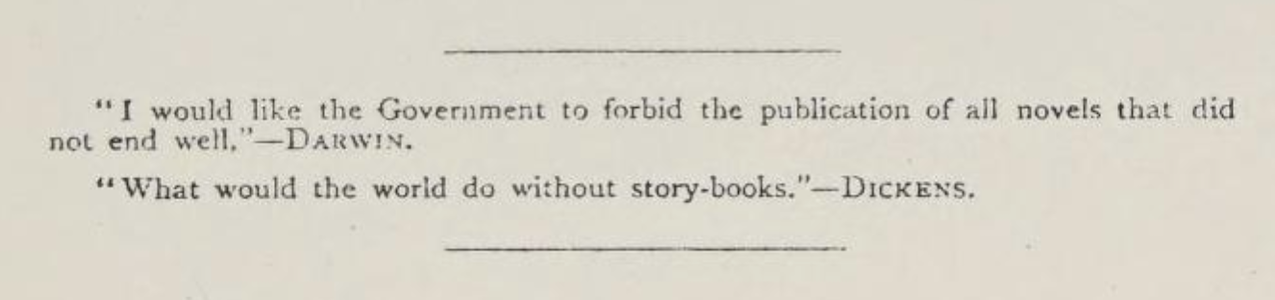
Nothing is spoiled in reporting that all ends happily; the first of the novel's two epigraphs suggests as much.


Mrs Savigny's note makes it plain that A Romance of Toronto (Founded on Fact) is a roman à clef. but who are its models? Her two plots – "one of which was told to me by an actor therein; the other I have myself watched" – are "living facts." Who are the originals?  

A Montrealer, I hope to hear the answer from one of Toronto's fair children.

Trivia: The epigraph attributed to Charles Darwin – "I would like the Government to forbid the publication of all novels that did not end well." – is a false quote. Sleuthing led to the December 3, 1887 number of The Illustrated London News, which cites "Darwin's delightful biography [sic]" as the source. In The Autobiography of Charles Darwin (1887), the naturalist writes of the pleasure he receives from novels, adding: "A surprising number have been read aloud to me, and I like all if moderately good, and if they do not end unhappily—against which a law ought to be passed."

Mrs Savigny attributes her second epigraph – "What would the world do without story-books" – to Charles Dickens. I've not been able to find this quote or anything resembling it outside the pages of her novel.

Trivia II: The University of Toronto is referred to only once as such; "Toronto University" is used throughout the rest of the novel. I asked Amy Lavender Harris, author of Imagining Toronto, about this. She suggests that "Toronto University" might have been used to connote familiarity.

Bloomers: There are two, both expressed by Mrs Gower. The first is upon learning of Charles Babbington-Cole's departure for England:
"Don't you think, Lilian, that the opposite sex is usually chosen to lend an ear?" she said, carelessly, to conceal a feeling of sadness at the out-going of her friend; for she is aware that the old friendly intercourse is broken, now that he has gone to his wedding.
In the second, Mrs Gower is speaking of the man she loves:
"I am so glad he has come into my life: I feel lonely at times; and he is so companionable, I know. What dependent creatures we are, after all—houses and lands, robes a la mode, even, don't suffice. Intercourse we must have."

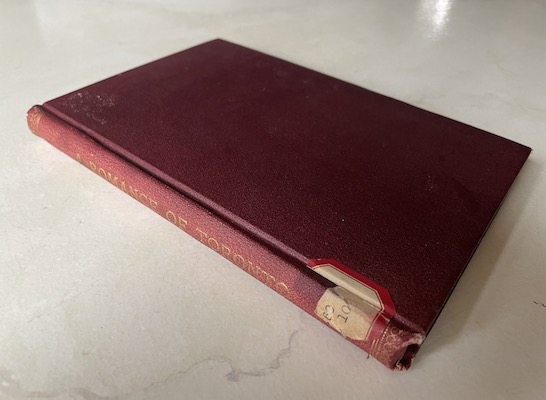
Object and Access: A deceptively slim hardcover. Fifty years after publication, my copy was added to the library of the Department of the Secretary of State. One wonders why. Might it have something to do with the suggestion that A Romance of Toronto is a roman à clef? I'm guessing not, but like to imagine otherwise. 


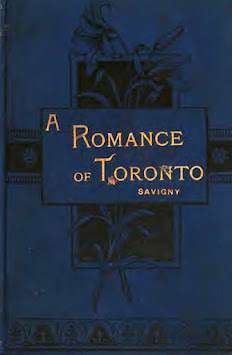
I don't know what to make of the binding, which is markedly different than Harvard University's copy:


I purchased A Romance of Toronto three years ago. As I write this just two copies are listed for sale online. The least expensive – $65 – is "good only." At $247, the alternative is "very fine." Take your pick.

A Romance of Toronto was reprinted in 1973 by the University of Toronto. If anything, that edition is even more rare. Long in the public domain, it continues to be picked over by print on demand vultures. This cover is my favourite by far:


17 August 2022

Dope. Danger. One Doll.


Lost House
Frances Shelley Wees
Winnipeg: Harlequin, 1949
192 pages

Frances Shelley Wees runs hot and cold with me. I liked The Keys of My Prison so much that I selected it for reissue as a Ricochet Book. I did the same with M'Lord, I Am Not Guilty, but disliked No Pattern for LifeThis Necessary Murder, and Where Is Jenny Now?*

So, Lost House? Hot or cold?

The prologue 
is frozen solid. This takes the form of a brief conversation between the head of  Scotland Yard's Criminal Investigations Department and one of his detectives. Apparently, a man known as "the Angel" is up to something in a place known as "Lost House." The detective is dispatched to see what's what:
He rose. "Very well, sir, I'll have a go at it."
Action shifts to British Columbia, where newly-minted physician David Ayelsworth is exploring "the forest primeval" astride his horse Delilah. What David finds is a half-submerged body by the shore of a lake. The doctor's attention is then drawn to the sound of a young woman chasing a dog. She falls, twists her ankle, and he comes to her aid. The injured young woman is Pamela Leighton, who lives at nearby Lost House.

Harlequin's cover reminds me of nothing so much as Garnett Weston's Legacy of Fear (New York: W S Mill/William Morrow, 1950), which also features a grand house in a remote corner British Columbia.

Interesting to note, I think, that both pre-date 
Psycho.

The mysterious D. Rickard is credited with Harlequin's cover art. I make a thing of his rendition because Rickard's Lost House isn't at all as described in the novel. Wees's Lost House rests on a walled island linked to the mainland by causeway and drawbridge. An immense structure, an exact replica of an English country manor, it was built by an eccentric Englishman who sought to further his wealth through a local silver mine. The mine proved a dud, the Englishman died, and all was inherited by Pamela Leighton's mother. Improbably, Mrs Leighton manages to maintain the estate by taking in paying guests during the summer months. This year, they include:
  • James Herrod Payne, novelist;
  • Shane Meredith, tenor;
  • Archdeacon Branscombe, archdeacon;
  • Lord Geoffrey Revel, lord.
There's a fifth male guest, an unknown who is being cared for by Mayhew, the resident doctor. The patient was brought in one night after having taken ill on a train stopped at Dark Forest, the closest community.

(That Lost House has an infirmary speaks to its immensity. That Lost House staff and guests are close in number speaks to Mrs Leighton's financial difficulties.)

There are also four female guests, Lord 
Geoffrey's mother being one, but it's the males that command our scrutiny; after all, we know the Angel to be a man.

Which is the Angel? Which is the Scotland Yard detective? It's impossible to tell. The focus is so much on David and Pamela, and to a lesser extent Mrs Leighton and Dr Mayhew, that the guests are little more than ghosts. The reader encounters them from time to time, but as characters they barely exist. Lost House fails as a mystery for the simple reason that Wees provides no clues. The Angel could be any one of the male guests. Indeed – and here I spoil things  much of the drama in the climax comes when he passes himself off as the Scotland Yard detective. And why not? There's nothing that might lead the reader or the other characters to suspect otherwise.

As the novel approaches mid-point, Pamela apologies to David. "I've dragged you into a dreadful mess," she says. "I've spoiled your holiday..."

This isn't true; David's
 involvement has nothing to do with her. He's at Lost House because the body he found by the lake turns out to be that of a missing Lost House staff member.


Lost House is a dreadful mess. The novel's disorder may have something to do with the fact that it first appeared serialized in Argosy (Aug 27 - Oct 1, 1938). Its fabric is woven with several threads that are subsequently dropped, the most intriguing involving Verve. A new brand of cigarette. Verve is a frequent topic of conversation, as in this early exchange between Pamela and David:  
"You've been smoking a tremendous lot." Her eyes were on the big ash tray before her.
   "Yes."
   "I like Verves," she decided, looking at the tray. "Not as much as you do, apparently... I don't smoke very much though. But when one is a bit tired, a Verve seems to give one exhilaration. Doesn't it?"
   "Yes," David said after a moment, "I... think it does."
   "You say that very strangely."
   "Do I ?" He shifted in his chair. "perhaps I'm a little lightheaded. I've sat here and smoked twenty of them in a row, and they do give one exhilaration. That's... the way they're advertised, of course. But other cigarettes, other things, have been advertised that way, too. Only... this time... and the whole world is smoking Verves. They've caught on extremely well. The whole world."
   She said, troubled, "You are queer."
   "Sorry." He crushed out the cigarette carefully and locked his hands together.
More follows, including a suggestion that the cigarettes have some sort of additive, but the subject is dropped in the first half of the novel. In the latter half, it's revealed that the Angel is using Lost House to store marijuana bound for the United States and United Kingdom. It seems a very lucrative trade. Might the drug have something to with Verve? The question is asked, but never answered.


Lost House was the second ever Harlequin, but the publishers pushed it like old pros.

Dope? Sure.

Danger? Ditto.

Dolls? Well, Pamela is described as attractive in the way prospective a mother-in-law might approve. Wees makes something of her playing around with "the soft pink ruffles of her skirt" when speaking to David in the final chapter. That's sexy, I guess. But Pamela's just one doll. The female guests at Lost House include a sad middle-aged widow who has yet to throw off her weeds, elderly Lady Riley, and two older spinster sister twins who live for knitting. 

Pamela's mother often appears in a lacy negligee, though only before her daughter. Is Mrs Leighton the the other doll?

Back cover copy continues the hard sell:


Pamela does not "land at David's feet, showing more in the process than a nice girl would normally show to a strange male." She wears a heavy skirt that approaches the length of a nun's habit. I add that she has sensible walking shoes.

Lost House is not "a fashionable British Columbia retreat for wealthy guests from all over the world;" it is nowhere so exotic, attracting only the dullest the English have to offer.

At end of it all, I found Lost House neither hot nor cold. It's lukewarm at best, despite Mrs Leighton's negligees.

*In fairness, as a romance novel, No Pattern for Life doesn't fit the Ricochet series. I recommend it as a strange romance.

Trivia I: In the preface to the anthology Investigating Women: Female Detectives by Canadian Writers (Toronto: Dundurn, 1995), David Skene-Melvin writes that the novel's royalties helped finance "Lost House," Wees's home in Stouffville, Ontario.

Trivia II: Like Wees, David is a graduate of the University of Alberta. He and his father practice medicine at the University Hospital, Edmonton. 

University Hospital, Edmonton, Alberta, c. 1938

Object: A very early Harlequin, my copy is a fragile thing. The publisher used the same cover in 1954 when reissuing Lost House as book #245, marking the last time the novel saw print. 

Access: Lost House was first published as a book in 1938 by Philadelphia's Macrae-Smith. The following year, Hurst & Blackett published the only UK edition. In 1940, the novel appeared as a Philadelphia Record supplement.


As of this writing, one jacketless copy of the Macrae-Smith edition is being offered online. Price: US$50.00. I'm not sure it's worth it, but do note that the image provided by the bookseller features boards with yellow writing. I believe orange/red (above) to be more common.

The Whitchurch-Stouffville Public Library doesn't hold a single edition of Frances Shelley Wees's twenty-four books.

11 July 2022

Gothique Canadien


Cameron of Lochiel [Les Anciens Canadiens]
Phillipe[-Joseph] Aubert de Gaspé [trans Charles G.D.
     Roberts]
Boston: L.C.Page, 1905
287 pages

Pulled from the bookcase on la Fête de la Saint-Jean-Baptiste, returned on Canada Day, I first read this translation of Les Anciens Canadiens in my teens. It served as my introduction to this country's French-language literature. Revisiting the novel four decades later, I was surprised at how much I remembered.

Les Anciens Canadiens centres on Archibald Cameron and friend Jules d'Haberville. The two meet as students at Quebec City's Collège des Jésuites. Cameron, "commonly known as Archie of Lochiel," is the orphaned son of a father who made the mistake of throwing his lot behind Bonnie Prince Charlie. Jules is the son of the seigneur d'Haberville, whose lands lie at Saint-Jean-Port-Joli, on the south shore of the Saint Lawrence, some eighty kilometres north-east of Quebec City.

Montreal's Lakeshore School Board – now the Lester B. Pearson School Board – was very keen that we study the seigneurial system.

And we did!

We coloured maps using Laurentian pencils; popsicle sticks and papier-mâché landscapes were also involved. There was much focus on architecture and geography, but not so much on tradition and culture.

We were not assigned Les Anciens Canadiens – not even in translation – which is a pity because I find it the most engaging historical novel in Canadian literature. 

It was through Les Anciens Canadiens that I first learned of Marie-Josephte Corriveau – la  Corriveau – who was executed in April 1763 for the bloody murder of her second husband, Louis Étienne Dodier. Her corpse was subsequently suspended roadside in a gibbet (left). Just the sort of thing that would've caught the attention of this high school Hammer Horror fan.

La Corriveau owes her presence in the novel to José Dubé, the d'Haberville's talkative trusted servant. Tasked with transporting Jules and his "brother de Lochiel" Archie from the Collège to the seigneury, he entertains with legends, folk stories, folk songs, and tall tales. José's story about la Corriveau has nothing to do with the murderess's crime, rather a dark night when "in her cage, the wicked creature, with her eyeless skull" attacked his father. This occurred on on the very same evening in which his dear père claims to have encountered all the damned souls of Canada gathered for a witches' sabbath on the Île d'Orléans (also known as the Île des Sorciers). Says José: "Like an honest man, he loved his drop; and on his journeys he always carried a flask of brandy in his dogfish-skin satchel. They say the liquor is the milk for old men."

Seigneur d'Haberville [Les Anciens Canadiens]
Phillipe Aubert de Gaspé [trans Georgians M. Pennée]
Toronto: Musson, 1929
Les Anciens Canadiens is unusual in that José and other secondary characters are by far the most memorable. We have, for example, M d'Egmont, "the old gentleman," who was all but ruined through his generosity to others. The account of his decent, culminating in confinement in debtors' prison, is most certainly drawn from the author's own experience. And then there's wealthy widow Marie, "witch of the manor," who foretells a future in which Archie carries "the bleeding body of him you call your brother."

The dullest of we high school students would've recognized early on that Archie and Jules' friendship is formed in the decade preceding the Seven Years' War. The brightest would've had some idea as to where things will lead. The climax, if there can be said to be one, has nothing to do with the Battle of the Plains of Abraham, rather the bloodier Battle of Sainte-Foy.

Not all is so dark. Aubert de Gaspé, born twenty-six years after the fall of New France, makes use of the novel to record the world of his parents and grandparents: their celebrations, their food, and their games ("'does the company please you,' or 'hide the ring,' ''shepherdess,' or 'hide and seek,' or 'hot cockles'"), while lamenting all that is slipping away:
In The Vicar of Wakefield Goldsmith makes the good pastor say:
     "I can't say whether we had more wit among us than usual, but I'm certain we had more laughing, which answered the end as well."
     The same might be said of the present gathering, over which there reigned that French light-heartedness which seems, alas, to be disappearing in what Homer would call these degenerate days.
Les Anciens Canadiens is so very rich in detail and story. Were this another country, it would have been adapted to radio, film, and television. It should be assigned reading in our schools – both English and French. My daughter should know it. In our own degenerate days, she should know how to make a seigneurial manor house out of popsicle sticks. 


Object: Typical of its time. As far as this Canadian can tell, what's depicted on the cover is the Cameron tartan. The frontispiece (above) is by American illustrator H.C. Edwards. 

The novel proper is preceded by the translator's original preface and a preface written for the new edition.

Twelve pages of adverts for other L.C. Page titles follow, including Roberts' The Story of Red FoxBarbara Ladd, The Kindred of the Wild, The Forge in the Forest, The Heart of the Ancient Wood, A Sister to Evangeline, By the Marshes of Minas, Earth's Enigmas, and his translation of Les Anciens Canadiens.


Access: Les Anciens Canadiens remains in print. The first edition, published in 1863 by Desbarats et Derbyshire, can be purchased can be found online for no more than US$150.

First editions of the Roberts translation, published as The Canadians of Old (New York: Appleton, 1890), go for as little as US$28.50.

In 1974, as Canadians of Old, it was introduced as title #106 in the New Canadian Library. This was the edition I read as teenager... and the edition I criticized in middle-age. Note that the cover credits the translator, and not the author:


That said, the NCL edition is superior to Page's 1905 Cameron of Lochiel – available online here thanks to the Internet Archive – only in that it features Aubert de Gaspé's endnotes (untranslated).

Les Anciens Canadiens has enjoyed three and a half translations. The first, by Georgians M. Pennée, was published ion 1864 under the title The Canadians of Old. It was republished in 1929 as Seigneur d'Haberville, correcting "printer's errors" and "too literal translation." Roberts' translation was the the second. The most recent, by Jane Brierley, published in 1996 by Véhicule Press. is the only translation in print. It is also the only edition to feature a translation of the endnotes.

Jane Brierley's translation, Canadians of Old, can be purchased here through the Véhicule Press website. Ms Brierley also translated Aubert de Gaspé's Mémoires (1866; A Man of SentimentVéhicule, 1987) and Divers (1893, Yellow-Wolf and Other Tales of the Saint Lawrence, Véhicule, 1990).

Lester B. Pearson School Board take note.

 
Related posts:

01 November 2021

We All Win With May Agnes Fleming!

Who Wins?; or, The Secret of Monksworth Waste
May Agnes Fleming
New York: New York Book Company, 1910
180 pages

A woman trudges by night, babe at breast, though England's bleak marshes and ghastly commons. She begs for rest at Leamington, the nearest town, but her brute of a husband is insistent on making a ship that is scheduled to depart from Plymouth the next day. Yet, upon reaching Leamington, he's drawn to the warm lights of the Vine Inn. He does decide stop – but not before blackening his wife's one unblackened eye. "I'm going in for a pot o' porter, mistress," says he; "wait you here till I come back. The poor woman does just that. Upon her husband's return, she takes up a long, heavy, sharp-pointed stone, "deadly as a dagger," and brings it down on his head:

There was one convulsive bound, one gurgling cry, a spout of hot, red blood, and then—
      The woman turned away with sickening horror from what lay before her. It was very still, too; there was no need to repeat the blow. She flung the stone away, took one last glance at the sleeping child, one last, shuddering gaze at that other still form, then turned swiftly and flitted away into the night.
Time and place shift abruptly to a crowded French vaudeville on the Surrey side of the Thames, where dark-eyed danseuse Miss Rose Adair is giving her farewell performance before returning to Paris. It's the cheapest hot ticket in all of London. A small gathering of slumming military men sit in the more expensive seats:
Very harmless young heroes, their maiden swords still unfleshed — their maiden pistols preserving their pristine glitter — dainty carpet knights, great in the dance, and mighty at the mess-table. They lounged about the boxes, amusing themselves with sarcastic criticisms on their neighbors, while waiting for the curtain to rise.
The most envied of their circle is nineteen-year-old Lieutenant Cyril Paget Trevanion; this has less to do with his striking good looks – he has the proportions of "a muscular Apollo" – than it does with his  future as Lord of Monkswood Hall, Trevanion Park, and heir to an estate with a rental income of £15,000 per annum (roughly £1,830,000 today). In the immediate, young Trevanion has caught the eye of la belle Rose... and she his. Trevanion's fellow officers see short-term fun, but no future:
"A man can not marry his grandmother — no more can he marry a little danseuse, particularly at the innocent age of nineteen. Not but that Miss Rose Adair is pretty enough and sparkling enough to almost warrant such folly. Trevanion’s deucedly spooney about her, but there’ll be no marrying, take my word for it. He comes of a race as proud as the devil.”
What is the connection between these two disparate scenes? Who is the murderess? What happened to her baby? Will Trevanion marry Rose? Can an aristocrat and vaudevillian share a future?

And then there's the title. Who Wins? Against whom? What's the prize?

As in all May Agnes Fleming novels, answers come in time. Who Wins?, being one of her shortest, they come more quickly and are a touch more obvious. This is not to suggest that the standard elements of a Fleming novel are lacking; murder, extreme wealth, extreme poverty, inheritance, disinheritance, secret identities, secret passages, more murder, and romance all figure.

Hermit or hag? There's always one.

In this case, it's the latter.

Much as I'm loath to use the term, I can't help but describe Who Wins? as the most meta of the Flemings I've read to date. This has much to do with the mysterious character Angus Macgregor's occupation as a writer of popular fiction. In this scene, acquaintance Charley Chudleigh stops by for a tongue-wag:
"Busy, as usual?" he remarked, lounging in, looking inexpressibly handsome and cool in his summer suit of spotless linen. "If I disturb the exercises, I'll go." (Macgregor, in the deep, rose-shaded window-seat, was writing.) "Whereabouts are you? Is Lord Charlemagne Charlemount on his knees to the lovely Lady Sleepshanks? Or is the Black Bandit in the act of leaping from the top of the Martello Tower with the shrieking Aureola Pasdebasque in his arms, or has Rinaldo Binaldi, the magnificent hero of the tale, the dazzling son of 'poor but honest parents,' just been consigned to the deepest dungeon beneath the castle moat by that black-hearted scoundrel, the gouty old Marquis of Carabas? Egad! Macgregor, you sensation novelists are tremendous fellows, and play the very mischief with the women's noddles. Say the word, and I'll go; I've the greatest awe of the profession, and wouldn't interrupt a thrilling chapter for countless worlds."
I laughed aloud when reading this passage, in which the valet M François resigns his position:"Mr. Macgregor's valet may seem to have little to do with this veracious history, but Mr. Macgregor's valet was the direct means of bringing about a rapid dénouement."

Who Wins? isn't my favourite Fleming novel – that would be The Midnight Queen –but as I'm learning there is no bad place to start reading her work.

Give Who Wins? a try if you're looking for one of her shorter reads; whether female or male, she will play with your noddle.

Trivia: Google informs that Plymouth is a 317-kilometre hike from Leamington, estimating sixty-five hours of steady walking between spa town and port city. I expect May Agnes Fleming, a New Brunswicker who never visited England, was unaware of this fact.

Object: My copy was purchased last year from a bookseller in upstate New York. Price: US$12.00. It was once owned by a man named Gerald E. Rule ("from Mother"). The title on its cover and spine drop the question mark, but the title page (above) gets things right. Likely the most recent edition, it was published as part of the New York Book Company's Famous Fiction Library. Amongst the other Canadian titles in the Famous Fiction Library, we find only Mrs Fleming's The Baronet's Bride.

Access: Lauren McMullen's invaluable "Checklist of Works by May Agnes Fleming" suggests that Who Wins? made its print debut serialized in Philadelphia Saturday Night (16 April and 23 July 1870). She records a second serialization under the title The Mystery of Mordaunt Hall, which ran anonymously from 16 July 1870 to 1 November 1870 in the London Journal. Prof McMullen notes that the names of settings and characters are altered in the latter serial.*

Prof McMullen's research suggests that Who Wins? may have first appeared as a book published by New York's Surprise Library. No date is given. The earliest edition that can be read online – New York: Munro, 1895 – is here at the Internet Archive. Those looking to purchase a copy online have two choices: a 110-year-old or so New York Book Company bind-up of The Baronet's Bride and Who Wins? (price: US$15.93) or a nearly-equally-as-old paper-covered Street & Smith edition (price: US$25.00).

I'd be torn.

No pun intended.

The Mystery of Mordaunt Hall is not to be confused with another novel of the same title serialized in New Zealand's Thames Star (4 February-14 April 1896). It too was published anonymously.

Related posts: