Pagan Love
John Murray Gibbon
Toronto: McClelland & Stewart, 1922
310 pages
John Murray Gibbon
Toronto: McClelland & Stewart, 1922
310 pages
The start of this novel sees a suicide thwarted. Walter Oliphant awakens to the dawn of a day he'd determined would be his last. He walks leisurely, fully resolved, to the bank of the Thames, where he catches sight of a figure falling into the drink:
Nothing to be seen yes, there a ripple and there a hand stretched out of the waters. It was not a hand that he altogether welcomed, but hands to shake were rare in these days, and so our loiterer stretched out to grasp it. This was foolish, for the grasp of a drowning man is not so easy to escape. The hand that clung to his became an arm and a shoulder and then, by some instinct, our loiterer used his feet as leverage, and pulled out from the stream a Man.The "Man" had been mugged. A wallet had been stolen. A whack on the back of the head had been given. The victim is Frank A. Neruda, a visiting millionaire from New York City.
But this is Walter's tale, and the backstory is not pretty.
Walter had wanted to kill himself because he could not longer stand the pain of starvation. A young poet from Aberdeen, his condition has as much to do with public disinterest in his work as it does the Great War, during which he served as cannon fodder. "The two years of after-the-war had reduced him to atrophied inertia, a
bundle of nerves barely attached to skin and bone."
Neruda takes Walter under a wet wing, slowly nursing him back to health. In doing so, the millionaire seeks to inspire by sharing the Frank A. Neruda Story. It begins with a Czech childhood, a mother's death, and emigration to America. Weeks after arrival, the father is crushed in a Pennsylvania coal mine.
Neruda's ascent begins as an orphaned breaker boy working by oil lamp at that same mine, and leads to a commercial empire valued at ten million American dollars.
A self-described self-efficiency expert, Neruda is intent on remaking Walter. The first lesson takes the form of a performance:
"Have you ever considered what puppets we all are?" remarked Neruda. He was manipulating, on a tiny stage, for Walter's entertainment, a marionette play in which Faust sold his soul to Mephistopheles and became a master of magic, raising spirits from the dead until the Devil came to fetch him, Neruda was so expert with the fantastic figurines, that the Devil himself could not be more inhumanly human."Who is it that holds the strings?" asked Walter."The God of Success for me," said Neruda. "I haven't yet made up my mind whether I am Faust or Mephistopheles.
This is by far the most whimsical scene in the novel. As part of his make-over, Walter is inundated with books and articles. All written in a staccato style, they coach Success:
"As you dress, repeat to yourself inspiring sentences. As you are brushing your teeth, say to yourself firmly:"'Let me never be the Skeleton In the Family Cupboard.'"When you are buckling on your garters, repeat these words three times:'I will not be a Has-Been.I will not be a Has-Been.I will not be a Has-Been.'"When you are tying your necktie, say four times:'Why should I not be a Pierpont Morgan?Why should I not be a Pierpont Morgan?Why should I not be a Pierpont Morgan?Why should I not be a Pierpont Morgan?'"Be god-like in your bearing. Grab off opportunity. Don't be afraid to be a Rockefeller. Learn to talk, and cash in on your conversation. Concentrate on Confidence. Get busy with old Tempus Fugit. Say 'Boo' to worry. Be virile, vital, valiant, versatile, invincible, vigorous. Know yourself for a Giant. Cultivate health, hope, happiness, hilarity, holiness. Prime yourself with pep, pugnacity, psychology and perfection. Purify the soul with purpose and publicity. Vibrate your solar complex. Conserve every moment. Develop your Conscious Cosmos and incarnate your essential quiddity. Put punch into your pith and ginger into your jocosity. Carry on your face the lines of rectitude and integrity. Move among the Brighter Intellects and the Masterfully Tactful. While your dinner digests, read Ruskin's Crown of Wild Olives [sic]. Cultivate Art. You can study Michael Angelo while you are sipping soup."
Neruda and apprentice travel by way of Quebec City to New York where Walter is installed as a staff writer for the millionaire's Aduren Publishing. Walter belongs to the company's House-Organ Department, contributing to publications tailored for corporate interests. Aduren's other half is the Foreign-Language Newspaper Agency. Though there is no communication between the Department and Agency, their raisons d'être are the very same same. Both are intended to mollify workers.
Walter rises quickly through the ranks at Aduren, his income seeming to double every fortnight.
A Success Story!
Before long, Walter is appointed General Editor of the House-Organ Department. He finds himself living in luxury building owned, as he discovers, by Frank A. Neruda. The millionaire demands Walter's time, but there are occasions to slip away.
The Scot has taken a shine to his boss's pretty, plump, petite secretary Beatrice Anderson, a gal from British Columbia who is caring for her dad. Father Tom Anderson is going blind, the result of a mine explosion, and hopes that New York doctors might save his eyesight. The Andersons introduce Walter to a welcoming contingent of Canadian expats: a musician, a singer, a painter, a doctor, and another writer. The sociability is a welcome relief from the Aduren day-to-day; a refuge, that is spoiled when Walter recognizes Neruda's attempts to separate him from Beatrice.
But why?
Anyone thinking of giving Pagan Love a read is advised to stop here.
 |
| The Regina Morning Leader, 4 November 1922 |
The 4 November 1922 Regina Morning Leader carried one of the novel's earliest reviews. For a newspaper, it's unusually long. It's also extremely positive, though its author, Prof William Talbot Allison of the University of Manitoba, expects not all will not share his opinion. He predicts that Pagan Love would "divide the critics and the reading public, to say nothing of Scotsman, New Yorkers, Labor leaders, Czechs, romanticists, moral uplifters, and the fair sex."
I would've thought the same, yet I've not found a single review that isn't enthusiastic about Pagan Love. The following year, the novel was awarded a prix David.
 |
| Le Nationaliste et Le Devoir, 24 May 1923 |
I read this story with avidity to the last line of the last page; in other words, I found it intensely interesting, but if I were at liberty to disclose the plot, which in fairness to Mr. Gibbon and to the readers of his book, I am unable to do, I could register my own personal reactions.
In fact, the professor does share his personal reactions – and the greater percentage of the plot. What Allison doesn't share is anything beyond the first twenty-three (of twenty-nine) chapters.
In 1922, Pagan Love was sold as "A Story of Mystery and Romance with a Surprising Climax."

I have no doubt readers of one hundred and one years ago were surprised. This twentieth-century boy – much younger than Marc Bolan – had the advantage of a twenty-first century viewpoint. The novel's great reveal was unexpected, though it didn't come as a great shock. There were hints, the most interesting being a conversation Neruda and Walter share as they stroll arm-in-arm during outside the Château Frontenac.
At the climax, Frank A. Neruda is revealed as a beautiful woman. In fact, she reveals herself – scantily-clad as Cleopatra for a masquerade ball. Her love for Walter gives the novel its title.
I'll say more because I don't want to spoil every last thing.
 |
| The St Petersburg Times, 18 March 1923 |
The first Canadian edition of Pagan Love was published by McClelland & Stewart. The first American edition was published by transplanted Torontonian George H. Doran. Neither company went back for a second printing. Given the critical reception, I found this surprising; all the more so because there is evidence of controversy.
Pagan Love is a tragedy. Walter may be the protagonist, but at the end of the day it is the story of a woman who must disguise herself as a man so as to achieve wealth and power. As a girl, it was only by pretending to be a boy – a breaker boy – that she was able to place a foot on lowest rung of the ladder that brought her success. I took away this lesson and two more:
It's hard to make an honest buck.
In business, it's who you know.
Personal note: Wikipedia informs that John Murray Gibbon had "a major impact on the creation of a bilingual, multicultural, national culture," yet I never encountered his name in high school. The same can be said about my university years, during which I majored in Canadian Studies and English. The Canadian Encyclopedia informs: "His book Canadian Mosaic (1938) popularized the 'mosaic' as a metaphor for the diversity of 'the Canadian people.' It has since been used by politicians, educators and policy makers to describe the cultural makeup of the country."
In my many decades, I've yet to hear a politician, educator or policy maker reference Gibbon.

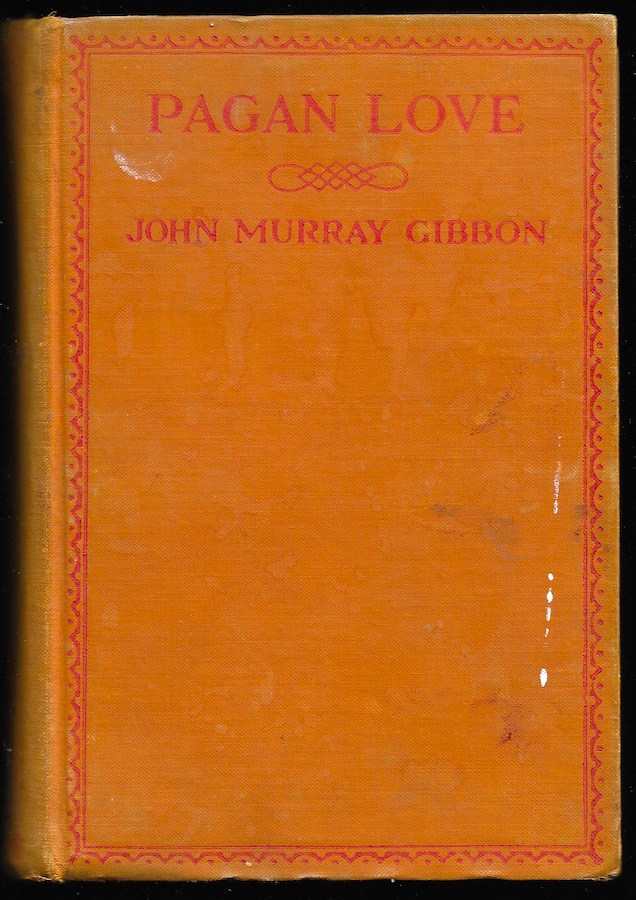
Object and Access: An attractive hardcover, typical of its time, lacking the all-too-rare dust jacket. I purchased my copy, the first Canadian edition, earlier this year from a St John bookseller. Price: US$35. Awaiting its arrival, a Yankee bookseller listed a jacketless but inscribed copy at US$25, but what you really want is an inscribed Canadian first in dust jacket. Offered by a Nova Scotia bookseller, it can be found online at US$250.

I share the bookseller's photo so as to encourage the sale. If that isn't enough, I add that the inscription is addressed to a woman named Beatrice.
The novel has been out of print ever since.
Of all the out-of-print titles I've read, Pagan Love ranks amongst the two or three most deserving of a reissue.
I'm looking to you Invisible Publishing.
I'm looking to you Invisible Publishing.
Related post: