Showing posts with label Glassco. Show all posts

24 August 2026

Looking Back on Lot's Wife


Lot's Wife [La Femme de Loth]
Monique Bosco [trans John Glassco]
Toronto: McClelland & Stewart, 1975
151 pages
De temps à autre, un mot, une phrase, entendus malgré moi, me frappent comme un autre soufflet immérité.
– La Femme de Loth, Monique Bosco, 1970
There was a time in this great land when translations of French-language books were published with near exclusivity in hardcover. There were no second printings and there were no paperback reissues. I'm thinking of titles like In Quest of Splendour (Pierre le magnifique), Orphan Street (Un Chaîne dans la parc), and The Scarecrows of Saint-Emmanuel (L'épouvantail).

Lot's Wife met the very same fate.

I was a child when La Femme de Loth was published. I was an adolescent when it appeared in English translation. I was adult when I first read Lot's Wife. I was an older adult when I wrote Monique Bosco to ask about her working relationship with the translator. This was when I was working on A Gentleman of Pleasure, my biography of John Glassco. The letter I received in response was generous and gracious. She'd had very limited correspondence. Though they were both living in Montreal they'd never met.

I never met Monique Bosco, either. She died two years after posting that letter, just short of her eightieth birthday.

Author photo on the jacket of Lot's Wife.
I wish our correspondence hadn't ended there. She was a remarkable woman and this novel is one of the best to come out of 1970s Quebec. It was an extraordinary decade.

Lot's Wife opens with the narrator addressing a physician. These aren't the very first lines, but they are my favourite:
You're used to passing terrible sentences on people. Your technique is remarkable. First deliver the blow: the illness may be fatal. Then announce the remedy: amputation. The solution is hailed with positive joy. Those condemned to an imminent death are equally "reasonable." As a reward, the pretty joys of the invalid world are danced before them.
Though not obvious at first, the physician was her married lover. He's ended their decade-long affair and has sent her off for two weeks in Venice to recover, as if from surgery. What we're reading is the narrator's writing. She's writing because she cannot sleep. She cannot do anything but write. The text, disjointed and at times confusing, consists of 240 numbered segments that skip back and forth in time. The shortest, not more than two or three sentences, tend to be self-revelatory. The longer touch here and there on past events in her life. The total is addressed to her former lover.

She was the unwanted child of a Jewish mother and Catholic father, both blessed with good looks she did not inherit. Her earliest memories are of Paris. As clouds of the Second World War begin drifting westward, the small family relocates to New York. This proves a disaster for two reasons, the least of which has to do with her parents' broken English and inability to find employment. The second has to do with a dark episode she had always kept hidden.

Fortunes change with a chance encounter with a family friend. This results in relocation to Montreal where the narrator's parents thrive while striving to avoid any and all news of the country they left behind.

As the narrator grows into womanhood and the Nazis occupy Paris, her parents show the first signs of middle-age. Self-absorbed, they cling to what remains of youth with such desperation that they attempt to recast their daughter as more of a friend than a child. Their campaign is cut short when both die in an automobile accident on the way back from a ski trip in the Laurentians. Their adolescent daughter survived because she'd been left alone in their Montreal apartment.

Much of what the narrator writes she's told no one, not even the physician. She shares it now through her writing – the humiliations and horrors of a short-lived marriage included – though she knows it won't make a difference. The only person she has ever loved, the person she still loves, has cast her aside. She goes over her past because she cannot imagine a future. She doesn't want a future:
God was right. Those must be saved who value life enough to flee, following their noses, letting flames devour the wreckage behind them. Lot and his family. His daughters are young, their life is all before them. But for the old wife, it is her whole past that is being swallowed up. So she turns her head, trying to see what is happening – and what has happened. She looks back, breaking the commandment. Poor old woman. In the Bible you have no name. Lot's wife, that was enough.
It's not until the second half of the novel that the narrator reveals that her name is Hélène. The physician's name is Pierre. She was not his wife, though she very much wanted to be.

Monique Bosco published seventeen volumes in her seventy-nine years, consisting of novels, short story collections, and verse. La Femme de Loth is the best known, having received the 1970 Governor General's Award for French-language Fiction. A half-century after publication, Lot's Wife remains the lone translation of her work.

More, please.

Dedication:

Trivia: Curiously, McClelland & Stewart rejected Lot's Wife as the title of the translation and kept pushing the nonsensical The Woman of Lot. The pressure was such that in desperation Glassco offered an alternative: You Found Me Beautiful.

The critic's rave: Glassco's translation was well received. The only negative review I've found came from Pat Barclay. In the 
19 July 1975 edition of the Victoria's Times-Columnist, Barclay writes that it "brings with it the whiff of the original French in its clipped yet dramatically effective phrasing. I found it dreary, depressing, almost maudlin – yet at the same time impressively well planned and presented."

The critic concludes:


Two things:

It's Hélène, not Helene.

No committee "one mad spring day in 1970, decided to select Lot's Wife [here I assume the critic means La Femme de Loth] as the winner of a Governor General's award [sic]" for the simple reason that La Femme de Loth was released in the autumn of that year.

Object and Access: A slim hardcover with black boards and a jacket by David Shaw. Does the woman depicted not resemble Margaret Atwood?

As I write, five copies are listed online with prices beginning at $9.95. Mine was purchased in 1999 from The Word in Montreal. Price: $60.


La Femme de Loth was first published in 1970 by Robert Laffont. I was surprised to learn that the novel is no longer in print. It was last published in 2003 by Bibliothèque québécoise.


Related posts:

14 August 2026

Fun With Translation!


Day fourteen of Women in Translation Month and I've yet to participate. What with car troubles, appliance breakdowns, other unforeseen expenses, and health issues (not mine), it has been a summer of distractions. All is capped by the most violent and most frequent thunderstorms I've ever experienced. The most recent passed not two hours ago.

In lieu of a review, I present something light.

Published in 1974, They Won't Demolish Me! is Sheila Fischman's translation of Roch Carrier's Le deux-millième étage, which had been published the previous year. It was her fourth translation of Carrier. Many more have followed.

Thirteen of the eighteen Sheila Fischman translations of Roch Carrier in my collection.
Floralie, Where Are You? appears twice. The first is a copy signed by the author.
The second belonged to John Glassco and bears his signature.
Le deux-millième étage isn't one of Carrier's best-known works, but I think of the translation often as it contains a nod and a wink to her friend and fellow translator John Glassco. This comes on page 68 of They Won't Demolish Me! 


The original French, which appears on page 88 of the 1973 Éditions du Jour edition reads:


Such a subtle change, one letter for another. Having written Glassco's biography and editing his selected letters, I'm certain it was done with both great affection and a sense of fun.

How could she resist!

24 June 2024

Fifteen Favourite Quebec Novels pour la Fête


For the day, a list of fifteen novels by Quebecers – born and bred – all deserving more attention. In each case, the image presented is the cover of the edition I read. Descriptions are short, but clicking on the links will give a better idea as to why they were selected.

Was 1960 the banner year for Quebec literature? 1962? 1916?

Les Anciens Canadiens
Phillipe-Joseph Aubert de Gaspé
1863


The second French-language novel – following son Philippe-Ignace-Francois's L'influence d'un livre (1837) – Les Anciens Canadiens is set in the decades surrounding the fall of New France. Steeped in history, culture, and the supernatural, I've read it twice, but only in translation.    

Rosanna Eleanor Leprohon
1868

A novel I read in French translation, though it was composted in English. Makes sense in a way because Mme Leprohon was even more popular amongst French readers. Like Les Anciens Canadiens, it leans heavily on what would've then been described as Canadien traditions and culture. A moving tale of love and betrayal.

Albert Laberge
1909

Condemned by Mgr Paul Bruchési, Archbishop of Montreal, as "ignoble pornographie," you can understand the attraction. La Scouine is populated by dislikable, immoral, and hypocritical characters, clergy included. It is, in short, the anti-roman a terre. Sadly, Laberge paid a real price in writing this novel.

The Miracle Man
Frank L. Packard
1911

A gang of thieves and con artists leave New York City for rural Maine so as to get in on the scam pushed by a blind faith-healer, only to find there there is no grift. The 1919 Hollywood adaptation is considered one of the great lost silent films. Since writing my 2011 review twenty-four more seconds have been found. I couldn't be happier.

Similia Similibus
Ulrich Barthe
1916

A Great War nightmare in which Germans invade Quebec City, seize the Legislative Assembly, and slaughter citizens, this novel was almost certainly inspired by propaganda involving supposed atrocities committed in Belgium. Civil servant Barthe's lone novel, it is itself propaganda.

   Model
Winnifred Eaton
1916

No other Montreal family has been so remarkable. Though a novel, Marion provides the most intimate glimpse of the Eatons' struggles against racism and poverty. Winnifed was a successful novelist with a career in early Hollywood. Imagine!

Les Demi-civilisés
Jean-Charles Harvey
1934

Another banned book, the villain this time is Jean-Marie-Rodrigue Villeneuve, Archbishop of Quebec, who condemned it for criticizing religion. It does not. What Les Demi-civilisés does criticize is the Roman Catholic Church. The novel has been translated twice, but John Glassco's is the one to read.

Erres boréales

Faurent Laurin [Armond Grenier]
1944

The craziest Quebec novel I've read thus far, in Erres boréales massive heaters have been placed in the Gulf of St Laurence so as to make Quebec a tropical paradise. A travelogue of sorts, the story follows friends as they explore the province, now an independent country with palm trees.
Roger Lemelin
1948 

Roger Lemelin's first book, for decades Les Plouffe stood second only to Gabrielle Roy's Bonheur d'occasion as the best known French Canadian novel. The television series it inspired made for essential viewing. So why is Mary Finch's translation not in print? I blame Bertelsmann.

Le Libraire

Gérard Bessette
1960

The story of a washed up man who somehow manages to get a job in a shop selling stationary, religious items, and books. After a time, the proprietor comes to trust him with selling literature banned by the Catholic Church. Le Libraire was first published in France, not Quebec... 'cause, you know, the Church. 
 
The English Governess

Miles Underwood [John Glassco]
1960

First published in Paris by Olympia Press, The English Governess is both this country's finest and best selling work of erotica. That said, I much prefer Harriet Marwood, Governess, the more elegant version of the love story, published fourteen years later. 

Doux-amer

Claire Martin [Claire Montreuil]
1960

A literary editor is presented with a bad manuscript by a good looking woman. He reworks, remakes, and remodels, crafting a work that is both a critical and commercial success. A novel of obsession, it is vaguely Nabokovian – which is always a plus.

John Buell
1962

This writer is far better known for his first novel, The Pyx (1960), but it was the second that caused critic Edmond Wilson to place Buell alongside Marie-Claire Blais as one of Canada's great writers. Of the nineteen novels I've helped return to print, this is my favourite.

The Damned and the Destroyed
Kenneth Orvis
   [Kenneth Lemieux]
1962

Another novel I helped usher back to print, The Damned and the Destroyed is set during the earliest days of Jean Drapeau's first term. Its hero, a Korean War vet, is hired to go after the heroin ring polluting the veins of a rich man's daughter. Lee Child is a massive fan.

Une Chaîne dans le parc
André Langevin
1974

Jack McClelland considered this novel the best to have come out of French Canada since Bonheur d'occasion. Sadly, sales did not in any way match expectations. Alan Brown's 1976 translation received no second printing and has been out of print ever since. The novel is a masterpiece.

Bonne fête!

19 June 2023

Véhicule Press: Ten for Fifty


Véhicule Press celebrated its fiftieth anniversary this past weekend. One of eight people invited to speak at the celebration, I kept kept my comments short, but only because Mark Abley, who co-hosted the evening with Nyla Matuk, threatened hook and hammer if I went over my allotted time. I left the stage unscathed by channelling Big Star... as opposed to, say, Emerson, Lake and Palmer.

Fifty years is a remarkable achievement, particularly in this country. The press has survived while others, large and small have ceased or been absorbed by foreign multinationals. I'm proud to have played a small role in its history.

For you bibliophiles, I've have put together a list of ten old favourite Véhicule Press books from my collection:

Yellow-Wolf and Other Tales of the Saint Lawrence [Divers]
Philippe-Joseph Aubert de Gaspé [trans Jane Brierly]
1990

Jane Briery translated the complete published oeuvres of Philippe-Joseph Aubert de Gaspé, beginning with Les Anciens Canadiens (Canadians of Old), one of this country's most translated works. The last, Yellow-Wolf and Other Tales of the Saint Lawrence, received a Governor General's Award for Translation. 

Veiled Countries/Lives
Marie-Claire Blais [trans Michael Harris]
1984

Marie-Claire Blais is my favourite Québécoise writer. To think that we've both been published by the same press!

Comprising Pays voilés (1963) and Existences (1967), this volume is the only translation of her poems. 

The Crow's Vow
Susan Briscoe
2010

The poet's only book. How I looked forward to her next.

It was not to be.

A wonderful friend and a beautiful soul.

Neons in the Night
Lucien Francoeur [trans Susanne de Lotbinière-Harwood]
1980

The oldest Véhicule Press book in my collection. Francoeur inscribed it to "Joe," describing a 1981 John Abbott College class as "wild and crazy." I was a John Abbott student at the time, but do not remember his visit. If memory serves, I purchased my copy at Aeroplane, a basement-level book and record store on Sherbrooke Street in NDG. 

The Heat Accepts It All: Selected Letters of John Glassco
John Glassco
2013

A Gentleman of Pleasure, my biography of Glassco, was the culmination of seven years' work. The Heart Accepts It All was edited in its wake. Credit goes to Carmine Starnino for proposing this book. For a time, I thought of it as my farewell to things Glassco, but I now realize I was just taking a breather.


Dr. Delicious: Memoirs of a Life in CanLit
Robert Lecker
2006

Best to leave the description of this book to the author:
The idea of being Dr. Delicious instead of plain old Professor Lecker made me think about the kind of writing I would have done if I was really the tasty version of myself. Professor Lecker would be reluctant to tell stories about his own life. He would resist the temptation to make his life in Canadian literature personal. He would not gossip. He would write scholarly articles and books that no one would read. But Dr. Delicious would lead a completely different life. He would delight in his classroom experiences. He would take liberties with his life story. He would talk about the ups and downs of being a Canadian publisher. He could bring in music, painting, hypochondria, malt whisky, deranged students, government grants, questionable authors, bank debt, termite infestations, a teaching stint in Brazil, lawsuits, the pleasures of hot-sauce. He would write about his passions, his failures, how the whole business of CanLit drove him crazy, lost him sleep, drove him on.
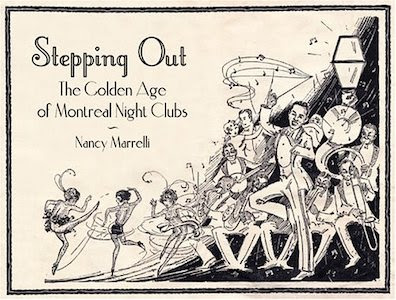
Stepping Out: The Golden Age of Montreal Night Clubs
Nancy Marrelli
2004

Hello Montreal! Stepping Out covers thirty years – 1925 to 1955 – during which Montreal's night clubs presented the finest jazz musicians, crooners, and burlesque acts in North America. Oh, the photos!

Remember the scene in The Great Gatsby when Nick suggests Gatsby lie low in Montreal? This is the city he had in mind.

David Montrose [Charles Ross Graham]
2010

A second sentimental favourite, The Crime on Cote des Neiges was the first title in the Ricochet series. Sixteen have followed. I'm most proud of the John Buell reissues – The Pyx and Four Days  but this stands as one of this country's three best private dick novels

Remarkably, after all these years, Montrose/Graham remains a mystery. For all my efforts, I've yet to find a single person who so much as remembers meeting the man.

Wardlife:
The Apprenticeship of a Young Writer as a Hospital Clerk
Andrew Steinmetz
1999

Another book by a friend. I first met Andrew in the summer of '85 at Station Ten, which I maintain was the smokiest of all Montreal night clubs. My eyes still sting. Andrew was then a member of Weather Permitting. We two were young pups, each imagining that we might one day produce a book. Andrew was the first to realize the dream. As much a fan of his writing as I was of Weather Permitting. 

Lasting Impressions:
A Short History of English Publishing in Quebec
Bruce Whiteman
1998

Short and bitter sweet, Bruce Whiteman's history of English publishing is an invaluable resource. Véhicule Press figures. How could it not?

It's only in writing this that I realize Lasting Impressions was published a quarter-century before last weekend's half-century celebration.

Here's to the next fifty!

Related posts:

29 August 2022

The Dustiest Bookcase: X is for X X X


The Dustiest Bookcase:
Short pieces on books I've always meant to review (but haven't).
This one's a cheat.
I reviewed The Whip Angels in this blog's earliest days, but have no other 'X' authors.

CanLit professors hold many, many secrets. Sitting through their lectures, I heard no mention of Grant Allen, Robert Barr, Margaret Millar, Ross Macdonald, Mavis Gallant, John Buell or Phyllis Brett Young. It wasn't until a course titled "American Writers of the Twenties," taught by an American, that I was introduced to John Glassco. Louis Dudek considered  Glassco's Memoirs of Montparnasse "the best book of prose written by a Canadian," but it wasn't on syllabi of we 'eighties CanLit students. Those looking to read the book today will find it available only through an American publisher. 

Why isn't Memoirs of Montparnasse taught in CanLit courses? Why isn't The English Governess?

Glassco's English Governess stands with his Squire Hardman as the greatest pastiches in Canadian literature. So great was his talent that academics have erred in describing the former as a work of Victorian erotica.

Edward VII was on the throne when Glassco was born. Elizabeth II had begun her long reign when Glassco wrote The English Governess. Victoria was more than a half-century dead.

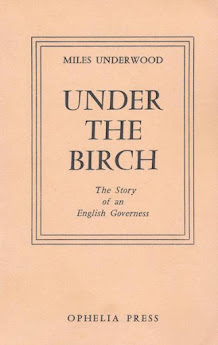
Published under its Ophelia imprint, The English Governess was an Olympia Press bestseller. When seized by French authorities, publisher Maurice Girodias released a new edition with the title Under the Birch. It is the bestselling Olympia Press book by a Canadian author. The Whip Angels comes second.

The novel was first published in 1955 as by "X X X." Diane Bataille, the woman behind the novel, was born Princess Diane Kotchoubey de Beauharnais on 4 June 1918 in Victoria, British Columbia, She was the second wife of philosopher, librarian, pornographer Georges Bataille. He was her second husband. The Whip Angels may have been written in response to his claim that she'd never be able to write erotica that could stand up to his. Was "X X X" inspired by husband Georges' "Louis Trente" pseudonym? So little is known about Diane Bataille.

The Whip Angels is Diane Bataille's only known novel. It has been suggested that she wrote policiers for money, but evidence is lacking.

Like The English Governess, The Whip Angels is forever being ravaged by pirates. Separating the legitimate from the illegitimate is a challenge.

Diane Bataille is one of our bestselling authors. She is one of the very few Canadian Olympians.

Is it not time we recognize and celebrate Diane Bataille?

A Bonus: What my wife refers to as "Brian Busby music."


04 July 2022

A Forgotten Novelist's Hidden Debut


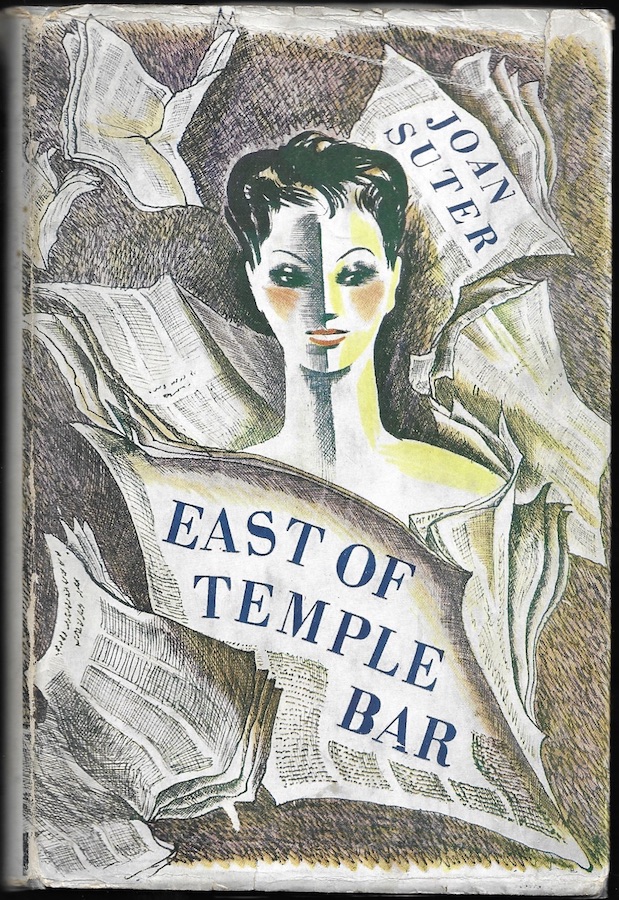
Joan Suter was thirty-seven when her first novel, East of Temple Bar, was published. She'd begun her working life as a fashion illustrator, then headed for Fleet Street, east of Temple Bar, where she found employment as an editor for Amalgamated Press and the George Newes Firm. Suter also wrote short stories under the name "Leonie Mason," which led to some confusion when the London Daily Herald (18 August 1938) reported on the marriage of "Miss Leonie Mason who writes fiction under the name of Joan Suter" to journalist Ogilvie "Punch" MacKenzie Kerr.

London Daily Herald, 18 August 1938
According to the Daily Herald, the wedding followed "a romance of 14 days, which began when they met in a darts match."

Sadly, by the time East of Temple Bar was published, Joan and Punch were no more. She had yet to divorce, but had already met second husband James Walker, a major in the 12th Canadian Tank Regiment. They married in Toronto on 20 September 1946. From that point onwards she wrote as "Joan Walker," and erased East of Temple Bar and her Leonie Mason fiction from her bibliography.

I was on a bit of a Walker tear earlier this year, reading and reviewing her novels Murder by Accident (1947) and Repent at Leisure (1957). In April, I spoke about the author with Dick Bourgeois-Doyle on his Canus Humorus podcast.


I review East of Temple Bar in the new issue of Canadian Notes & Queries. The exercise brought to mind my work on A Gentleman of Pleasure, a biography of self-described "great practitioner of deceit" John Glassco.  

Speaking of Glassco, Carmine Starnino's The Essential John Glassco (Porcupine's Quill) is one of the three reissues I chose for the What's Old feature; No Crystal Stair by Mairuth Sarsfield (Linda Leith Publishing) and The Tangled Miracle by Bertram Brooker (Invisible Publishing) are the two others.

All three belong on your bookshelves.


Invisible, let me know what you're up to!

As always, Seth provides the cover. The Landscape, his regular feature, concerns the long-dead Montreal Standard's magazine supplement.

Margaret Atwood looks at the the short stories of Clark Blaise.

Other contributors include:
Marc Allen
Barry Baldwin
Elaine Coburn
Robert Colman
Jeffery Donaldson
sophie anne edwards
Sadie Graham
Brett Josef Grunisic
Tom Halford
Rhiannon Ng Cheng Hin
Kate Kennedy
Marius Kociejowski
Kim Johntone
Robin Mackay
David Mason
Dominik Parisien
and 
Alice Petersen
Jean Marc Ah-sen interviews Dimitri Nasrallah.

Megan Durnford interviews Céline Huyghbaert.

Sindu Sivayogan adapts Shyam Saladurai's Cinnamon Gardens.

As always, the last page belongs to Stephen Fowler, who serves up Melva E Adams' Marshmallow Magic. Self-published in 1978, it belongs in every Canadian kitchen.


Subscribers receive John Metcalf's The Worst Truth: Regarding A History of Canadian Fiction by David Staines.

Sixty-one pages in length, I read it in one sitting.


Subscriptions to Canadian Notes & Queries can be purchased through this link.

My review of Prof Staines' history was written for another magazine.

It's coming.


17 January 2022

The Dustiest Bookcase: U is for Underwood


Short pieces on books I've always meant to review (but haven't).

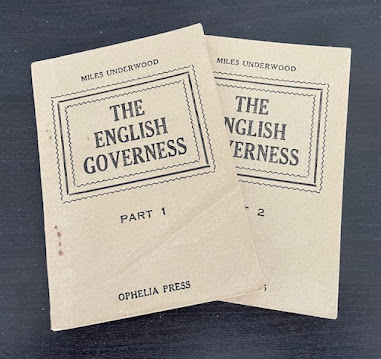
The English Governess
Miles Underwood [John Glassco]
Paris: Ophelia Press, 1960 [sic]
290 pages (in two volumes)

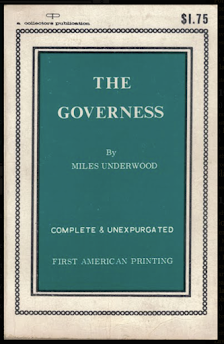
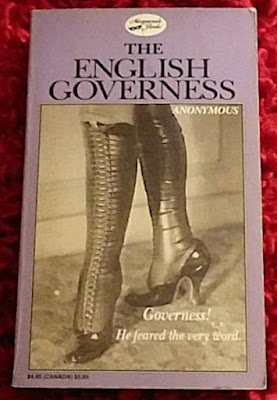
Is The English Governess Canada's biggest selling work of erotica? If not, then the honour goes to Harriet Marwood, Governess, its non-identical twin. I don't suppose we'll ever know; they've both appeared under different titles and disguises, most often clothed and sold by pirates. The above was printed by Taiwanese freebooters. Glassco spent much of the 'sixties and 'seventies going after Collector's Publications of Covina, California for this unauthorised edition:


Publisher Marvin Miller may not have paid the author, but he at least gave credit; most pirated editions of The English Governess are attributed to Anonymous.

Miles Underwood was just one of Glassco's many noms de plume. The novel's original publisher, Maurice Girodias of Olympia Press, claimed the pseudonym to be of his own making, when in fact it was Glassco’s creation alone. In a 1967 letter to his friend Milton Kastello (aka Milton Douglas) wrote that it was “dreamed up on an hour’s notice to meet a printer’s deadline in Paris in 1959 [sic]. It signifies a man who would be under by miles and miles."

It's entirely possible that the Underwood name inspired Under the Birch, the title Girodias slapped on the novel after French authorities seized and destroyed copies of The English Governess


The English Governess was the subject of the seventh Dusty Bookcase postnearly thirteen years ago! I covered the novel exhaustively in A Gentleman of Pleasure, my biography of Glassco, but have never written what might be termed a "review."

One day.

For now, I'll encourage you to hunt down the novel. There's a reason for the sales.

A bonus: An edition of The English Governess I'd not seen before today.