Showing posts with label Harris (John Norman). Show all posts

29 December 2025

The Three Best Reads of 2025 (two are in print!)


An annus horribilis, wouldn't you say? Strange, too! Never thought I'be be flying the flag of Greenland from the porch of our Upper Canadian home. 

This has also been an unusual twelve months for the Dusty Bookcase in that two of this year's top three reads are actually in print!

Huzzah!


Douglas Durkin's 1930 novel Mr. Gumble Sits Up, reviewed here in 2012 so disappointed that a full thirteen years passed before I got around to The Magpie; this despite having been given a copy by a reader of this blog. He recommended it, suggesting it as the Great Canadian Post-Great War Novel. I think he's right.

First published in 1923 by Hodder & Stoughton, it's currently available here from Invisible Publishing.

Related to Durkin, quite literally, is future wife Martha Ostenso and her award-winning 1925 novel Wild Geese.

Was Durkin the co-author? Evidence more than suggests so.

Will we ever know the extent of his contribution? I expect so.

Do I want to get into it? No, I do not. 

Aging copies of the 2008 New Canadian Library edition are still available for purchase from Penguin Random House. The cover, an abomination, was clearly created by someone who knew nothing about the novel. Who signed off on it, I wonder.


Reuben Ship's The Investigator, a 1956 adaptation of his then-two-year-old radio play of the same name, rounds out the top three best reads. I enjoyed this book more than any other read this year. It made me laugh, and is as relevant a commentary on American politics as it was seven decades ago. 

If I could revive just one of the out-of-print books read this year, The Investigator would be it. However, tradition dictates I select another two books deserving a return to print. And so:

A case can be made for The Salt-Box, her Leacock award-winning 1951 debut, but I consider A View of the Town (1954) to be Jan Hilliard's first true novel. It concerns the approaching sesquicentenary of a Nova Scotia town and the rivalry between the heads of its founding families. The lightest of the novelist's five novels, should it also have won the Leacock? It was up against Joan Walker's Pardon My Parka, which I aim to read next year.

Will let you know.


Winnifred Eaton's second novel as "Onoto Watanna," and her second novel overall, A Japanese Nightingale (1901) was the Montreal author's big commercial breakthrough, I liked it a lot, and was surprised to find that it has not been caught up in the wave of things Eaton – Winnifred and sister Edith –  that has swept through academe these last few decades.

Returning to the in print, three more titles figure, beginning with The Weird World of Wes Beattie (1963), the first book read and reviewed this year.


Had it not been for the good folks at New York publishers Felony and Mayhem, this bit o' fun would've made it to the list of three books most deserving of a return to print. That said, I do wish F&M would stop pushing The Weird World of Wes Beattie as "The First Truly CANADIAN Mystery."

It's nowhere close.


Stephen Leacock's Arcadian Adventures of the Idle Rich (1914) is still in print. The fifteen-year-old copies New Canadian Library edition sitting in the Penguin Random House warehouse have a better cover than Wild Geese, but I recommend the Tecumseh Press Canadian Critical Edition edition edited by D.M.R. Bentley.


Finally, we have Charles G.D. Roberts' The Heart of the Ancient Wood (1900). This was was the most disappointing read of the year, but only because I remembered liking it so much as a young golden blonde university student. This old grizzled guy saw it quite differently.


The Heart of the Ancient Wood is in print today as part of the the Formac Fiction Treasures series.


The Investigator aside, it's no great shame that the rest are out of print. Robert G. Collin's Tolerable Levels of Violence (1983) was interesting for its depiction of a dystopian North America in which law and order has collapsed. It stands in stark contrast with Rev Hugh Pedley's Looking Forward (1913), which imagines a futuristic near-Utopian Canada brought about by the unification of most Christian denominations. Expo 67 obsessives – I'm one! – will want to hunt down copies of A Fair Affair (1967), Paul Champagne's lone novel.

Regrets? Well, I was looking forward to reading They Have Bodies, the 1925 debut novel by Barney Allen (aka Sol Allen), but somehow misplaced my copy. I found it only a few days ago.

Resolutions, by which I mean reading resolutions, I have but one. Since 2009, when I began this journey through Canada's forgotten, neglected and suppressed writing, I've read and reviewed 460 books, barely thirty percent of which were penned by women.

In the New Year, I'll be reading and reviewing books by women only. No male authors. Barney Allen will have to wait.

Should be interesting.

I'm looking forward to it.

Wishing you all a Happy New Year. I'm confident that it will be happier one.

Really, I am.

Related posts:


20 January 2025

The Boy Who Cried Truth


The Calgary Herald, 26 October 1963

The Weird World of Wes Beattie
John Norman Harris
New York: Harper & Row, 1963
216 pages


Wes Beattie was born with a Woolworths spoon in his mouth; father Rupert's came from Birks. The vast difference in fortune is best explained by youthful folly and libido. Rupert had been the favourite son of Toronto's wealthy Beattie family until he had the misfortune of attending a stag party during his sophomore year at Trinity College. There he met a sixteen-year-old tap dancing accordion player named Doreen. She was so unlike the Rosedale girls he'd grown up with that he couldn't help but be captivated. Within nine months, Mr Maggs, Doreen's dad, came calling at the opulent Beattie home demanding money. Ever the romantic, Rupert thwarted the wishes of both sets of parents by marrying Doreen. She gave birth to a baby girl, and Rupert went from golden child to black sheep. Disowned, he became a door-to-door encyclopedia salesman and Doreen turned to drink. When war was declared in 1939, he was only too happy to enlist and be shipped overseas. Son Wes may have been the result of a fond farewell.

Wes Beattie never met his father, though he'd come to know all sorts of very nice servicemen who visited his mother. After Rupert was killed in Italy, his remorseful mother gave Doreen a nice payout and brought the her grandchildren into her home. Jane, the baby girl whose existence had caused the rift, rebelled, while younger brother Wes just wanted his mummy.


Backstory, all of the above is relayed in much more detail – and much more entertainingly – in the seventh of this novel's eighteen chapters. That it comes roughly half-way through the novel, speaks to its complexity.

Wes Beattie himself is a complex character. Though just twenty-three, recent adventures have made his life such a tangled mess that he has drawn the attention of psychiatrist Milton Heber, who lays all out in a seminar attended by doctors, lawyers and social workers. Heber's assertion is that Wes lives in a "weird world" of his own making; he is a fabulist unable to differentiate fantasy from reality. Wes has been charged with two crimes, the first involving a purse he took from a car parked outside the Midtown Motel. He served two months for that offence. The second, much more serious, is the charge that he murdered his beloved Uncle Edgar for fear of being cut out of his will. Lawyer Sidney "Gargoyle" Grant, one of the attendees, is so bothered by a seemingly insignificant detail in Heber's talk that he begins his own investigation.

Grant's efforts bring such small rewards that it would be easy to write at length about The Weird World of Wes Beattie without revealing much. To detail how it all fits together would take thousands of words. Your time is better spent reading the novel.

The Weird World of Wes Beattie is not "The First truly CANADIAN Mystery" as current publisher claims, but it is one of the very best.

What's more, it will make you laugh.

About the author: The life of John Norman Harris (1915-64) is worthy of a biography; consider the introduction to the John Norman Harris fonds housed at the University of Toronto. Is the "Wooden Horse" escape from Stallaf Ludt III not enough?

The author died alone on 28 July 1964, not one year after The Weird World of Wes Beattie was published, suffering a heart attack during an early morning walk in rural Vermont. This brief bio, attached to the 13 October 1963 Star Weekly bowdlerization of The Weird World of Wes Beattie hints at what we missed.


Trivia I: Though the novel makes much about Wes Beattie facing the gallows, the last execution in Canada took place on December 11, 1962. Capital punishment was abolished for murder in 1976. In 1999, it was abolished for all other crimes. 

Trivia II:
The Globe & Mail, 14 March 1964
Trivia III: Announced by Warner Brothers in 1965 as a forthcoming Merwin Gerard production.

And still we wait.
 
Trivia IV:
 John Norman Harris's last address was 45 Nanton Avenue in Toronto's Rosedale, the very same neighborhood in which Wes Beattie is raised.

The house, described in the 17 September 2004 Globe & Mail 'Home of the Week' real estate column as a being of a "rambling English-cottage-style," has had several notable inhabitants. Its first owner, lawyer Edward Brown, was the son of John Brown, who became editor of the Globe after his brother George (Edward's uncle) was shot by a disgruntled former employee.

Future Pearson Minister of Finance Walter L. Gordon lived in the house during the Great Depression, only to leave after a ten percent increase in the rent. 

It was at 45 Nanton that Harris wrote The Weird World of Wes Beattie, though you wouldn't know that from the Globe piece:

In 1959, it was owned by John Norman Harris, a writer who was also a public relations officer for the Canadian Bank of Commerce, which was poised to merge with the Imperial Bank to form the Canadian Imperial Bank of Commerce. 
Mr. Harris offered the home as a venue for the secret negotiations, and the deal was signed in a large second-floor bedroom in 1961.
Bankers in bedrooms! Meeting secretly! Do tell!

The address's connection to things literary doesn't end with Harris. Apparently, playwright Tom Hendry rented a third floor room in the 'seventies. The only reason for the Globe piece is that the house had been put up for sale by children's author Kati Rekai.

This is the house as it was ten years ago.


Note the Heritage Toronto plaque on the fence. It has nothing to do with Harris, Hendry or Reikai, rather J.J.R. MacLeod. Because it's hard to read, I share this template from the Heritage Toronto site.


A man worthy of more than this honour alone.

Object: A solidly constructed hardcover with burgundy cloth and pale orange boards. The endpapers remind that this is a HARPER NOVEL OF SUSPENSE, which explains why the back jacket features no author photo, rather promos for other novels in the series:

Love in Amsterdam - Nicholas Freeling
The Fifth Passenger - Edward Young
A Dragon for Christmas - Gavin Black
It's Different Abroad - Henry Calvin
Access: First published in Canada by Macmillan, in the United States by Harper & Row, and in the United Kingdom by Faber & Faber. I see no evidence of second printings for any of of these editions, though as noted in the previous post the novel has reappeared a few times through the years, French and Spanish translations included.

The book isn't easily found in Canadian bookstores; online booksellers are your best bet. At £2, the cheapest edition is the 1966 Corgi, listed by a bookseller in Boat of Garten, Scotland who dares charge the equivalent of $35 to ship a mass market paperback to Canada.

The cheapest Faber & Faber edition – "Condition: Good" – is offered at €14.90 by a Dublin bookshop. It will ship to Canada for roughly $24.50.

The Harper & Row, with jacket, can be purchased for US$40 from a New Jersey bookseller.  

If I were a rich man, or reasonably comfortable, I'd buy the signed copy of the Macmillan offered at US$150 by a Stoney Creek, Ontario bookseller. There can't be many signed copies out there.

Underpriced, if not sold by this time tomorrow I will be greatly disappointed.

Related post:

15 January 2025

The Weird Covers of Wes Beattie


Two weeks into 2025 and I'm only now starting in on my first novel of the New Year... and so late in the day!

I've wanted to read The Weird World of Wes Beattie for some time, but forays through the used bookstores of Ontario, Quebec, New Brunswick, and Nova Scotia brought frustration. Exhausted from the chase, I resorted to online booksellers, which explains how it is I ended up with a copy of the Harper & Row first American edition purchased from a bookseller in New South Wales.

It took longer than expected to arrive. 

I like to "follow the flag" – The Weird World of Wes Beattie was published in 1963 by Macmillan in Canada – but the expense could not be justified. A rare book, the Canadian first edition was a split run with the American Harper & Row. Publisher names aside, it is pretty much identical, the only other exception being the price. Harper & Row's front flap lists the price as US$3.95, while the Macmillan is not so base as to mention cost. For the record, the Canadian price was $4.95. 

From what I've read so far, it was a bargain either way.

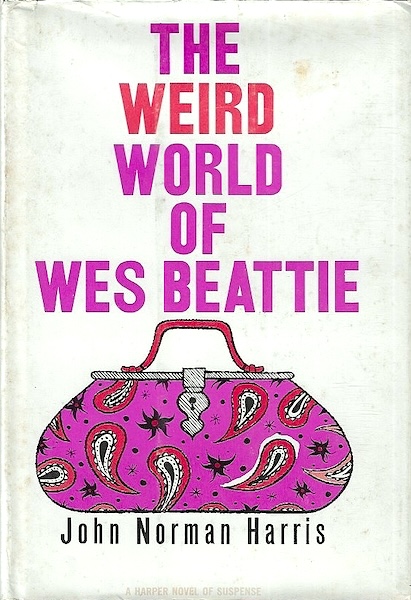
Both the Macmillan and Harper & Row editions share the same James Kirby jacket illustration (above). Does it not suggest whimsy?

I ask because the Faber & Faber's first British edition strikes a very different tone:


The illustration used in the 13 October 1963 Star Weekly condensed version looks like something from a storyboard of Silence of the Lambs:


In 1966, Corgi published a mass market edition with prominent quote from the Scotsman review:


It's a challenge to make out, and so I quote:
A novel of suspense with all the ingredients of a Hitchcock thriller... A new talent in detective writing... if Harris can keep this up, Gardner has a formidable rival.
Sadly, tragically, in 1966 Harris was in no position to "keep this up;" he'd died in 1964, not twelve months after The Weird World of Wes Beattie arrived in bookstores.

The Corgi cover suggests something sophisticated along the lines of Ocean's Eleven. To this reader, it appears incongruous, but then I'm only a few chapters into the novel. The Canadian Popular Library edition, published the same year, is gritty as all get out:


Nothing whimsical here.

SOON BE A MAJOR MOVIE? 

How soon is now?

Two translations followed in the heels of the novel's first publication, the earliest being Un monde farfelu, which came out in 1964 from Gallimard as part of its Séries noire


This was followed by a Spanish translation titled El fantástico mundo de Wes (Barcelona: Malina, 1965). It's cover illustration with tortured soul is the bleakest by far.

 
The Weird World of Wes Beattie is in print today thanks to the good folks at New York publishers Felony and Mayhem. The covers they've used to date are more in line with  James Kirby's original, though I have a bone to pick with the claim that it is "The First Truly CANADIAN Mystery."


Is The Weird World of Wes Beattie whimsical, sinister, sophisticated... bleak?

I'll let you know next Monday.