Showing posts with label Monk (Maria). Show all posts

21 September 2026

A Nellie McClung Manitoba Mystery


The Black Creek Stopping-House and Other Stories
Nellie L. McClung
Toronto: William Briggs, 1912
224 pages

We have here a collection of short stories by a writer best known as a novelist.

Scratch that.

Nellie McClung is remembered today as a campaigner for women's rights. I learned this in 1973 when my mum brought home a sheet of newly issued postage stamps bearing her portait.

My mother was born at a time when women in Canada were not considered persons under the law. Strange but true. She wasn't recognized as a person until the month after her second birthday. Nellie McClung worked to made that possible.

I don't remember my mum mentioning that Nellie McClung wrote fiction and am not certain that she knew, though McClung had once time one of the country's bestselling novelists. Her 1908 debut, Sowing Seeds for Danny, sold over 100,000 copies.

Toronto: William Briggs, 1908
The Black Creek Stopping-House and Other Stories was the author's third book and the first of her two short story collections. It was published fifteen years before my mother's birth, sixty-one years before that stamp was issued, and one-hundred-and-thirteen years before today. 

There are eight stories in all. They are interesting enough, though much of that interest has less to do with prose or clever plot than as snapshots of the time in which they were penned. Nowhere is this more true than with 'The Elusive Vote,' which takes place on the final day of the 1911 Canadian federal election:


The story centres on John Thomas Green, "a gentle soul in ill-fitting armor," and attempts by local Conservative Association to secure his vote – or, failing that, preventing him from casting a ballot. It reminded me of Stephen Leacock, as did 'The Runaway Grandmother,' in which a bachelor farmer hires an tenacious elderly housekeeper, bends to her will, and finds his life much improved. Then I remind myself that Prof Leacock was fairly new on the scene as a humorist.

I'm more confident that 'A Short Story of a Rabbit' was influenced by by Ernest Thompson Seton and Charles G.D. Roberts. A young rabbit disregards the warnings of his mother and so learns a valuable lesson.

'The Return Ticket' is also timestamped. The narrator has a chance encounter with a woman who is accompanying her daughter's body back from Rochester, Minnesota to Manitoba's Rose Valley. The only the only truly dark story, it is also the very best.

But it is the title story that dominates:


'The Black Creek Stopping-House' begins with John Corbett strolling into a Salvation Army meeting at Winnipeg's Victoria Hall. He has for no other reason to be there other than the fact that "he would do anything once, and if he liked it he would do it again." Corbett is very taken with the music, the camaraderie, and more than anything Maggie Murphy, the pretty young thing seated by the door selling War Cry: "When he went in he bought one; when he came out he bought all she had left."

Corbett is a card shark. He loves the life, the challenge, the money, and may be the very best. But he gives it all up, ill-gotten gains included, for pretty Maggie Murphy. The two wed and with the aid of oxen move more than 200 kilometres west to what would become Brandon, Manitoba. There they set up a "stopping house," feeding hungry men traveling east and west. The railway comes the following year, thus securing their future.
 
Early in the story, John and Maggie Corbett cede their positions as protagonists to twin Brydon brothers Reginald and Randolph. Are they remittance men? They don't do much of anything apart from waiting for wealthy, appropriately-named Aunt Patience to die. As they mess about, making money tighter, Randolph comes up with an idea to tide them over. Why not encourage young half-brother Fred to come out West?
“Wot’s the matter with us gettin’ out Fred for our farm pupil? He’s got some money—they say he married a rich man’s daughter—and we’ve got the experience!”
Fred sends money, then follows with his elegant, delicate, doll-like wife Evelyn. The daughter of a wealthy lumber baron, she had defied her father to marry for love. Events after the couple's arrival are not happy, and involve deceit, betrayal, misunderstanding, and a wolf of a man named Rance Belmont. I was all in! But then came an unimaginative climax that for a short story, no matter how long, relies far too much on coincidence. The denouement, happy and breezy, sees the Brydon twins receiving their just desserts.

Those familiar with the story will appreciate the pun.

The first ten chapters of 'The Black Creek Stopping-House' were so engaging that I moved my copy of Sowing Seeds for Danny to my night table. The final two chapters were such a disappointment that I moved it back to the shelves.


I thought no more about it until glancing through Nellie McClung's 1935 biography Clearing in the West. In the nineteenth chapter, the author recounts a thirty-mile trip to Brandon with her mother and brother Jack on a sleigh heavily loaded with wheat. According to McClung she was twelve at the time, meaning that the journey was untaken in the December of 1885: 


Though the stay at this "Black Creek Stopping house" is brief, four pages provide a Clearing in the West provides a description of the stopping house, which is something lacking in McClung's long short story:
Mrs. Cobett's stopping house was one big room, with one end used as a kitchen, in which stood a great high-over black stove where Mrs. Corbett with quick movements filled plates with a cut of roast bef and helpings of turnips, potatoes and gravy. Each man, who was helped took a place at the long table coveref with oil-cloth, where he found everything else he needed.
   "Da," Corbett, traversed the length of the table with a blue enamel tea pot and filled the cups that were stationed at every place. Bread and butter, pickles, biscuits and cheese were set at close intervals, along the long table and it took but little time to serve thirty or forty men.
Mrs Corbett's first name is not shared in Clearing in the West. In 'The Black Creek Stopping-House,' Maggie cannot bring herself to address her husband, whom she first knew as "Mr Corbett," by his first name. "Da" is Da is short for "Dad" which is something I'd rather not address, particularly as  they have no offspring .

The Corbetts of 'The Black Creek Stopping-House,' have one employee, a young hireling blessed with the unforgettable name Peter Rocket. The Clearing in the West Corbetts have help in the form of an child  named Peter Rocket about whom twelve-year-old Nellie has a strong opinion:
I could see he was a lout of a boy, who could not even think of two things at once.
   There was an impatient rattling of spoons on cups.
   "Let me do it," I said, and took the smallest pot on the stove and went down the line.
   I could hear Mrs. Cobett's voice above the chatter.
   "Look at that now, there's a girl with a quick turn, and her not more than twelve years old. I'd be a proud woman, if I had a little girl like that comin' along."
Young Nellie's mother is not of similar mind: "When we were in the sleigh again, Mother told told me, I should nt be so forward. It did not look well for a little girl to jump up and pour tea for strange men."

Was there a Peter Rocket? No one by that name is recorded in 1881 and 1891 census records, though the latter does include an English immigrant named John Rocket living in Manitoba. In 1885, that Rocket would've been a fourteen-year-old.  

Similarly, the Corbetts don't match up. The 1881 census features a John Corbett (age 27) and Maggie Corbett (age 21) living in Manitoba, but not close to one another. The sole Margaret Corbett is fifty-nine.

Don't get me started on the Brydon bothers.

Neither the Corbetts nor their Black Creek stopping-house receive mention in 1880 editions of the Brandon Daily Sun. Curiously, the newspaper did not review The Black Creek Stopping-House and Other Stories.

So, I ask, is 'The Black Creek Stopping House' a nouvelle à clef? Did such a place exist? Could it be that the Corbetts are modeled on a couple who had entirely different names? What of Peter Rocket? Is it that the author couldn't remember John Rocket's first name? Did she even know it?

And now, I can't stop thinking about 'The Black Creek Stopping House.'

Dedication:


Trivia (personal): Because I'm working on a book about the Maria Monk hoax, I'm leaving this paragraph from 'The Way of the West' by way of reminder.


Object and Access: A very attractive hardcover, my copy, was purchased eight years ago in Toronto as part of a lot. It once belonged to Florence Adams.

The 1911 census features twenty-six women named Florence Adams, three of whom lived in Toronto. I'm ruling out the three-month-old, but not the twenty-three and twenty-five-year-olds  Of course, it's entirely possible that the woman who once owned the copy never lived in Toronto at all. 

I find no evidence of an edition published after 1919.

First editions begin at $30.00. At $177, the prize is a copy inscribed to one Alice Jordan:


A perfect gift for Xmas 2026.

04 December 2023

The Ten Best Book Buys of 2023!


With sadness, I report that 2023 was another year in which all my favourite acquisitions were purchased online. This is not to suggest that every transaction was a good one. In March, I won a lot of twelve Marilyn Ross Dark Shadows books, three of which bear the signature of their true author, New Brunswick's W.E.D. Ross. 

My lengthy victory dance came to an abrupt end when they arrived loose in a recycled Amazon box. Most were in poor condition, some featured stamps from used bookstores, and one had a previous owner's name written on its cover. Added to all this was the shipping charge, which far exceeded the amount paid for the books themselves, and was several times greater than what Canada Post had charged the seller.

Had all gone well, this copy of Barnabas, Quentin and the Frightened Bride (New York: Paperback Library, 1970) would've surely made the cut.

Enough negativity! It was a good year!

What follows is 2023's top ten:

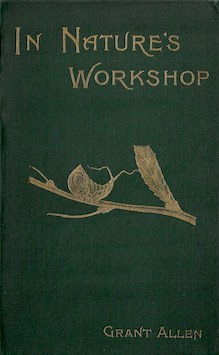
In Nature's Workshop

Grant Allen
London: Newnes, 1901


I bought three Grant Allen books this year – the novels This Mortal Coil (1888) and At Market Value (1895) being the others – but this is the one I like the most. The posthumously published second edition, it features over one hundred illustrations by English naturalist Frederick Enock (1845-1916).


Hot Freeze

Martin Brett [Douglas
   Sanderson]
London: Reinhardt, 1954

For years I've been going on about Hot Freeze being the very best of post-war Canadian noir; it was one of the first novels reissued as a Ricochet Book. I was aware that there had been a UK edition, but couldn't find a copy with dust jacket.

Found it!
Hilary Randall: The Story
   of The Town
Horace Brown
Toronto: Voyageur, [n.d.]

While working to return Brown's 1947 novel Whispering City to print, I learned that Saturday Night editor B.K. Sandwell had thought Hilary Randall just might be the great Canadian novel. Self-published roughly four decades after its composition, my copy is inscribed!

Wedded for a Week; or, The
   Unseen Bridegroom
May Agnes Fleming
London: Milner, [n.d.]

As with Grant Allen, I can't let a year go by without adding more Fleming to my collection. The Actress' Daughter was the first, but I much prefer this 1881 novel, if only for its two titles.

Writing this I realize that I haven't read a Fleming in 2023. 

A Self-Made Thief

Hulbert Footner
London: Literary Press,
   [n.d.]

As my old review of 1930's The Mystery of the Folded Paper suggests, I'm not much of a Footner fan, Still, at £4, this last-minute addition to a large order placed with a UK bookseller seemed a bargain. The dust jacket illustration, which I hadn't seen, is unique to this edition.

Pagan Love
John Murray Gibbon
Toronto: McClelland &
   Stewart, 1922

Had I not read this novel, it's unlikely this wouldn't have made the list. Pagan Love entertained at every turn as a take-down of the burgeoning self-help industry and corporate propaganda. Odd for a man who spent most of his working life writing copy for the CPR.

Dove Cottage
Jan Hilliard [Hilda Kay
   Grant]
London: Abelard-Schulman,
   1958

There are books that grow on you. Reviewing Dove Cottage this past March I likened it to an enjoyable afternoon of community theatre, but it has remained with me in a way that the local real estate agent's performance as George Gibbs has not.

Three Dozen Sonnets &
   Fast Drawings
Bob McGee
Montreal: Véhicule, 1973

This year marked the fiftieth anniversary of Véhicule Press. Three Dozen Sonnets & Fast Drawings was the press's very first book. A pristine copy with errata slip, it appeared to have been unread.

No longer.

Awful Disclosures of Maria
   Monk
Maria Monk
New York: Howe & Bates,
   1836

A first edition copy of the text that launched an industry. Not in the best condition, but after 187 years, much of it being pawed over by anti-papist zealots, what can one expect.

My work on the Maria Monk hoax continues. 


Crimes: or, I'm Sorry Sir,
   But We Do Not Sell
   Handguns to Junkies
Vicar Vicars [Ted Mann]
Vancouver: Pulp, 1973

As far as I know, Crimes is Ted Mann's only book. When published, he was an editor at National Lampoon. The Bombardier Guide to Canadian Authors was in his future, as were NYPD Blue, Deadwood. and Homeland.


What to expect next year? More Allen and Fleming, I'm betting.  Basil King seems likely.


10 March 2020

Maria Monk and Me


I didn't know her.

How could I?

We were born one hundred and forty-six years apart, and yet I think of Maria Monk each and every day.

I offer this by way of explanation.

Things are about to become quieter and dustier here as I focus on a book I'm writing about Maria and the Presbyterian clergymen who did her wrong.


I believe an exploration of Maria Monk and the hoax perpetuated under her name is long overdue. As if to confirm, this past weekend I stumbled upon this being offered online:


In fact, the artwork used, Jean-Jacques Lequeu's And we too shall be mothers, because...!, dates from 1794. Maria Monk was born in 1816.

Still, I was tempted.

Related posts:

29 July 2017

The Dusty Bookcase in the Toronto Star


Not my pool, sadly, but that belonging to a friend and old work colleague. Today's Saturday Star features a piece by Nick Patch on the forthcoming Dusty Bookcase book. Although the article itself isn't available online – not to non-subscribers – my picks of five books worthy of attention is open to all:
Because I've received requests for links to my writing on the titles mentioned in the list and article:

The publication date for The Dusty Bookcase is 15 August. It is available for pre-order at Amazon, Chapters/Indigo, and McNally Robinson.

29 May 2017

The Dusty Bookcase at 1000


Last Tuesday's post marked the one thousandth since this blog began. I saw it coming, took my eye off the ball, and didn't notice when it hit. Nevertheless, that post, on a lost film adaptation of a once-popular work by one-time bestselling author Ralph Connor, seems appropriate enough. The Dusty Bookcase began in early 2009, with a review of novelist Brian Moore's suppressed debut Sailor's Leave (a/k/a Wreath for a Redhead). The idea back then, as it is now, was to read and review all the suppressed, ignored and forgotten Canadian books I've been collecting.

I'm falling behind.

One thousand. I thought I'd mark the start of second thousand by listing the ten most visited posts in this blog's history. For obvious reasons, older posts have an advantage. These aren't necessarily my favourites, you understand, but the fans have spoken!
1
A collection of covers (with commentary) depicting the heroine of Governor General's Award-winning poet John Glassco's pornographic novel. I suspect it's popularity was boosted somewhat by a New York dominatrix's use of the same name. 
The post was later expanded upon – more images – for A Gentleman of Pleasure, the blog used to promote my Glassco biography of the same same. 
2
The first of four posts – here are the second, third, and fourth – on the surreal covers produced by rip-off artists VDM Publishing. Recommended reading for anyone who still needs convincing that Amazon knows no shame. 
3
She haunts us still, I suppose, but then so do the rest of the family. Another Trudeau title features below, and pretty much everything I wrote that included the surname proved popular: Sex and the Trudeaus: The Bachelor Canada, Sex and the Trudeaus: Son and Hair, Pierre Trudeau's Letter to the Children of Troy, Trudeau Redux: Compare and Contrast, Trudeau Redux: Compare and Contrast II, Wishing the Prime Minister Dead, Trudeaumania II. 
My posts on Stephen Harper – on his forgotten speech and his forgotten hockey book – deserve more attention. 
A revised and expended version of the post on Margaret Trudeau: The Prime Minister's Runaway Wife features in my forthcoming book, The Dusty Bookcase. 
4
Jalna's Dirty Little Secret (Parts I & II) 
I had an awful lot to say about this awful book and the awful television series that encouraged its publication – so much that I had to cut it in half. Both halves will feature – revised – in the forthcoming Dusty Bookcase book. 
Have I mentioned it can be bought here? 
5 
Forget VDM, no print on demand publisher has given me more enjoyment than Tutis Classics. This was my first post about these crooks, though my favourite is It's Tutis Time, posted a few weeks later. Sadly, Tutis is no more. Fortunately, their covers remain.
6
Maria Monk's Immortal Book 
My earliest writing on Awful Disclosures of Maria Monk (1837), the oldest book reviewed here, proved to be one of the most commented upon posts in the blog's eight years. The book and associated scandale are also the subjects of ongoing research and a future book.
7
Galt's Damaged Pastor Novelist 
A post about the forgotten and unlucky Robert E. Knowles, whose debut novel, St. Cuthbert's, was the most torturous read of my life.
8
Who dares deny the popularity of Harriet Marwood? Posted less than a month into the blog, this piece on The English Governess was the third in a four-part series focussing on the four Olympia Press titles written by Canadians: Diane Bataille's The Whip Angels, John Glassco's complete of Aubrey Beardsley's Under the Hill (by far the most attractive volume the press ever produced), Glassco's pseudonymously published The English Governess, and Jock Carroll's Bottoms Up (inspired by his assignment to photograph Marilyn Monroe at Niagara Falls). 
The English Governess is the best of the lot. 
9
A slight post about a slim book of humour, I can't quite get over its popularity. Michelle Le Grand, Alison Fay, I'd love to hear from you!
10
It may be word "pornography". Seven years ago, a post I'd titled A Prudish Policewoman's Porn attracted visitors by the thousands. Click on the link and imagine their disappointment! 
Must say, I find the popularity of this old post, which draws on images from various editions of Awful Disclosures of Maria Monk, encourages work on my Maria Monk book. 

More to come. For now, I'd like to thank readers and fellow bloggers who have been supportive these past one thousand posts: Patti Abbott, John Adcock, Bowdler, Curtis Evans, Le Flâneur, Kristian Gravenor TracyK, Leaves & Pages, Jean-Louis Lessard, Melwyk, J.R.S. Morrison, J.F. Norris, Noah Stewart, and the late, much-missed Ron Scheer. The Dusty Bookcase would've become mouldy without you.

28 May 2015

Brian Busby's Dusty Bookshelf


Honoured to be today's Bookshelf feature over at Patti Abbott's blog. Amongst other things, I reveal the purpose behind all those 19th-century anti-papist tracts I've been collecting.

You can all stop worrying.

Patti's debut novel, Concrete Angel, has just received a star review in Library Journal. The publication date is June 9, but the sharp-eyed may find it's already arrived in their local bookstore.


23 December 2013

Christmas Comes Early


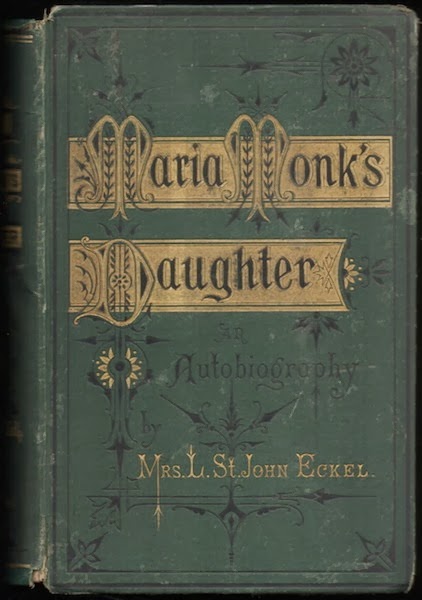
My newest acquisition:

Maria Monk's Daughter: An Autobiography
Mrs. L. St. John Eckel
New York:
Published for the Author by the United States Publishing Company

27 June 2011

Words of Hate for Maria Monk


Maria Monk was born 195 years ago today in Dorchester, Lower Canada (now Saint-Jean-sur-Richelieu, Quebec). The "Awful Disclosures" published under her name were just one awful part of an awful life that ended tragically in a New York City prison thirty-two years later. Neither the date of her death, nor her place of burial were recorded, but this didn't stop poet John J. MacDonald (a/k/a James MacRae) from putting poison pen to paper. From his self-published Poems of J. J. MacDonald, a Native of County Glengarry (c. 1877):
EPITAPH FOR MARIA MONK

Whoever ye are by this tomb that shall go,
Beware lest ye tread on the filth that’s below,
For under this monument lowly are laid
The mortal remains of a comical jade.

Ye swine that by accident hither come round,
Refrain from disturbing or turning the ground,
Or else you will die from inhaling the air;
Ye feathering songsters, be cautious, take care.

The only exception 'tis proper to make:
That Methodist preachers full freedom may take,
For they loved and accompanied her while she lived,
And from them she special attention received.
In actuality, it wasn't "Methodist preachers", but Presbyterian clergymen who used poor Maria in creating the hoax. There is a difference.


An early, hand-tinted photograph of St Marys, Ontario showing MacDonald's church, Holy Name of Mary (right) and one of the town's two Presbyterian churches (left).

Related posts:

23 March 2010

Maria Monk and the Kennedy Campaign


Hard to get much work done this past weekend, what with the din drifting across the border, so it seems somehow appropriate that I came across the item below, printed fifty years ago today in the 23 March 1960 edition of the Milwaukee Journal.

Click to enlarge, as they say.


A full 124 years after publication – a full 124 years after it was discredited – and still Awful Disclosures of Maria Monk was being paraded about by religious bigots. Here it joined old frauds Abraham Lincoln's Warning and the bogus Knights of Columbus Oath, along with newer works like Do you Want the Pope for a President?, written specifically with Kennedy in mind. I dare say that the book credited to Montrealer Maria is the most interesting of the bunch.


Though there's little fun to be found in a hoax built upon a brain-damaged prostitute, a smile might be raised by Don W. Hillis' If America Elects a Catholic President. The prolific pastor wrote a good many works, including Tongues, Healing and You, What Can Tongues Do for You? and Is the Whole Body a Tongue? My favourite is The Mini-Skirt Speaks. I present the first four paragraphs:
I want to make it clear that I am a Christian miniskirt. That is, I go to church every Sunday. What's more, I attend an evangelical Church. Of course, I am not the only Christian miniskirt in town. There are many others who go to my church.

Though we represent a variety of colors and patterns there is one thing we have in common. We all have a way of revealing attractive thighs, especially when the legs are crossed. They tell me that's the most comfortable way to sit.

Unless I am misreading the situation we seem to make our wearers a bit self-conscious. At least the girl who wears me is always tugging at my hem. Though I am not an expert on human nature, this appears to indicate some kind of complex.

I have also noted that we miniskirts have the ability to attract a good deal of masculine attention even at church. At first I took pride in the fact that men are fascinated by my pattern and color design. However, just this morning I heard the preacher say that this was not really what the young men (some not so young) were looking at. Though I was all ears when he started to preach, "The Appeal of a Miniskirt," I was embarrassed before he was through.
Imagine the stories Ann Coulter's little black dress could tell.
My thanks to Marc Fischer of Public Collectors for the image of Pastor Hillis' tract.