Showing posts with label Levine. Show all posts

15 October 2026

Oh, Little Man!


Chipmunk
Len Peterson
Toronto: McClelland & Stewart, 1949
299 pages

Claude Widgewood specializies in buns at Toronto's Modern Baker. He's an expert at adding just the right amount of cinnamon. The other bun-makers aren't so exacting. They don't care. There's no better employee than Claude, and yet he's afraid of being dismissed. Proulx is the problem. Claude considers this co-worker a Communist intent on spreading the Red Octopus's tentacles into his workplace. Leaving for home at the end of his shift, a notice of a union meeting is thrust into Claude's hand. He hides it in his coat pocket, fearful that Mr Cadenza, the bakery owner, is watching. Is he? What about Mr Spidafora, the Assistant Manager?  

Claude tries to rid himself of the notice on the crowded streetcar home. Sliding it from his coat, he lets it loose to drop on the floor. It does not. The sheet is wedged between himself and an elderly woman with purple hair. She gives him a look when he tries to shimmy it loose.

Chipmunk may be a comedy, but its humour is dark. The eyes of Messrs Cadenza and Spidafora are a definite concern, but Claude's greater worry is the tall man in trench coat standing idly outside the bakery cleaning his fingernails with a comb. Claude is almost certain that he's with the Special Branch of the Mounties investigating subversive activities. 

The chill of the Cold War permeates. Whether at the bakery, traveling to and from the bakery, or drinking in a tavern with his friend Mott Kilsoonski, Claude is on edge. It is a mistake to drink so much:


When sober, Claude idolizes Kilsoonski. The man fought in Italy, the man was wounded in Italy, while Claude never even made it overseas:
The first Medical Officer who examined him said he had shoulders like a bird, and all those who examined him afterwards agreed; he had the narrowest shoulders they had ever seen.
The war three years in the past, Mott is a rising talent in the boxing world. He defeated Andy Anzopoulis in his most recent fight at the Gardens.

Mott is one of the three most important people in Claude's life. His friendship with the boxer extends back to pre-war years when the big man rescued him from a bunch of mean-talking thugs. Claude's relationship with young tough Nick Yakyuchuk, the most recent, came about when he volunteered with the "Great Big Brothers." The baker is meant to provide moral guidance and an upstanding male role model. Nick has just returned from a juvenile detention centre. Nick's mother, a prostitute, is intimidating because she is such a good looking woman. Claude is ever wary, thinking that she will make some sort of move. Besides, he has a wife.

This is the novel's most unbelievable ingredient.

The marriage between Claude and Faustina Widgewood is unlike any other I've encountered in Canadian literature. He's as small as she is large, but that isn't it. Faustina is cold and distant, sometimes pushing him away. Then there are times she draws him so close that her knitting needles poke. They wrestle in their marital bed – brutally and violently – but slight Claude always wins and Faustina is satisfied.

It's tempting to dismiss Claude as so many do – as a weakling – but there is strength in his imagination. This muscle he has exercised since childhood in picturing his father, a soldier passing through on way to the Great War... or so his mother told him. As a child, he came up with a believable story about his "widowed mother." It has served him well. Though he has altered it slightly over the years, this is the one Faustina knows.

Of course, it is that same imagination that is the greatest source of torment.

Chipmunk
is a first novel. After publication, Len Peterson spoke of his plans for a second novel, but it never appeared.

I can see why.

In a 16 August 1955 letter to Norman Levine, Jack McClelland responds to a the former's Times Literary Supplement piece titled 'Canadian Writers Come into Their Own.'

McClelland has this to say about Levine's praise for Len Peterson: "as a novelist in the Canadian scene, [Peterson] is hardly worth mention. He hasn't produced a book-length script for about seven years, and even at that he probably showed more promise than anything else."

Chipmunk does show promise. It is one of the strongest debuts I've ever read.  

Len Peterson was first and foremost a playwright. At thirty-two, his age when Chipmunk was published, he was also English Canada's leading radio dramatist. The CBC paid so much better than McClelland and Stewart. 

A man has to make a living.

Claude Widgewood would tell you as much.


About the title:


About the novel:


Trivia: A Len Peterson-scripted CBC Radio adaptation aired in March 1950.

Object: An attractive hardcover in navy blue cloth. The jacket design, superior to most published in 'forties Canada, is credited to German immigrant Robert Langstadt (1912-1987). Nearly everything I know about the artist is found on this McMaster Museum of Art page. It is well worth a read.


My copy was purchased online two years ago from an Ontario bookseller. Price: US$15.00. 

Access: McClelland & Stewart did not reprint. There have been no other editions. Seventy-seven-year-old copies are listed online for as little as fifteen Canadian dollars. At $100, the most expensive is inscribed by Len Peterson to author and academic Sylvia De Vrenet. If you have the money, this is the one to purchase.


Read for the 1949 Book Club hosted by Karen and Simon.

Other titles from 1949 covered at the Dusty Bookcase:

More than any other year! 

18 December 2017

Yeah, I Know the Muffled Man


The Mystery of the Muffled Man
Max Braithwaite
Toronto: Little, Brown, 1962
160 pages

Fifty-five years ago, The Mystery of the Muffled Man vied with Joe Holliday's Dale of the Mounted in Hong Kong as a Christmas gift for young, bookish nephews. I doubt either won, but it would not surprise
me if the former achieved greater sales. After thirteen volumes, Holliday's Dale of the Mounted books were getting tired; I think it worth noting that the Hong Kong adventure would be his last. Braithwaite's, on the other hand, was part of the Secret Circle, a new and exciting series driven by a survey of booksellers, librarians, teachers and, most importantly, Scarborough school children and their parents.

Results in hand, General Editor Arthur Hammond, set about recruiting what was described in a November 1962 press release as "the best available Canadian authors."

It seems that most were too busy.

The Secret Circle stable was very small,  containing veteran workhorses like Robert Collins, Lawrence Earl, David Gammon, and Scott Young. Hammond himself contributed two of the series' twelve books, while dictating length, plot points, and endings for the others.

The extent of Hammond's influence on The Mystery of the Muffled Man might make for an interesting paper, but I'm not the one to write it. Braithwaite's first novel, preceding Why Shoot the Teacher by three years, this one is a bit of a bore. It begins with a chilly wait for a train in
a northern Ontario mining town. Young Chris Summerville has been sent by his parents to meet his cousin, equally-young Carol Fitzpatrick, who will be visiting while her parents spend the Christmas holidays in Bermuda. Eventually, the train arrives, but before Chris meets Carol there is an altercation that will hang over the remainder of the novel. Chris's overly-friendly dog, Arthur, runs to greet the new arrivals, only to be clubbed by a "muffled man" who had emerged from the train. Carol later tells her cousin of some suspicious behaviour the muffled man exhibited on the train: pouring over maps, avoiding RCMP officers, and pretending to have a broken left arm.

There's little more worth reporting, except to say that The Mystery of the Muffled Man is a novel bereft of mystery. The character who clubs a dog is obviously the villain. Why is he in the northern Ontario mining town? Well, the only thing we know of the area's history is that there had been a bank robbery ten years earlier, and that the money was never found.

By far the most interesting thing about the novel is how little the muffled man figures. Accompanied by friend Dumont LePage, Chris and Carol decide to go ice fishing, get lost in the woods, climb an old fire tower to get their bearings, and discover an abandoned gold mine. After a cave-in separates him from the rest of the group, Chris sees the muffled man digging to retrieve the stolen loot and empties the bullets from his unattended rifle. Chris's father and two RCMP officers show up in the nick of time, resulting in this climactic passage:
"You stay here with the boy," Constable Scott said to Mr Summerville. "We'll deal with him." And, holding their guns at the ready, the two uniformed men moved down the tunnel.
     In five minutes it was over. The muffled man, trapped by the wall of fallen stone, and with an empty gun in his hands, was quickly overpowered.
Before dismissing The Mystery of the Muffled Man as the weakest novel read this year, it's only fair to acknowledge that it wasn't written with me in mind. The survey that informed the Secret Circle was conducted before I was even born. What's more, I've never so much as considered living in Scarborough.

Trivia: Jack McClelland once encouraged a hard-up Norman Levine to contribute to the series.

Object: A compact hardcover with eight illustrations of varying quality by Joseph Rosenthal. My copy, not nearly so nice as the one pictured above, was purchased three years ago at a London book store. Price: 60¢


Access: WorldCat records a grand total of two Canadian libraries holding the Little, Brown edition. It also lists a 1981 Bantam-Seal paperback, and something titled The Muffled Man (Scarborough: Nelson, 1990).

Interestingly, no copies of the Bantam-Seal and Nelson editions are on offer from online booksellers. The original Little, Brown came and went with a single printing. Though not many copies are listed online, it is cheap. Very Good copies begin at US$8.00. At US$30.10, the most expensive is an inscribed copy offered by an Ontario bookseller.

Remarkably, the novel has been translated into Dutch (Avontuur in een goudmijn) and Swedish (Mysteriet med den maskerade mannen).

Related posts:

11 December 2017

The Year's Best Books in Review – A.D. 2017; Featuring Three Books Deserving Resurrection


I finished reading my last book of the year yesterday afternoon; there is no way the I'll reach the end of the next before January. And so, the time has come for the annual recap of the best dusty books reviewed here and in Canadian Notes & Queries.

Twenty-seventeen was an unusual year for the Dusty Bookcase. Roughly twice as many books were covered in the first half as in the second. Promotion of the Dusty Bookcase book, The Dusty Bookcase: A Journey Through Canada's Forgotten, Neglected and Suppressed Writing, had something to do with it, but so too did other projects. The sad result is that just nineteen books were reviewed in 2017... and here I include that for the book I finished yesterday, which has yet to be written and posted. Either way, it is an all-time low.

Happily, despite the relatively small number – nineteen! – it was very easy to come up with this year's list of three books deserving a return to print:


Revenge!
Robert Barr

Barr stands with May Agnes Fleming and Grant Allen as one of our three most interesting Victorian novelists, and yet we ignore them all. This 1896 collection of twenty short stories delves into the darkest, deadliest areas of the soul.


Behind the Beyond
Stephen Leacock

First published in 1913, this is one of titles dropped in the New Canadian Library's bloody post-Ross purge. It stands amongst Professor Leacock's best collections. Interested publishers should consider the sixteen A.H. Fish illustrations featured in the first edition.


In Quest of Splendour
[Pierre le magnifique]
Roger Lemelin
[trans. Harry Lorin Binsse]

Lemelin's third novel, and very nearly his last, this pales beside the sales of the other three, but I think it is his best. Harry Binsse's 1955 translation enjoyed a single printing. Time has come for a new edition.


Three works reviewed this year are in print:


First published in 1902, the oldest is Ralph Connor's somewhat nostalgic, somewhat autobiographical novel Glengarry School Days. Last I looked, the 2009 New Canadian Library edition with introduction by John Lennox was still available from Penguin Random House. For how much longer, I wonder.


Shadow on the Hearth (1950) by Judith Merril is far from the best novel I read this year, but is recommended just the same. A Cold War nightmare, it has as much to do with the H-bomb as state secrecy and control. It features as one of three novels collected in Spaced Out: Three Novels of Tomorrow, published by the New England Science Fiction Society Press.


Wives and Lovers (1954) is generally considered the last Margaret Millar non-Mystery... which isn't to say that there isn't mystery or that its characters don't do some very bad things. The very best novel I read this year, it can be found in The Master at Her Zenith, the third volume in Syndicate Books' Collected Millar.

I was involved in resurrecting only one book this year:


The Pyx
John Buell

The twelfth title in the Ricochet Books series, I consider this the best. A debut novel, first published in 1959 by Farrar, Straus & Cudahy, it has drawn considerable praise through the decades. This new edition has an introduction by Sean Kelly.


Praise this year goes to Biblioasis' ReSet series. Now, I do recognize the optics – Biblioasis being the publisher of The Dusty Bookcase – but, really, is it not overdue? For six years now, roughly half the life of the press, it has been bringing back some of our most unjustly neglected titles. Early in the New Year, I Don't Want to Know Anyone Too Well, the collected stories of Norman Levine, will be added to the series.


Speaking of the New Year, I don't think it's too early for resolutions. Here are mine:
  • I resolve to read more books by women (two-thirds of my 2017 reading were books by men);
  • I resolve to read more books by French language writers (In Quest of Splendour was the only one read in 2017);
  • I resolve to read and review more forgotten, neglected and suppressed books than I did this past year;
  • I resolve to continue kicking against the pricks. 
You?

Related posts:

06 May 2015

Thirteen for '15… what's left of it, anyway


A pile of books – beloved underdogs all – recommended by writers polled by Partisan magazine. I'm honoured to have been one.

My selection, Margaret Millar's An Air That Kills, won't come as much of a surprise to regular readers. You know how I'm always going on about her writing. If not An Air That Kills it would've been Vanish in an Instant or Wall of Eyes or The Iron Gates or Beast in View or… But no, with action alternating between Toronto and cottage country, An Air That Kills makes most sense. Summer approaches. Besides, I think it's her best novel.

The Partisan list, numbering thirteen, has some old favourites; I see others deserving reconsideration. I'll be reading them all over the next few months – including the four I don't know at all.

How come no one told me about Jonathan Goldstein's novel?

Anyway, here's the list. I'm presenting it in order of publication for no other reason than it places my selection first, but you'd do better to read the actual Partisan piece.

An Air That Kills – Margaret Millar
Recommended by Brian Busby

From a Seaside Town – Norman Levine
Recommended by Nathan Whitlock

Pandora – Sylvia Fraser
Recommended by Mark Sampson

Dancing Nightly in the Tavern – Mark Anthony Jarman
Recommended by Elisabeth de Mariaffi

Onyx John – Trevor Ferguson
Recommended by Andrew Hood

The Republic of Love – Carol Shields
Recommended by Joel Yanofsky

Wigger – Lawrence Braithwaite
Recommended by Derek McCormack

Paradise, Piece by Piece – Molly Peacock
Recommended by Guillaume Morissette

Lenny Bruce is Dead – Jonathan Goldstein
Recommended by Ian McGillis

A Tourist’s Guide to Glengarry – Ian McGillis
Recommended by Andrew Steinmetz

HA! – Gordon Sheppard
Recommended by Dimitri Nasrallah

The Darren Effect – Libby Creelman
Recommended by Saleema Nawaz

Lighthouse Island – Paulette Jiles
Recommended by Michael Winter


Related post:

27 May 2013

Selling From a Sea She'll Only Drag You Down


From a Seaside Town
Norman Levine
London: Macmillan, 1970
Challenge: Draw attention to a neglected, critically acclaimed novel by a neglected, critically acclaimed writer.

Solution: Title change. Bare breasts. 

Don Mills, ON: Paperjacks, 1975
Did it work? The copy pictured above is the only one I've ever come across. 

Subsequent editions – much more common – follow Macmillan's example.

Ottawa: Deneau & Greenberg, 1980
Erin, ON: Porcupine's Quill, 1993

The alternate title explained:


28 August 2012

Collecting Norman Levine (Arts '48)


A collector writes today in response to my column in the new Norman Levine issue of Canadian Notes & Queries: "You mentioned that you asked Levine if you could use one of his stories in an anthology. Was it ever published?"

Indeed it was. The story in question, "My Karsh Picture" was included in Classics Canada, Book 2 (Prentice-Hall Canada, 1994), the second of six ESL textbooks I co-edited with Patricia Brock.


Looking it over all these years later, I see that the story appears between Daniel David Moses' "King of the Raft" and "April Fish" by Mavis Gallant; selections by Margaret Atwood, Robertson Davies, Irving Layton, bonnet-babe Susanna Moodie and a bunch of other CanLit names also feature.

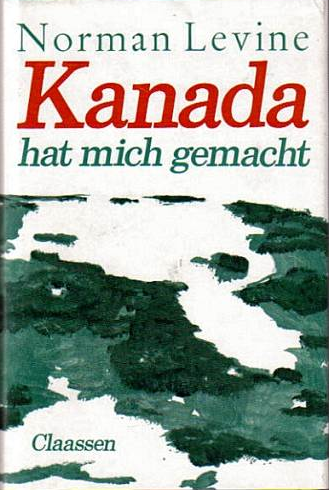
Must admit that despite my great admiration and appreciation, I've never really collected Levine's work myself. I have only five of his books, my favourite being a copy of the Porcupine's Quill Canada Made Me, which he inscribed nineteen years ago at Westmount's Double Hook Bookstore.


My most cherished Levine items are those I inherited from my father: the 1947 and 1948 issues of Forge, McGill's University's literary magazine.


These three issues feature some of Levine's earliest published work, most of it uncollected: the poems "Myssium", "Circles", "It Was a Dull Day", "Autumn" and "A Dead Airman Speaks"; the short story "Our Life is to Be Envied"; and "Prologue", which would today be described as creative non-fiction. Levine served as Poetry Editor in the 1947 issues and was elevated to Editor for the lone 1948 number.

Old McGill '48
He and my father attended McGill at the same time and were in the same faculty and graduating class. I don't know that they ever encountered one another. I like to think so. Both R.C.A.F. vets, they had a good deal in common.

Old McGill '48

27 August 2012

Advertising Norman Levine


Jack McClelland never tried to hide his dislike for Norman Levine's Canada Made Me; that his house acted as Canadian distributor was the result of an early promise made to its UK publisher. McClelland & Stewart took 500 copies, shipped 300, sent a further thirty or so out as review copies and sat back. There were no ads.

The above, put together by my daughter Astrid for the current issue of Canadian Notes & Queries, was inspired by a 12 December 1958 letter Levine sent Jack McClelland:


Writes Levine: "Do you mind me suggesting the kind of ad I'd like to see appear in those Canadian papers."

No question mark.

I think he knew the answer.

Astrid followed Levine's text and rough layout, all the while considering these McClelland & Stewart ads from 1958... four decades before she was born.

The Gazette, 1 November 1958
The Gazette, 15 November 1958
The Gazette, 13 December 1958

More in the new issue of Canadian Notes & Queries.

Subscribe today!

26 August 2012

Recognizing Norman Levine


The new issue of Canadian Notes & Queries landed in my mail box on Friday – a few days late owing, I suspect, to an ill-tempered sorting machine.


My heart sank... until I discovered that everything had arrived intact. Now I boast: "officially repaired". How special is that!

I always look forward to Canadian Notes & Queries, but this issue was more eagerly anticipated than most. Its focus is Norman Levine, a writer who has never received anything close to the attention he deserves. Happily, this issue goes some way in redressing the deficit, with:

"Kaddish (A Sketch Towards a Portrait of Norman Levine)"
by John Metcalf
"All the Heart is in the Things: Mapping Levine-land" by Cynthia Flood
"Chasing Norman: A Book-collector's Memoir" by Philip Fernandez
"Remembering Norman Forgetting" by T.F. Rigelhof
"Fiction, Faction, Autobiography: Norman Levine at McGill University, 1946-1949" by Robert H. Michel
and
Ethan Rilly's adaptation of Canada Made Me, episode six in his "The North Wing: Selections from the Lost Library of CanLit Graphic Novels"

Much more modest, my contribution covers correspondence between Levine, Jack McClelland and Putnum's John Huntington relating to Canada Made Me.

Further riches are found in a new short story by Lynn Coady, poetry by Mathew Henderson and a piece of creative non-fiction by my old pal Andrew Steinmetz.

You'll also find my review of Fraser Sutherland's Lost Passport: The Life and Words of Edward Lacey.


And finally, there's this issue's limited edition collectable, Signal to Noise, an excerpt from C.P. Boyko's forthcoming collection Psychology and Other Stories.


My copy is number 159.

The collectables are only for those with subscriptions.

You know you want one.

Here's the link.