Thomas D'Arcy McGee13 April 1825, Carlingford, County Louth, Ireland7 April 1868, Ottawa, Ontario, CanadaRIP
Related posts:
A JOURNEY THROUGH CANADA'S FORGOTTEN, NEGLECTED AND SUPPRESSED WRITING
Thomas D'Arcy McGee13 April 1825, Carlingford, County Louth, Ireland7 April 1868, Ottawa, Ontario, CanadaRIP
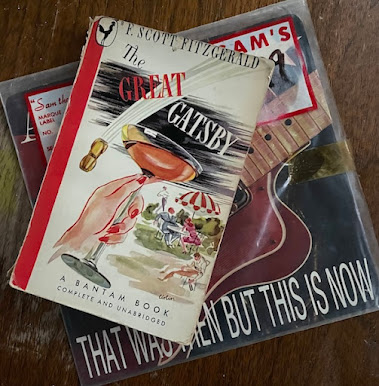
The description, as imagined by Nick, is so subtle that the tragedy passed without me seeing it. In my old Bantam edition it begins and ends on a single page. I returned to the beginning because I couldn't quite believe it.
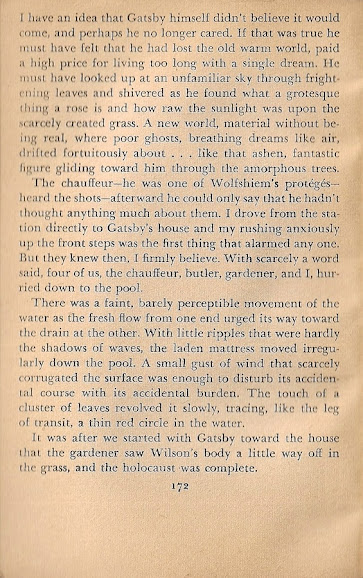
I write about Canadian literature. The Great Gatsby is not a Canadian novel, but it but it is my favourite novel.
On this, the one hundredth anniversary of its publication, it is only right to recognize it.About this time an ambitious young reporter from New York arrived one morning at Gatsby's door and asked him if he had anything to say."Anything to say about what?" inquired Gatsby politely."Why,—any statement to give out." It transpired after a confused five minutes that the man had heard Gatsby's name around his office in a connection which he either wouldn't reveal or didn't fully understand. This was his day off and with laudable initiative he had hurried out "to see."It was a random shot, and yet the reporter's instinct was right. Gatsby's notoriety, spread about by the hundreds who had accepted his hospitality and so become authorities on his past, had increased all summer until he fell just short of being news. Contemporary legends such as the "underground pipe-line to Canada" attached themselves to him, and there was one persistent story that he didn't live in a house at all, but in a boat that looked like a house and was moved secretly up and down the Long Island shore. Just why these inventions were a source of satisfaction to James Gatz of North Dakota, isn't easy to say.
His house had never seemed so enormous to me as it did that night when we hunted through the great rooms for cigarettes. We pushed aside curtains that were like pavilions and felt over innumerable feet of dark wall for electric light switches—once I tumbled with a sort of splash upon the keys of a ghostly piano. There was an inexplicable amount of dust everywhere and the rooms were musty as though they hadn't been aired for many days. I found the humidor on an unfamiliar table with two stale dry cigarettes inside. Throwing open the French windows of the drawing-room we sat smoking out into the darkness."You ought to go away," I said. "It's pretty certain they'll trace your car.""Go away now, old sport?""Go to Atlantic City for a week, or up to Montreal."

Say what you will about Satan, he's no dummy.
I think I'm right about this, but am not sure.
He had no place in my family's place of worship. I never once heard mention of the Prince of Darkness in church school, confirmation class or even a sermon. This could have something to do with having been raised Anglican.
I am not sure.
My early reading on Satan was extremely limited. It began in October 1974 with 'The Ecchorcist,' MAD magazine's parody of The Exorcist, continued with Joy Carroll's horror romance Satan's Bell (1976), and more or less ended with novelizations of the films The Omen (1976) and Damien:The Omen II (1978).

I may be wrong.
From everything I've read, Satan is cunning, creative, devious, and extremely intelligent. What he isn't is a good poet.
I can say this with certainty having browsed Michelle Remembers, the 1980 bestseller credited with providing the spark for the Satanic Panic. I'm planning on writing about it later this year, but for now, this being the first day of National Poetry Month, I thought it might be appropriate to share one of the many samples of Satan's verse recorded in the book by authors Michelle Smith and Lawrence Pazder:
If you say one word I say to you,
You'll say it all until it's through.
You'll run out of time, run out of space,
Run at the mouth all over the place.
You can only go inside your head,
And if you go there, then you're dead.So you see, I've turned it inside out;I've turned you around, turned you about,You always come back to me,The only way out is to see through me.The more goes out, the more comes in,You'll start to end when you begin.
So begins a theological debate. Is there something lacking in the Prince of Darkness – a heart, perhaps – that prevents him from being anything other than a rotten poet or is his verse intentionally bad so as to bring hell on Earth?
Frankly, I'm beginning to have doubts that Satan composed any of the poems in Michelle Remembers.
My thanks to fellow CanLit scholar Brad Middleton, who generously donated two copies of Michelle Remembers to The Dusty Bookcase.