Showing posts sorted by relevance for query james benson nablo. Sort by date Show all posts

10 April 2010

The Mysterious Mister Nablo


The Long November
James Benson Nablo
New York: Dutton, 1946

I'm going to step out on a limb here and state, with confidence, that this was one of the most popular Canadian novels published after the Second World War. Evidence? I can offer nothing more than its publishing history, which over six years included three Dutton printings, two News Stand Library editions and a very attractive Signet paperback. And yet, we remember nothing of James Benson Nablo; The Long November, his only novel, has been out of print for over five decades.

Nablo's narrator is Joe Mack, a wounded, unarmed Canadian soldier hiding from Nazis in a half-destroyed Italian home. Don't be fooled, this is not a war novel, but Horatio Alger's nightmare. As Joe waits out the enemy, he looks back on his 34 years, playing particular attention to his efforts to make something of himself. It isn't that Joe cares so much about money, rather he sees it as a means of winning the love of his life, beautiful blonde Steffie Gibson. Like Duddy Kravitz, who would follow, Joe realizes his riches by "borrowing" the last bit of money he needs to achieve his dream – and, as with Duddy, he loses the girl as a result.

The Long November is a rough book, told in a style that resembles tough guy film noir narration; only Nablo uses words that would not pass the Hays Code. In a 1949 letter to Jack McClelland, Earle Birney provides a list: "Jesus Christ, Christ Almighty, By Jesus, for Christ's sake, goddamit, Bugger all, sonofabitch, suck-holing, stumblebum, crap, shacked up, quickie, a lay, shove it up your keister, tired of being screwed-without-being-kissed." May I add that in one of his many moments of self-recrimination Joe describes his work as "of much use as a tit on a spinster"? Writing in the Pittsburgh Post-Gazette, John D. Paulus complained: "If this is modern 'realistic writing,' this reviewer will take vanilla."

And I'll take Rocky Road.


Nearly everything that's been written about Nablo is found on the book's dust jacket. Other references to the author are precious and few. In Imagining Canadian Literature, editor Sam Solecki provides nothing more than a fleeting footnote, referring to "J.V. Nablo [sic] (b. 1910)", an author who has not "been traced". Nablo was indeed born in 1910, making him exactly the same age as his protagonist. Here the future author is recorded in the 1911 census, as the daughter of George and Margery Nablo of 8 Centre Street in Niagara Falls.


I've found little else, though I can say that he never published another book. It seems Nablo left the world of letters for a life in film. In 1954, his short story "The Wheel Man" was adapted by a young Blake Edwards as Drive a Crooked Road. The flick has Mickey Rooney as an honest auto mechanic who finds himself driving the getaway car in a bank robbery. Blame it on a dame.


The god-awful A Bullet for Joey (1955) followed. Of the films made from Nablo's stories, it's by far the most interesting. Why? Well, for one it stars Edward G. Robinson as a French Canadian RCMP detective named Raoul Leduc. Need more? It's a Cold War thriller set in Montreal, and features George Raft as an American mobster who is hired by the Reds to kidnap a nuclear scientist. Who can resist?

A Bullet for Joey was followed by a forgotten western, Raw Edge (1956), which starred Vancouver beauty Yvonne de Carlo (née Peggy Middleton). One wonders whether Nablo lived to see it; industry reports from the autumn of 1956 refer to "the late James Benson Nablo".

The writer's executor seems to have had a busy time of it, selling options for Nablo stories like "Morning Star", which was to have been James Cagney's directorial debut. In the end, there was only one more film: a Victor Mature vehicle entitled China Doll (1958). Its release coincided with a "novelization by Edgar Jean Bracco of a screenplay by Kitty Buhler". Published as a 35¢ Berkley paperback, it makes no mention of James Benson Nablo.

Object: A fairly slim hardcover in green cloth with light brown lettering. What makes the book interesting is that Dutton changed covers for the second and third printings – both in March 1946 – replacing the battlefield landscape with an image of Steffie Gibson looking like a well-covered streetwalker.

Access: Fourteen copies are held in Canadian public and university libraries. It seems that the uncommon first edition exists only in rotten condition. The best copy currently listed online is a bargain at C$30; others lack dust jackets or are ex-library. Decent copies of the News Stand and Signet editions can be had for under C$10. I've yet to come across the 1957 Double Flame paperback.

Related posts:

06 September 2016

The Last of James Benson Nablo?


The life of James Benson Nablo has always intrigued. A Niagara Falls native who had never before appeared in print, he came out of nowhere in 1945 with The Long November, a solid novel from a major New York publisher. It was then off to Hollywood, where three motion pictures featuring big names like Mickey Rooney, George Raft and Edward G. Robinson were made from his stories. A fourth, China Doll starring Victor Mature, was in production when Nablo died at age forty-five.

There's more to the writer's story, of course. For one, there was a second novel, And Yet Another Four, he had under contract with Scribners. Nablo wasn't satisfied and set it aside. The manuscript is now lost.


Two years ago, I helped bring The Long November back into print as part of the Véhicule Press Ricochet Books series. It's now joined by Stories, a collection of Nablo's previously unpublished short fiction. This attractive hardcover, handset and printed using a Vandercook SP-15 press in an edition of fifty, is the latest title from J.C. Byers' Three Bats Press.


Five stories in all, they're preceeded by my Introduction. Also included is an Afterword and memorial verse by Nancy Nablo Vichert, Nablo's daughter. The latter dates from her years as a student at McMaster University.

With Stories, all known surviving writing by James Benson Nablo is now in print. Until today, they existed only as a series of manuscripts the author had entrusted to Nancy.


But what are they? As I write in the Introduction, Nablo couldn't have intended these stories for the movies, and yet Nablo never published any short stories. What's more, there's no evidence that he so much as tried. Were they written for his own amusement? Are they false starts? Fragments of larger works?

All these years later, he remains the Mysterious Mister Nablo.

Copies of Stories by James Benson Nablo can be purchased by contacting Three Bats Press: 
3bats@wollamshram.ca

Related posts:

07 October 2013

N is for Nablo News


All kinds of activity here this past weekend in preparation of Friday's Gwethalyn Graham plaque dedication and Saturday's John Glassco event, but I somehow managed to slip in a bit of work relating  to James Benson Nablo. I can now report that The Long November, the Niagara Falls writer's only book, will be returning to print this coming spring as part of the Véhicule Press Ricochet Books series.

I could not be happier.

Set in Toronto, Chicago, Moreland Lakes (read: Kirkland Lake, Ontario), an unnamed Italian village and the author's hometown, The Long November is one of the most interesting novels of the post-war period. News Stand Library pitched it as "a tale of passion and virile drive". It's all that and more.

One of the unexpected pleasures of this exercise, this stroll through the neglected writing of our past, is that it has often brought contact with the children, grandchildren, nephews and nieces of the writers concerned. It was my good fortune that the daughter and grandson of James Benson Nablo spotted my posts on The Long Novemberthe novel's paperback history and the author's career in Hollywood.


So it is that I spent an enjoyable few hours yesterday reading through five James Benson Nablo manuscripts on loan from Nancy Vichert, his daughter. As far as I've been able to determine, all are unpublished and have no connection with the stories that were adapted by Hollywood: Drive a Crooked Road, A Bullet for Joey, Raw Edge and China Doll.


After the success of The Long November five editions in six years! – the native of Niagara Falls made his way to Hollywood. The duo-tang for one of the of the manuscripts features an address that places him within walking distance of Laurel Canyon Boulevard, not too far from Chateau Marmont:
 

8401 Ridpath Drive, Hollywood, CA
(cliquez pour agrandir)
James Benson Nablo's time in Tinseltown was not long, but he left his mark. Drive a Crooked Road, adapted by Blake Edwards and Richard Quine, was Columbia Pictures' great attempt to turn Mickey Rooney into an adult star. A Bullet for Joey places Edward G. Robinson and George Raft in Montreal as, respectively, a French Canadian detective and infamous gangster.


Nablo's talent was such that further adaptations appeared after his untimely death at the age forty-five.

I'm pleased to be involved with the return of The Long November. It's been more than a half-century. Long overdue.

Related posts:

27 August 2014

The Long November in Late August


"Mysterious" is the word I used when first describing James Benson Nablo. This was four years ago. I'd just finished The Long November and I had questions:
  • How did a man who had never published anything bolt out of the gate with a novel from a major house?
  • Given its commercial success, why is The Long November Nablo's only book?
  • Why did the flurry of editions and printings of The Long November come to such an abrupt end?
It was my good fortune that my initial post on The Long November drew the attention of Nancy Nablo Vichert, James Benson Nablo's daughter. Had it not been for her, I'd have never known the answers. The mysterious Mister Nablo seems slightly less so now, but there remains much more to uncover about his all too short life. His Hollywood years hold promise of more riches.


Today, sixty-four years after the last edition, The Long November is again available as the latest in the Véhicule Press Ricochet Books series. I think it's worth a read. But then I would say that – I was the guy who suggested that it be reprinted in the first place. You'll find the answers to the question posed above in my Introduction.

Look, there aren't many novels out there that take place in Cataract City (read: Niagara Falls), Moreland Lake (read: Kirkland Lake) and Toronto (read: Toronto). This one is the real deal.

Write what you know.

Nablo wrote about rumrunning because he'd been a rumrunner, he wrote about mining because he'd been a miner, and he wrote about women because he had known more than a few. The Long November is a rough novel; back in 1946 its language offended a whole lot of people. If talk of "shacking up", "suck-holing"  and "being screwed without being kissed" offend, this isn't the book for you.

Stronger eggs and skirts will find The Long November just the thing for fin d'été. You Yanks will have to wait for autumn.

Den Lange November
James Benson Nablo [trans. Henning Kehler]
Copenhagen: Nyt Nordisk, 1948

Related posts:

12 May 2014

Edward G. Robinson Gets His Man


The coming reissue of  James Benson Nablo's The Long November has had me watching the films made from his stories. There were four in all, shot between 1953 and 1958, starring big names like Mickey Rooney, Edward G. Robinson and Victor Mature. Pretty impressive for someone who died six or so years after his arrival in Hollywood, don't you think?


Writing here four years ago, I described A Bullet for Joey, the second film made from a Nablo story as "god-awful". I haven't changed my mind. Still, I enjoy the movie, if only because it takes place in Montreal. A Bullet for Joey wasn't filmed in the city but at the RKO-Pathé Studios in California's Culver City. Lazy director Lewis Allen is content with stock footage, beginning with this establishing shot taken from Mount Royal.


…then blows it by cutting to an apartment building unlike any I've seen in Canada, outside of Vancouver.


We'll learn later that this is not an apartment building at all but a hotel… in a residential area… without signage… or a doorman.

Nuclear scientist Dr Carl Macklin, played by George Dolenz (Mickey's dad), emerges to greet a monkey and organ grinder.


Then he exchanges pleasantries with the friendly neighbour RCMP officer, in ill-fitting, faux-uniform.


The organ grinder will kill the officer as the monkey watches.

Enter Edward G. Robinson as Raoul Leduc, the RCMP inspector tasked with finding the murderer.


Note the portrait of Queen Elizabeth and the two maps of Canada. Allen may have been lazy, but set designer Joseph Kish was busy as a beaver placing STOP/ARRET signs, RCMP coats of arms and maps wherever possible. There are a lot of maps.


You've got to give Robinson credit for not falling into the trap that claimed Laurence Olivier in 49th Parallel; the actor never even attempts a French Canadian accent. He sometimes falters – Quebec is "Kweebec" – but for the most part his is a reliable performance; I was most impressed by the actor's ability to deliver lines like this with straight face: "An organ grinder? That early in the morning?"


You can hardly blame Robinson for his mispronunciations; the only Canadian I recognize in the credits is Henri Letondal, and the two share no scenes. Who was gonna set Rocco right?

Letondal plays a farmer who is being used by a foreign cabal to get a gangster into the country.

"Welcome to Canada, and to freedom Mister Steiner."
"Mister Dooboys?"
"Dubois. Your sponsor."
That's George Raft as the gangster. He's been offered $100,000 to kidnap Macklin. Next thing you know it's old home week, with his crew descending on the Dubois farmhouse from Havana, Mexico City, Chicago and Los Angeles.


At this point the film loses focus with the would-be kidnappers posing as surveyors, factory workers and moonstruck lovers, all in an illogical effort to get close to the nuclear scientist. Although not shared with the audience, it appears that at some point the decision is made to steal the very project on which Macklin is working. This part of the movie is pretty boring, but pays off in one dynamite headline:


James Benson Nablo can't be blamed for this mess; it is his story, not his script. No Canadian would write dialogue like this:
     "Two mornings a week Mr Macklin teaches physics at McGill University. He dines either at the club or the hotel."
     "What kind of a club?"
     "The one to the faculty he belongs. After dinner he usually plays chess."
     "Chess?"
     "An intellectual game you wouldn't know about. When the weather is fine he plays golf – two or three afternoons a week. If it isn't, he goes up to Mount Royal to ski or skate."
Montrealers will find it funny.

Everyone will wonder why the movie features no character named Joey.

What Nablo himself thought about it all I haven't been able to discover.

Related posts:

12 April 2010

Nablo in Hollywood


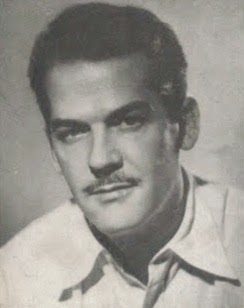
The only image I've been able to find of the Hollywood James Benson Nablo – and don't it look like crap. Blame attendees of the 1936 American Library Association's annual meeting and their enthusiastic endorsement of microfilm.

Published in the 11 May 1946 edition of the Globe and Mail, it has no article attached, so I can't begin to speculate as to why The Long November was never filmed. That said, is it not odd that the project is described as "the first motion picture attempted by Doyle-Nablo productions [emphasis mine]"? And don't the Doyles seem such an unhappy couple? Mrs Doyle looks to be scanning the room for the exit.

But co-producer Nablo is all smiles, as are the others around the table:

Brooke Burwell, who fits Nablo's description of Steffie Gibson to a tee, is a bit of a mystery woman. It appears she never made a film, and has not, to use another's terminology, "been traced".

Kenneth Roberts was a prolific writer, who had a number of forgettable films adapted from his equally forgettable historical novels.

Norman Reilly Raine was really an American, though he did work as a Toronto newspaperman, and later served in the Canadian army during the First World War. At the time this photo was taken, the 51-year-old would have been enjoying success for his adaptation of John Hersey's A Bell for Adamo (1945).

Raine's longtime flame, "Hollywood dancing star" Nova Dale, had one uncredited role as a chorus girl in 1951's Showboat. She died the following year, at the age of 31, several days after smashing up her car.

All this leads to Drive a Crooked Road (1954), which would be the first film based on a Nablo story. These nice, clear images from the trailer, point to a movie that is nowhere near as interesting as what is promised; evidence that promotion hasn't really changed all that much in the past half-century.


Finally, as part of
the National Poetry Month promise, another James McIntyre poem. "Niagara Dry" recounts the day – 30 March 1848 – when both the Canadian Falls and its bland cousin ran dry. Nablo grew up just over a kilometre from the falls, practically across the street from where the Ripley's Believe It or Not Museum stands. Culture.
NIAGARA DRY

It happened once in early spring,
While there did float great thick ice cakes,
That then a gale did quickly bring
Them all down from the upper lakes.

And Buffalo to Lake Erie,
Across the entrance to river,
It was a scene of icebergs dreary,
Those who saw it will remember ever.

The gale blew up lake and river,
And left Niagara almost dry,
This a lady did discover
As above the Falls she cast her eye.

Such scene it had been witnessed never,
Since Israelites crossed the Red Sea,
When they had resolved forever
From Pharaoh's bondage to flee.

Lady she resolved to venture,
Proudly carrying British flag,
Erected it in river's centre
In crevice of a rocky crag.

It seems like a romance by Bulwer,
How she captured Niagara,
But it was seen by Bishop Fuller,
Who did at sight of flag hurrah.
Ten thousand years may die away
Before another dry can tread,
In bottom of Niagara,
For she doth jealous guard her bed.

But ice her entrance did blockade,
And wind it kept the waters back,
So that a child could almost wade
Across the brink of cataract.


Related posts:

29 September 2014

The Double Flame Mystery


The first of five sent by Welland bookseller Steven Temple, this photo of James Benson Nablo's The Long November has had me pouring over old notes. Four years ago, my nose was to the ground in dogged pursuit of the figures behind its publisher, Double Flame of Hollywood, California. I enlisted help in the hunt from my man in L.A., Stephen J. Gertz. We got so far as to amass a list of suspects, but then I got hungry and was forced to return nose to grindstone.

Canadian writers should be ever mindful of the fate of John Richardson.


What's someone so focussed with things Canadian care about a Tinseltown publisher, anyway?

Good of you to ask.


Double Flame issued just three books – The Long November, Port of Call by Stephen Mark, and Serge C. Wolsey's Call House Madam – each of which had appeared six or seven years earlier as News Stand Library paperbacks. There's got to be a link between the two fly-by-night publishers, right?


The Long November is by far the best of the three titles, but it's Port of Call that holds my interest. It first appeared – more or less – as Overnight Escapade, one of the strangest books I've read this year. It's not a novel, but a very long short story packaged with some very short short stories and others of a conventional length. Port of Call and Other Selected Stories on the title page, the Double Flame edition not only renames the lead, but drops a couple of others.


It's easy to see why Double Flame was so attracted to the Nablo and Wolsey titles. First published by Dutton in 1946, The Long November enjoyed three hardcover printings and numerous mass market editions (and is back in print with a new Introduction by yours truly). Call House Madam, purportedly the story of the career of L.A. brothel keeper Beverly Davis, enjoyed even greater sales with all sorts of editions stretching from the very early 'forties to the very late 'sixties. "Over 400,000 copies sold at $3.95 " claims the 1963 Popular Library paperback.


But why Overnight Escapade? The book came and went in April 1950; unlike many of its titles, News Stand Library never even bothered issuing an American edition. The 1957 Double Flame repackaging is the second and last we've seen of Stephen Mark and his strange stories.

Looking over these photos has me itching to reopen the Double Flame file.

But now, it's time for lunch. Gotta eat, you know.


Note: My thanks to Steven Temple for the photographs. Those interested in purchasing the Nablo and Mark Double Flames are encouraged to contact the bookseller through his website.

Related posts: